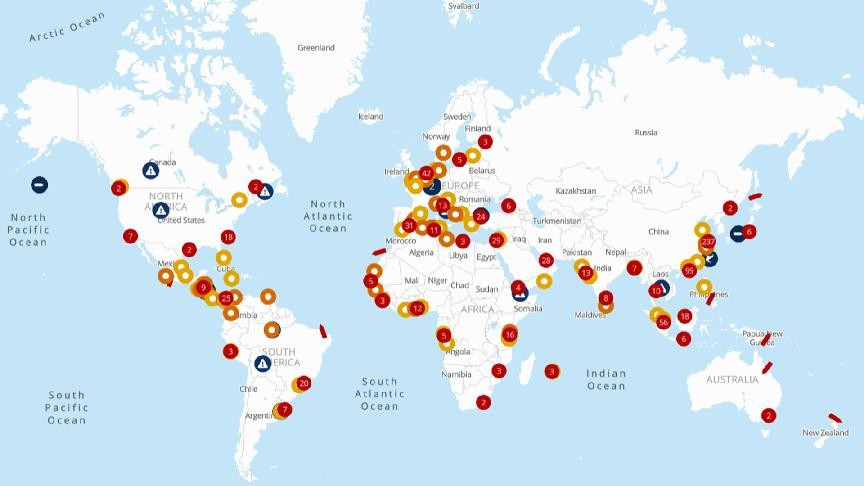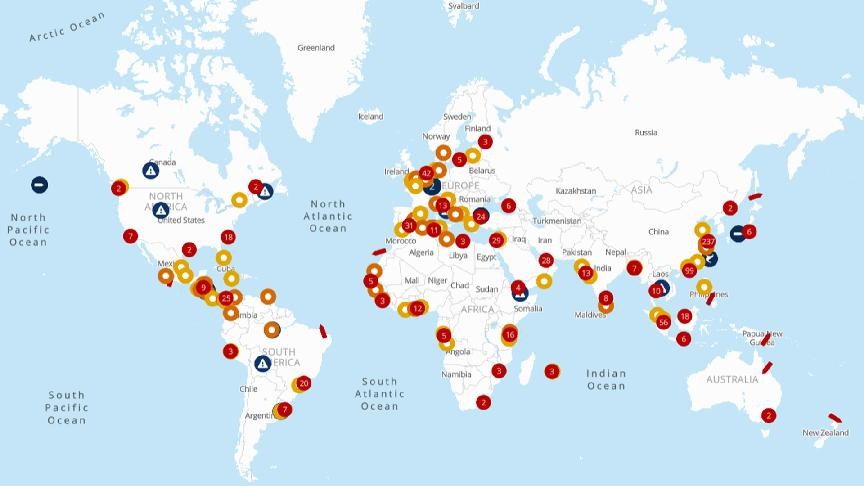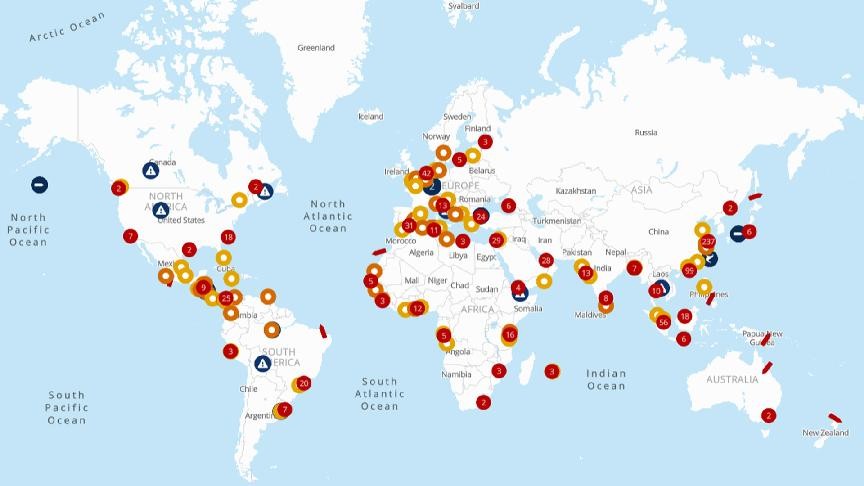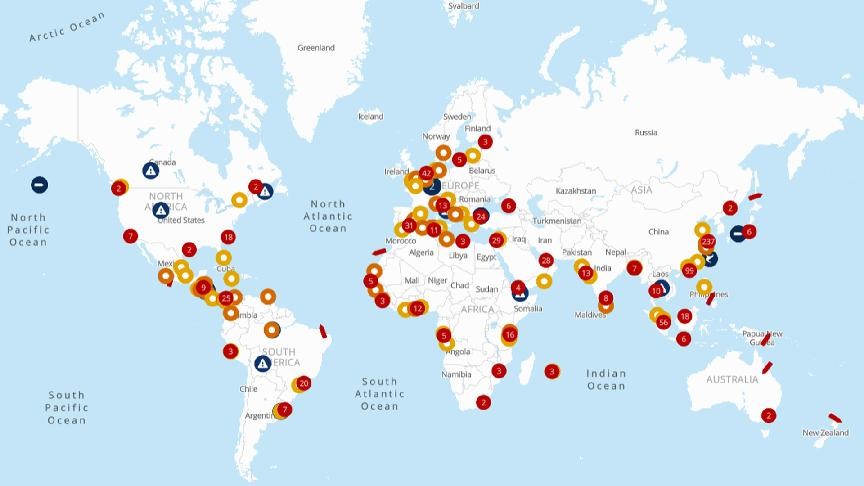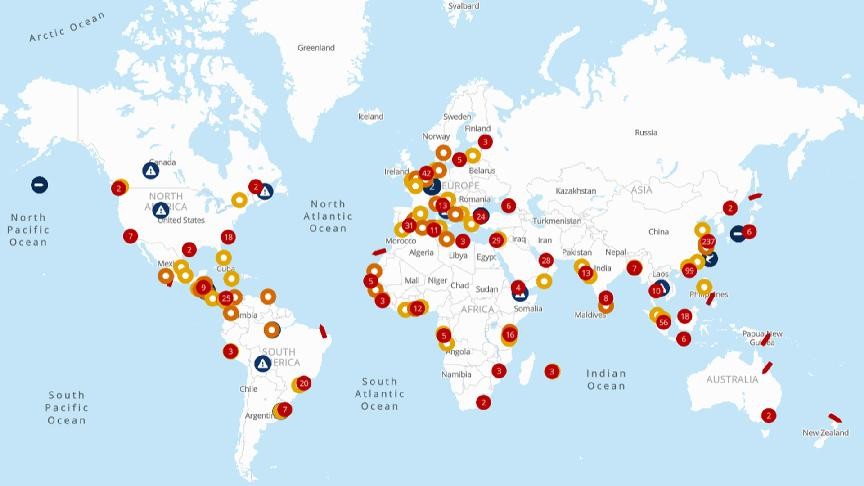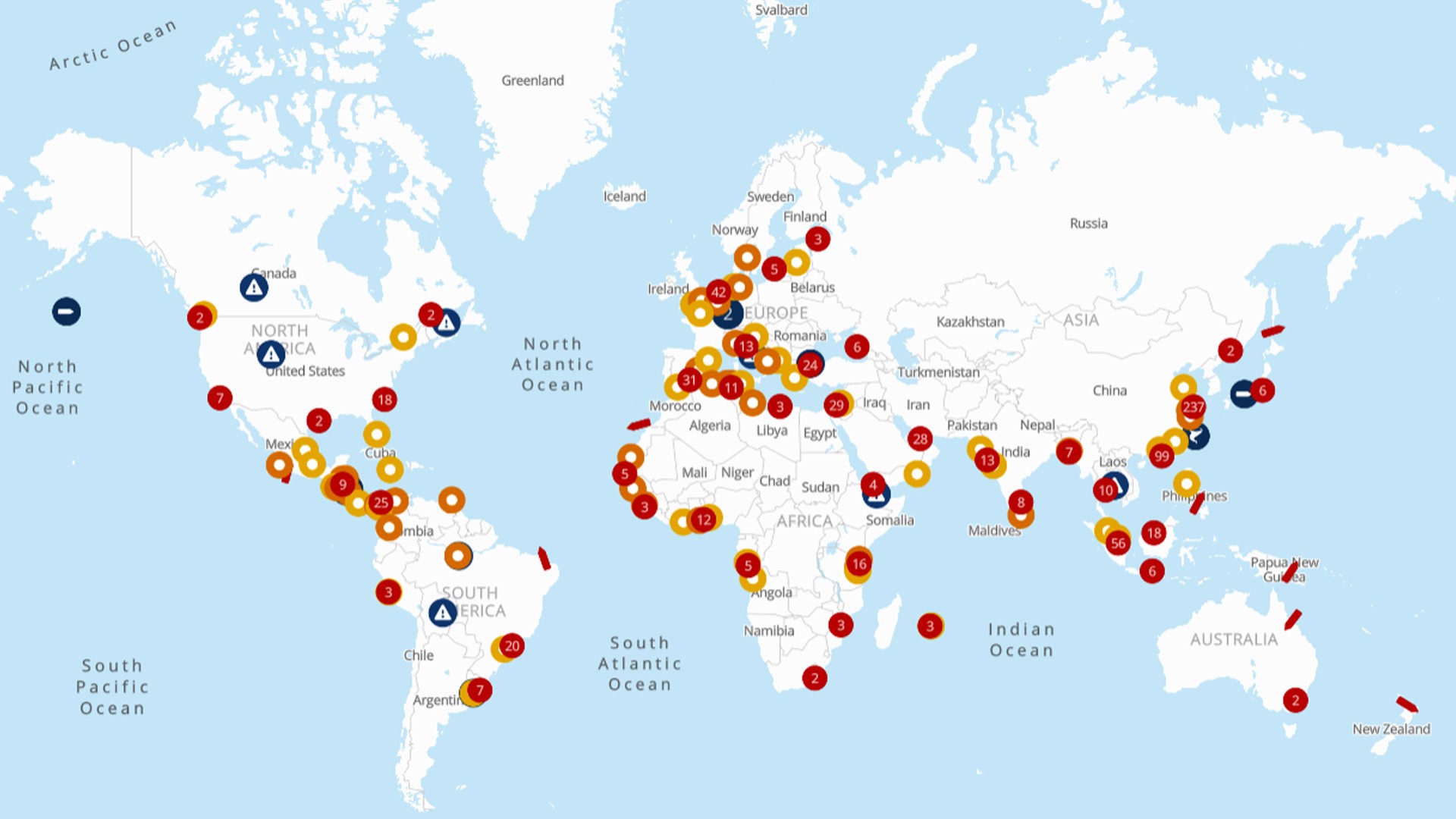

Stay ahead of supply chain disruptions and port congestion with Kuehne+Nagel’s weekly port operational update.
- Find out the latest vessel waiting times and status of ports in Africa, Asia Oceania, Europe, Middle East-Indian Subcontinent, North America, and South and Central America.
Africa
Ivory Coast
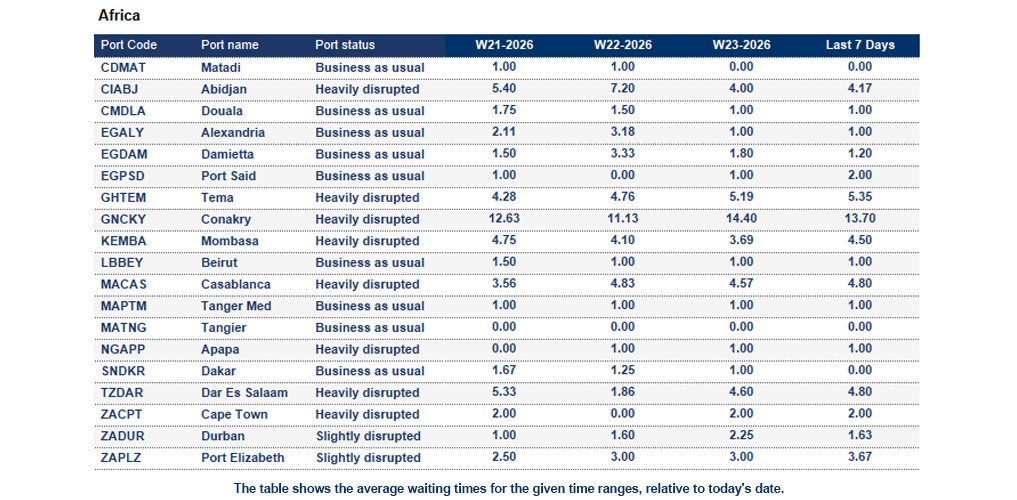
Abidjan: The 7-day average vessel waiting time reduced this week to around 4.17 days.
Kenya
Mombasa: The 7-day average vessel waiting time is around 4.5 days. Persistent congestion remains, and terminals have high waiting periods for vessels. There is an empty container imbalance with yard saturation. Truck driver disruptions impact cargo movement and create inland evacuation delays. Customs bottlenecks and new regulatory requirements add to delays.
Madagascar
Toamasina: The 7-day average vessel waiting time is around 4.0 days. Feeder services into Port Louis are unstable, with blanked or cascading schedules impacting departure times and increasing cargo dwell times. Inland transport disruptions may occur due to poor road conditions and rising transport costs. Limited berth capacity can result in berthing delays; container vessels are given priority.
Mauritius
Port Louis: Delays are due to recent weather disruptions – cloudy with intermittent rain. One crane is out of service and under repair following a reported incident involving a vessel.
Mozambique
Maputo: Intermittent wind gusts and rain are expected to persist for the remainder of the week, with the potential to disrupt operations.
Nigeria
Tincan/Lagos: The 7-day average vessel waiting time is around 4.0 days. Delays driven by a build-up of empty containers and intermittent gate closures. Cargo dwell times and manual processes are impacting terminal performance.
South Africa
Cape Town: The 7-day average vessel waiting time is around 2.0 days. Carrier and service allocations may vary depending on berthing windows.
Asia Oceania
China
Dalian: The 7-day average vessel waiting time is around 1.6 days. Operations were impacted by dense fog, with 40.5 hours of port closure in recent days causing disruptions.
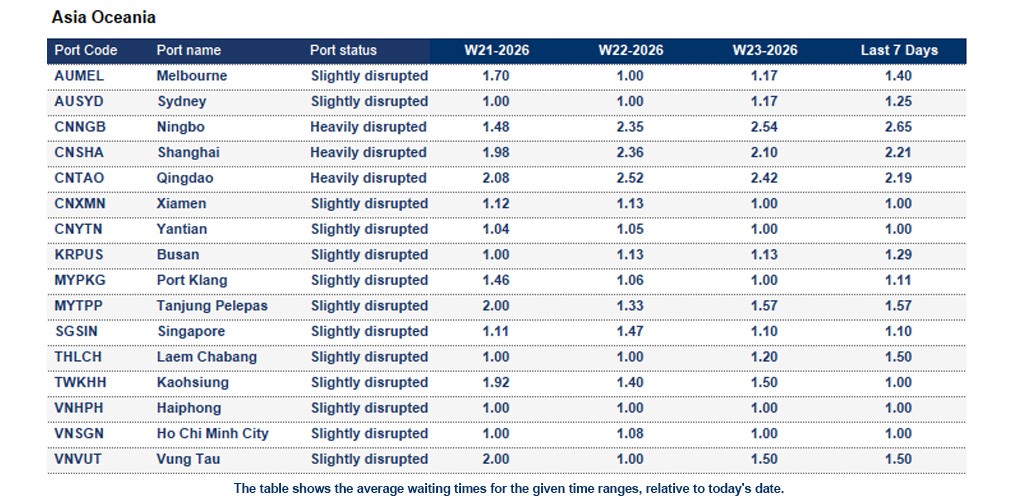
Ningbo: The 7-day average vessel waiting time is around 2.65 days. Recent dense fog caused terminal closures.
Qingdao: The 7-day average vessel waiting time is around 2.19 days. Severe fog over the past 5 days led to port closures, resulting in heavy congestion.
Xiamen: The 7-day average vessel waiting time is around 1 day. Two new gantry cranes are being installed to replace existing units at XHCT berths 15–16, with works expected to continue until mid-June. The ongoing equipment upgrade is contributing to congestion at XHCT, as operational capacity remains temporarily constrained during the installation period.
Indonesia
Surabaya: The 7-day average vessel waiting time is around 1.29 days. The port remains heavily congested. This is primarily due to the closure of a 200-metre quay section for the commissioning of new quay crane equipment, which is temporarily reducing operational capacity.
Japan
Osaka: Typhoon-related disruptions led to the suspension of gate and yard operations.
Tokyo: The 7-day average vessel waiting time is around 1.13 days. Minor disruptions from fog closures and typhoon-related suspensions are impacting terminal operations.
Yokohama: The 7-day average vessel waiting time is around 1 day. The port faced weather-related disruptions, with minor congestion and waiting times.
Malaysia
Port Klang: The 7-day average vessel waiting time is around 1.11 days. In WSP, yard density, productivity and waiting times remained at healthy levels during week 23. However, the berthing situation is expected to become more dynamic and complex from next week onwards, indicating potential variability in vessel scheduling and operational flow.
New Zealand
Tauranga: The 7-day average vessel waiting time is around 2.0 days. Yard utilisation ranged between 80% and 89% throughout the week. The port faced weather disruptions last week, causing vessel delays. Together with an existing backlog, the port expects operational challenges to persist.
Philippines
General Santos: Due to a strong earthquake, the Port of General Santos is currently closed, and terminal operations are fully suspended until further notice. Read more.
South Korea
Busan: The 7-day average vessel waiting time is around 1.29 days. Operations are currently stable with moderate yard density, though congestion risk is increasing due to expected vessel bunching.
Vietnam
Haiphong: The 7-day average vessel waiting time is around 1 day. Operations remain stable with healthy yard utilisation around 65% and no major congestion.
Ho Chi Minh City: The 7-day average vessel waiting time is around 1 day. Stable operations with moderate yard utilisation (~81%) and minor delays.
Europe
Belgium
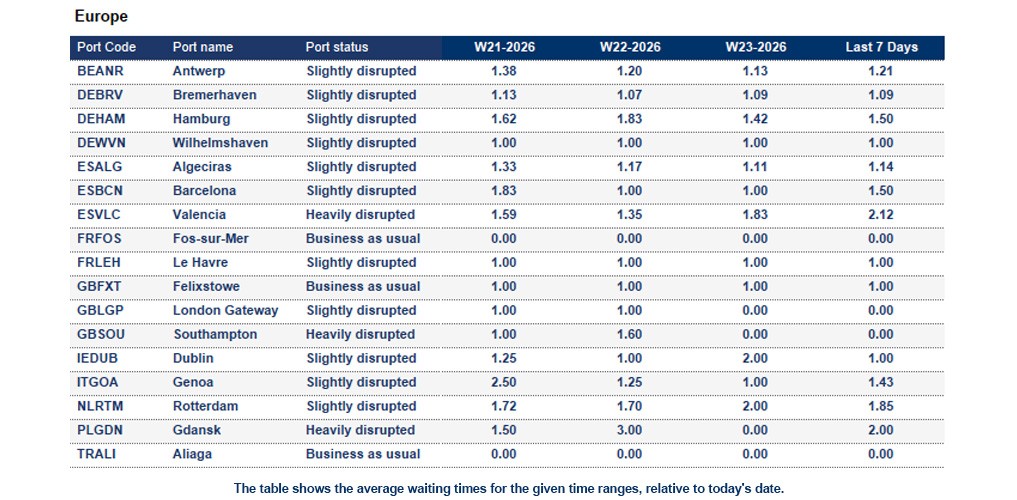
Antwerp: The 7-day average vessel waiting time is around 1.21 days. Q869 at 80% yard occupancy (reefers 65%, empties 35%) and is operating within stable levels, while Q913 is critically congested at 102% (reefers 65%, empties 65%). Upcoming vessel calls are expected to ease pressure at Q913. Landside operations remain efficient with truck turnaround times of 38–45 minutes and normal barge activity, supported by strong labour availability. However, crane maintenance at Q869 is temporarily impacting feeder and barge handling, requiring adjusted sequencing.
France
Le Havre: The 7-day average vessel waiting time is around 1 day. Operations remain stable with yard occupancy at 70% and no expected issues impacting vessel handling or berth availability. Despite a tightly scheduled 48-hour window for all calls, the terminal is managing operations smoothly without significant constraints.
Germany
Hamburg: The 7-day average vessel waiting time is around 1.5 days.
- CTA: operations remain under significant pressure with yard occupancy at 85% and restrictions in place for IMO reefer deliveries. Performance during the week has been critical, affected by congestion, which has led to operational disruptions. Low terminal productivity is also impacting other services, with expected cut cargo and potential knock-on effects across rotations, while some vessels are being redirected to alternative terminals to manage the CTA line-up. The outlook for the coming week remains challenging.
- CTH: operations are stable with yard occupancy also at 85%, but without major disruptions. Terminal performance has remained smooth throughout the week and weekend, benefiting from schedule adjustments such as the omission of Baltimore Express, which has freed up capacity.
Wilhelmshaven: Operations are currently stable with yard density at around 70% and no immediate capacity concerns. However, the vessel line-up remains tightly scheduled with no buffer for unexpected delays or operational disruptions. Resource availability continues to be constrained due to a high sickness rate among port workers, reducing structural capacity.
Netherlands
Rotterdam: The 7-day average vessel waiting time is around 1.85 days.
- ECT: Operations are constrained with 86% yard occupancy, reduced berth productivity due to crane outages, and delays of 36–48 hours for barges and feeders. Further delays are expected from upcoming service changes.
- MVII: Operations are under pressure with 85% yard occupancy, weather-related disruptions, and delays in vessel schedules. Temporary outages and gate closures have been implemented to control yard levels. Hapag-Lloyd reports that the terminal will temporarily reduce rail capacity from July 1, 2026, until approximately June 2027 due to terminal expansion and testing works.
- DELTA II: Operations remain stable with low yard occupancy at 30%, though minor disruptions persist, including delayed berthing and adjusted vessel calls.
United Kingdom
London Gateway Port: The 7-day average vessel waiting time is around 1 day. Operations are stable with moderate yard occupancy (59%) and steady labour availability. Rail disruptions have caused temporary delays, but recovery is expected once repairs are completed. Some equipment outages and container imbalances persist, though overall vessel operations remain controlled despite adjustments in move volumes.
Southampton: The 7-day average vessel waiting time is around 3.0 days. Berth SCT5: The arrival of the new crane has been advanced to 13 June. The berth will be unavailable from 13 to 22 June due to crane installation and positioning activities. Yard utilisation stands at 74% for dry cargo and 75% for reefer units.
Middle East - Indian Subcontinent
Bangladesh
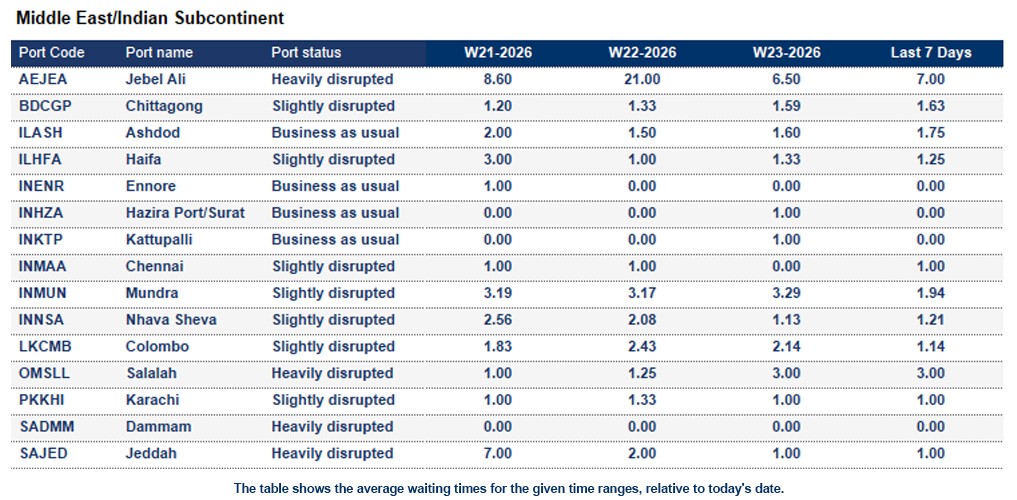
Chittagong (Chattogram): The 7-day average vessel waiting time is around 1.63 days. Operations remain stable with minor berthing congestion causing delays for both geared and gearless vessels.
Saudi Arabia
Jeddah: Increased volumes due to the port being used as an alternative route and cargo diversions. Jeddah has seen a role shift as the primary alternative hub for Gulf-bound cargo. Container dwell times are reported at approximately 16 days in peak scenarios.
North America
Canada
Average import rail dwell time for Canadian cargo (Vessel arrival to departure rail ramp):
- Halifax: 5 days
- Montreal: 5 days
- Prince Rupert: 8 days
- Saint John: 5 days
- Vancouver: 7 days
Mexico
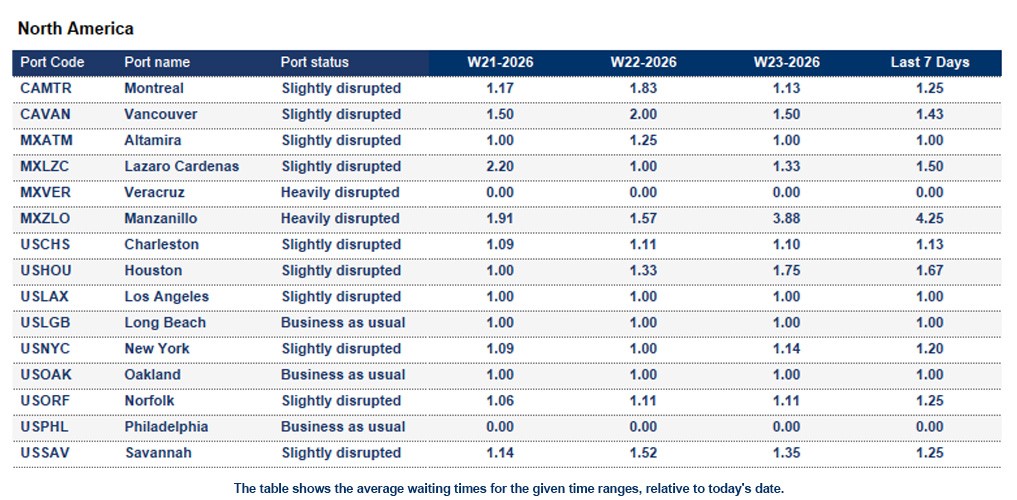
Lazaro Cardenas: The 7-day average vessel waiting time is around 1.5 days. APM: The yard is at 83%, and the berth is congested.
United States
Average import rail dwell and transit time for US cargo (Vessel arrival to departure rail ramp):
- Halifax - 9 days
- Montreal - 9 days
- Prince Rupert - 8 days
- Vancouver - 6 days
- Saint-John - 7 days
- Charleston - 2 days
- Newark - 2 days
- Houston - 8 days
- Jacksonville - 3 days
- Los Angeles - 5 days
- Long Beach - 8 days
- New York - 4 days
- Miami - 1 day
- Oakland - 5 days
- Norfolk - 3 days
- Philadelphia - 10 days
- Savannah - 2 days
- Seattle - 4 days
- Tacoma - 4 days
South and Central America
Brazil
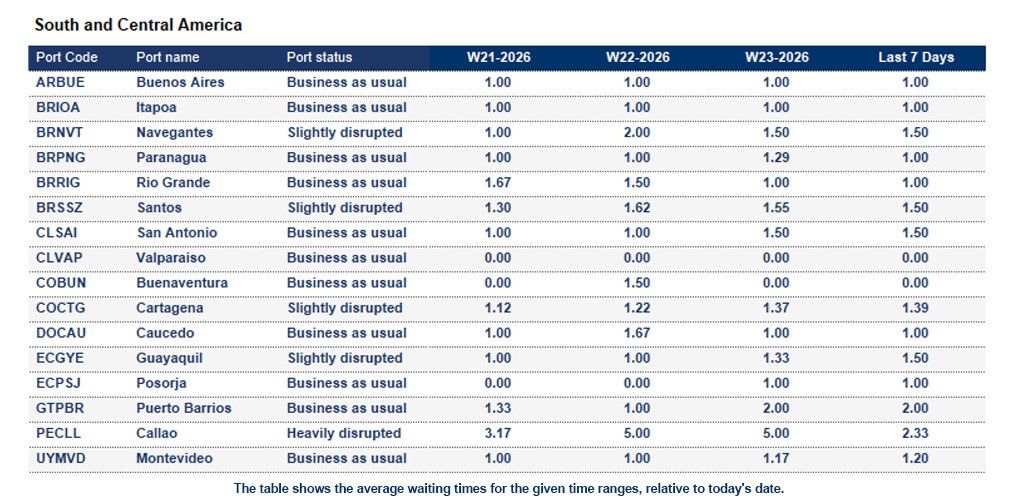
Navegantes: The 7-day average vessel waiting time is around 2.0 days. Yard utilisation is at 78%, reports Hapag-Lloyd. Vessel waiting times exceed 24 hours. The Portnave terminal is carrying out civil works to receive larger vessels.
Pecem: The 7-day average vessel waiting time is around 2.0 days. Equipment shortages are leading to a delay for the vessels arriving out of the window.
Chile
Arica: The 7-day average vessel waiting time is around 2.0 days. The port is congested. Hapag-Lloyd reports 66% yard utilisation and vessel waiting times of up to 34 hours.
How Kuehne+Nagel estimates port disruption statuses
Seaexplorer has four port statuses that are estimated based mainly on the 7-day average vessel waiting time. Other factors include yard congestion, labour strikes, natural disasters or intermodal disruptions. Slightly different rules are applied to major ports, or ports that are hubs in their region, as they are typically more efficient.
- Business as usual means the port is currently operating without any significant disruption.
- Slightly disrupted is used if the 7-day average vessel waiting time exceeds 2 days.
- Heavily disrupted is used if the 7-day average vessel waiting time exceeds 4 days.
- Port closed is used when the port suspends operations due to a major disruptive event.
How Kuehne+Nagel calculates the 7-day average vessel waiting time
Mainline container vessels may spend a certain number of days waiting at designated anchorage areas before their scheduled port call.
To calculate the 7-day average waiting time, we consider the waiting days of these vessels, excluding:
- Waiting times for feeder vessels,
- Idle ships without an announced next port,
- Slow steamers heading toward the anchorage, but not actively waiting within the designated area
- Vessels passing through the anchorage area without intending to call at the port.
This rolling average is based on the last 7 days of data and is updated daily in seaexplorer. To find the latest waiting time for a port, enter the port name or code in the search bar and select the relevant option.
Stay Ahead, Stay Informed: Register for seaexplorer for the latest disruptions and vessel waiting times at global container ports.