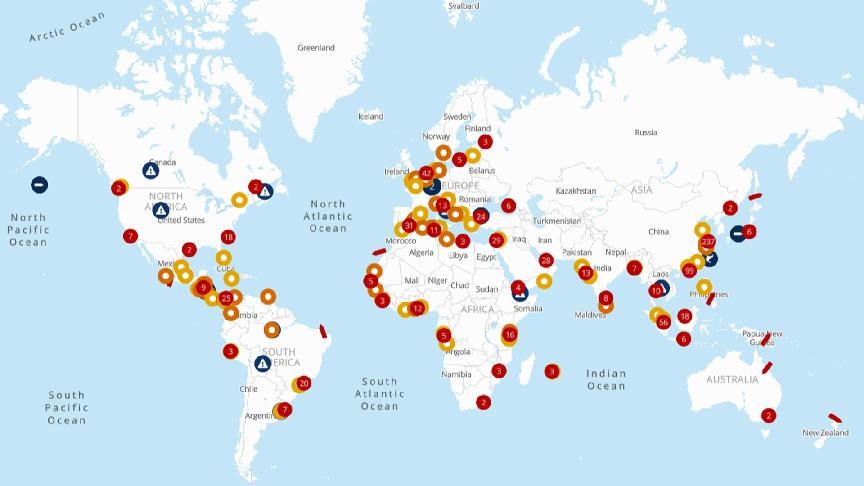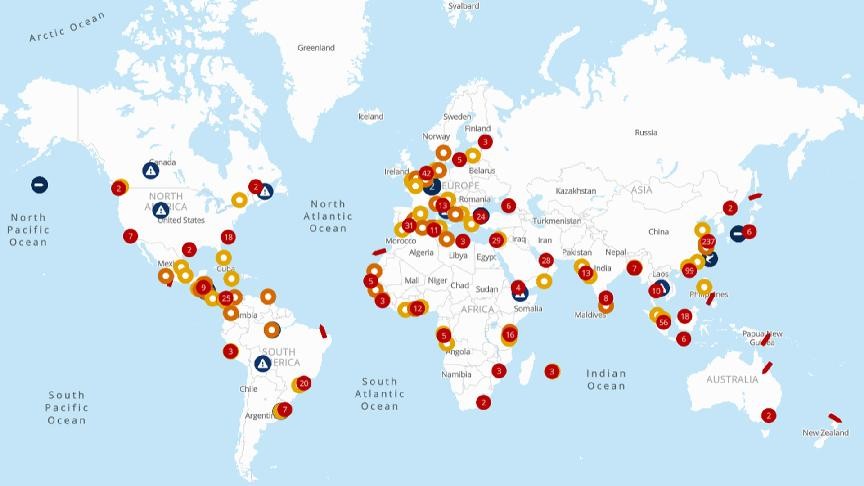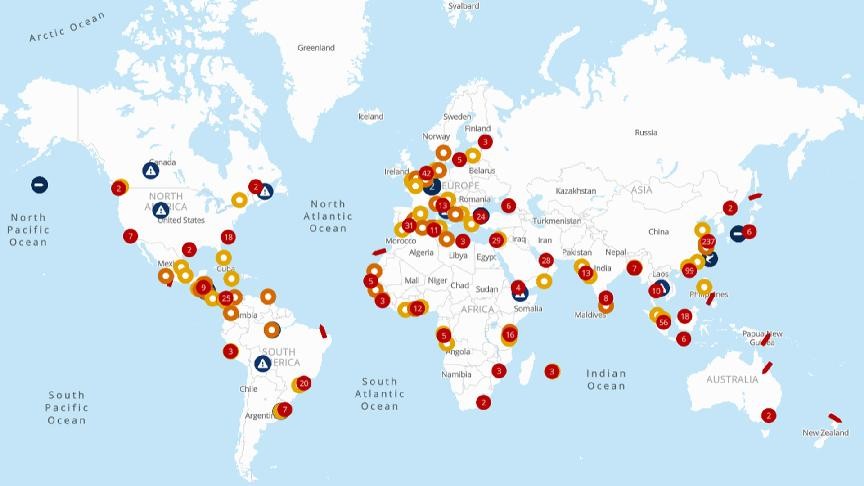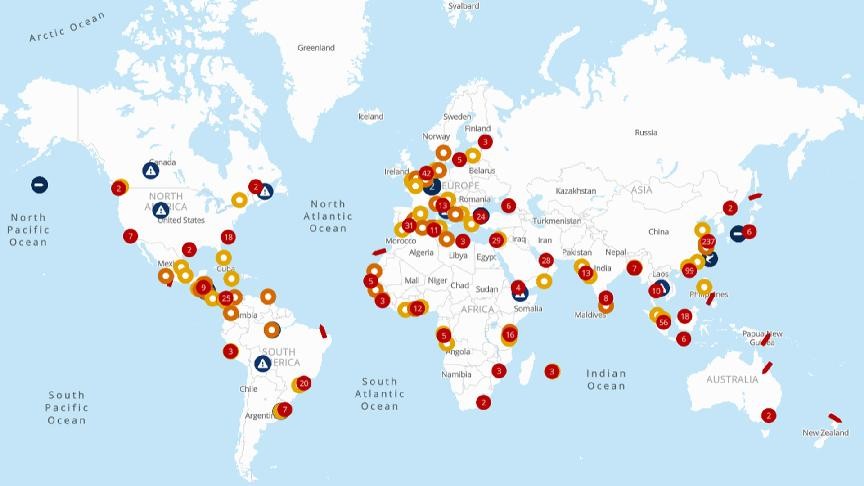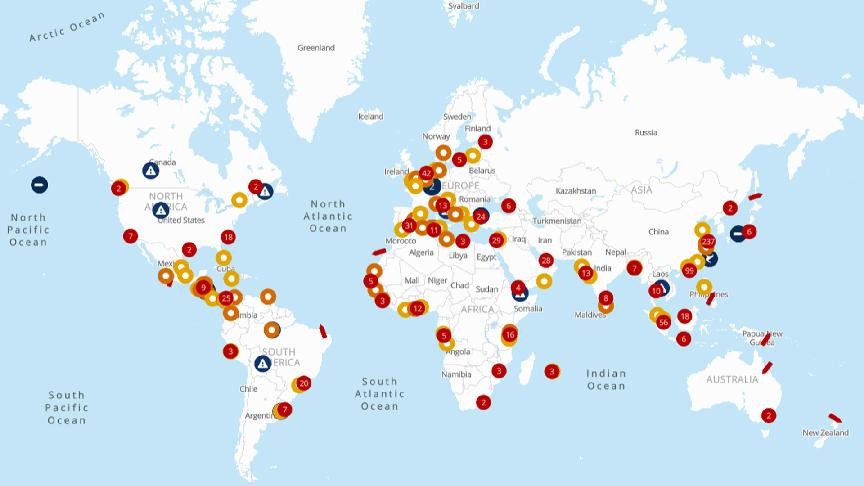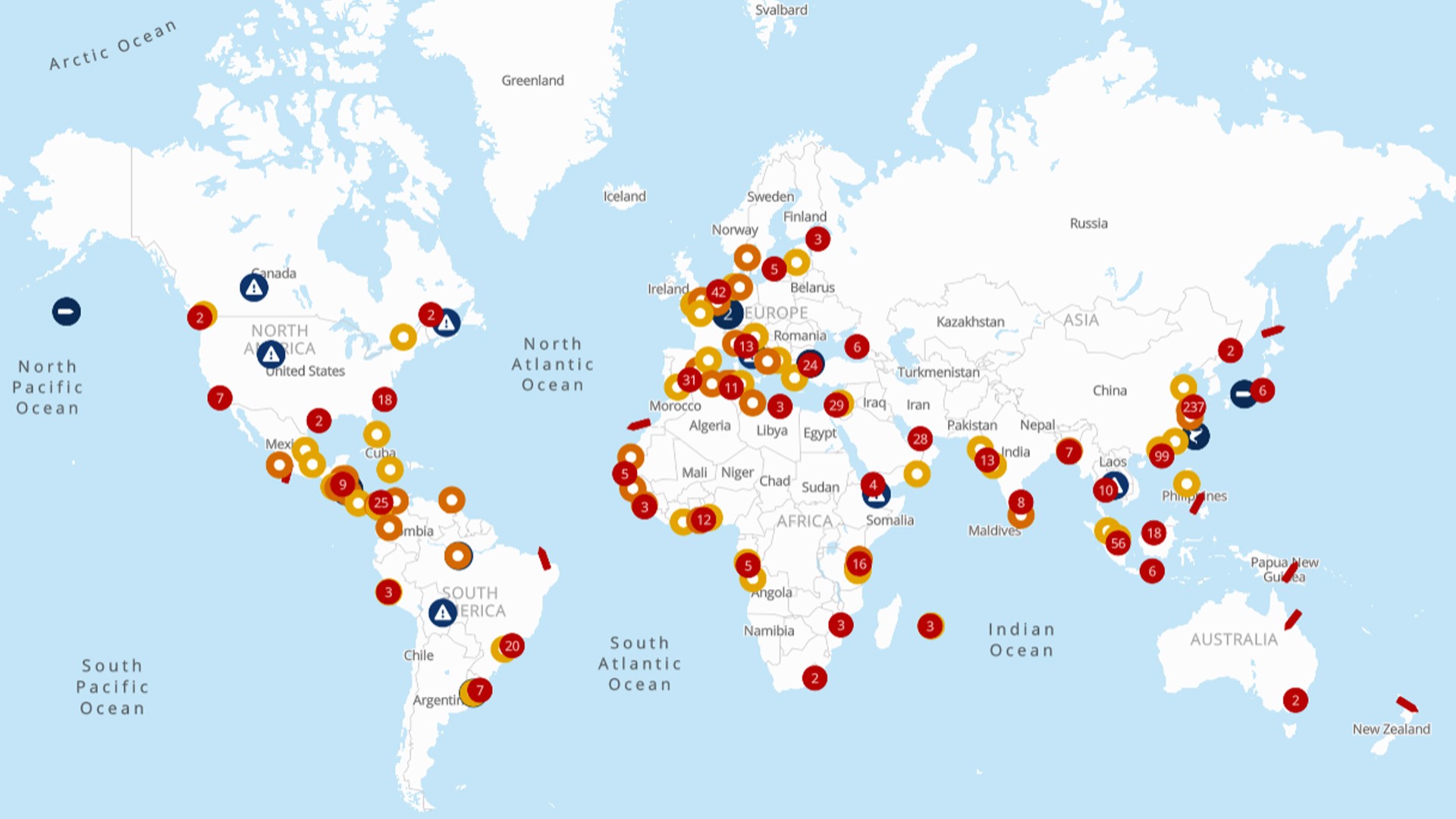

- Stay ahead of supply chain disruptions and port congestion with Kuehne+Nagel’s weekly port operational update.
- Find out the latest vessel waiting times and status of ports in Africa, Asia Oceania, Europe, Middle East-Indian Subcontinent, North America, and South and Central America.
Due to the Easter holidays and related public holidays, port operations are reduced or suspended on several non‑working days. As a result, no vessel handling is taking place during these periods, leading to operational backlogs and cargo accumulation. Consequential delays and congestion are therefore expected to persist in the days following the holiday period.
Africa
Algeria
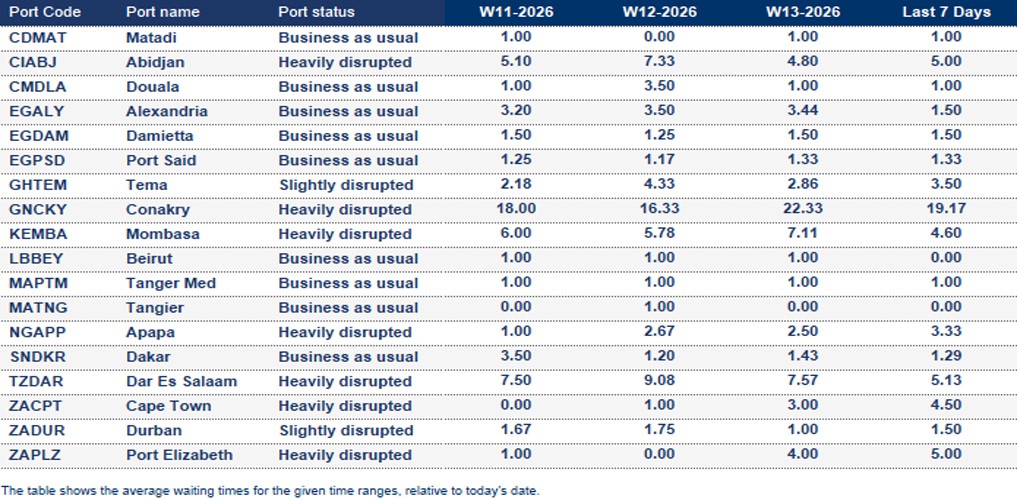
Algiers: The 7-day average vessel waiting time is around 7.43 days.
Cameroon
Douala: The 7-day average vessel waiting time is around 1 day. Feeder waiting times average around 3 days, mainly due to dependencies on mainliner connections.
Ghana
Tema: The 7-day average vessel waiting time is around 3.5 days. Non‑window vessels are subject to berth availability, and ad‑hoc vessels are not accepted. Berth 20 was unavailable from 6 to 31 March due to RTG installation.
Ivory Coast
Abidjan: The 7-day average vessel waiting time is around 5 days. The terminal is slightly congested.
Kenya
Mombasa: The 7-day average vessel waiting time is around 4.6 days. The terminal is experiencing prolonged congestion and reduced productivity due to equipment shortages. Berth delays are further exacerbated by vessel bunching resulting from off‑window arrivals.
Nigeria
Apapa: The 7-day average vessel waiting time is around 3.33 days. The port is currently impacted by severe weather.
Tincan/Lagos: The 7-day average vessel waiting time is around 1 day. High yard congestion persists, impacting terminal performance.
South Africa
Cape Town: The 7-day average vessel waiting time is around 4.5 days. CTCT: The terminal is currently congested with waiting times of up to 4 days.
Port Elizabeth: The 7-day average vessel waiting time is around 5 days. Port Elizabeth operations are running smoothly. At PECT, waiting times are between two and three days, with scheduled service maintenance planned from 19 January through to the end of April 2026. At NCT, current waiting times are approximately two to four days.
Asia Oceania
China
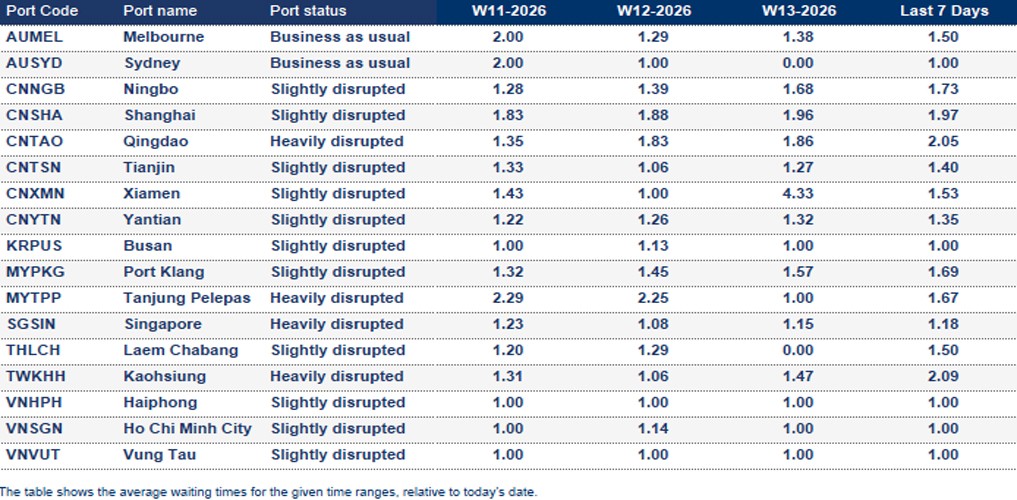
Nansha: The 7-day average vessel waiting time is around 1.19 days. The port is currently severely congested.
Indonesia
Jakarta: The 7-day average vessel waiting time is around 4.92 days.
Surabaya: The 7-day average vessel waiting time is around 4.7 days.
New Zealand
Lyttelton: The 7-day average vessel waiting time is around 3.5 days.
Tauranga: The 7-day average vessel waiting time is around 2 days. Severe weather has caused some challenges over the last week.
Singapore
Singapore: The 7-day average vessel waiting time is around 1.18 days. PSA terminals remain busy, with most carriers experiencing berth wait times of approximately 1 to 1.5 days. Overall yard utilisation is currently high, with density levels around 80%, reflecting sustained pressure on terminal operations. Transshipment delays of up to 2 weeks are reported.
Taiwan
Kaohsiung: The 7-day average vessel waiting time is around 2.09 days.
Europe
Germany
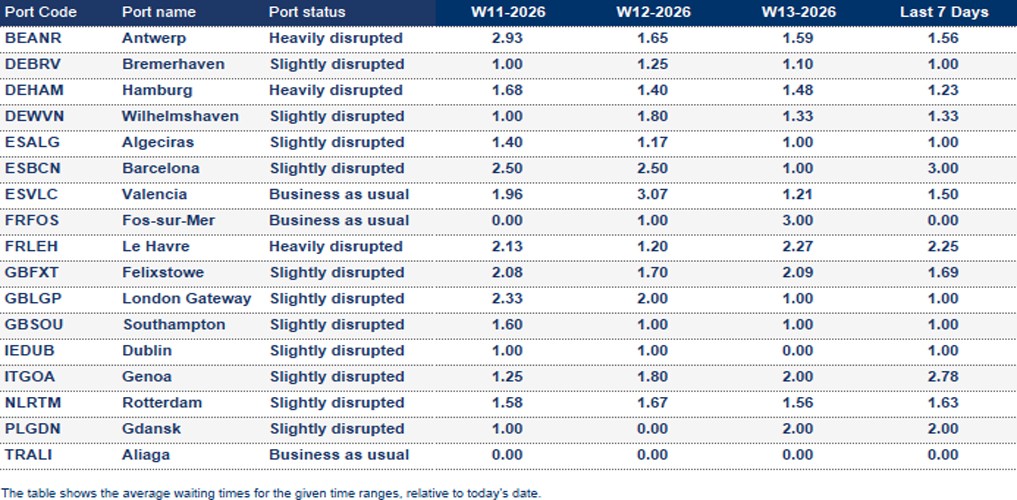
Hamburg: The 7-day average vessel waiting time is around 1.23 days. CTA: Yard utilisation remains critical at 89%, with the terminal operating at capacity. Construction works, limited space, and high import dwell times continue to drive congestion. Consecutive mainliner calls persist, labour constraints are expected over the weekend, and delays are likely to worsen ahead of Easter closures. No improvement is expected before then.
CTH: Yard utilisation stands at 80%.
CTB: Rail loading is delayed by 12 hours due to a main switch failure in the northern module and a power outage. Only two of four transtainer cranes are currently operational.
Italy
Genoa: The 7-day average vessel waiting time is around 2.78 days. The port is currently severely congested.
Trieste: The port was impacted by severe weather on 1 April. Although operations resumed, delays and disruptions are still likely.
Slovenia
Koper: The 7-day average vessel waiting time is around 2.33 days.
Sweden
Gothenburg: Earlier this morning, a fire occurred in a forklift truck at APM Terminals Gothenburg. The incident was swiftly brought under control, and no injuries were reported. Emergency services remain on site. Operations slowly resumed in the afternoon.
Middle East - Indian Subcontinent
Middle East
Due to the current situation in the Middle East, delays and disruptions are highly likely at ports in the Persian Gulf.
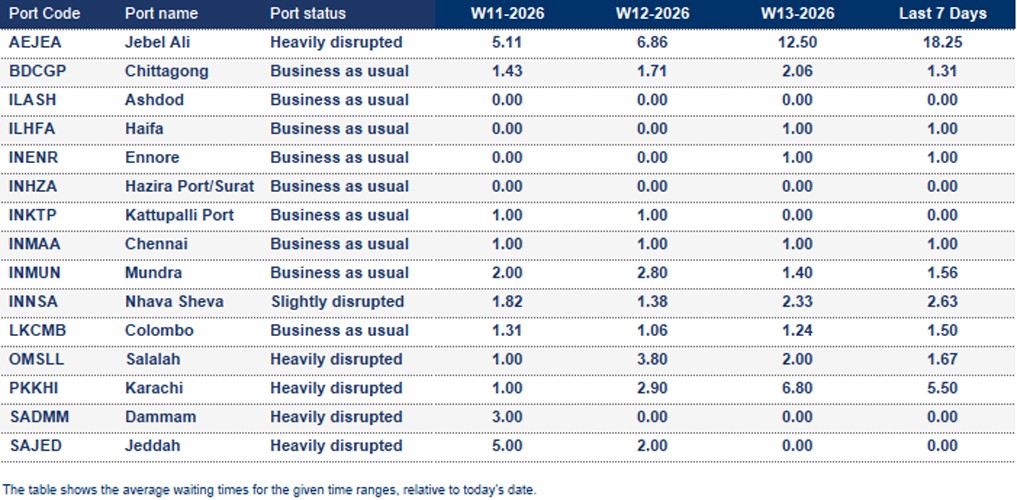
A security incident involving reported drone activity occurred at the Port of Salalah on 28 March 2026. A terminal crane was damaged, and one port worker sustained minor injuries, leading to an immediate evacuation and temporary suspension of operations.
Operations began gradually resuming on 31 March 2026. While the impact was limited to a specific area, some operational constraints are expected as the port works towards restoring full capacity. Read more here
India
Chennai: The 7-day average vessel waiting time is around 1 day. The port is currently congested.
Nhava Sheva: The 7-day average vessel waiting time is around 2.63 days. The port is currently congested.
Pakistan
Karachi: The 7-day average vessel waiting time is around 5.5 days.
Sri Lanka
Colombo: The 7-day average vessel waiting time is around 1.5 days. The port is currently congested.
North America
Canada
Average import rail dwell time for Canadian cargo (Vessel arrival to departure rail ramp):
- Halifax: 6 days
- Montreal: 8 days
- Prince Rupert: 6 days
- Vancouver: 5 days
Mexico
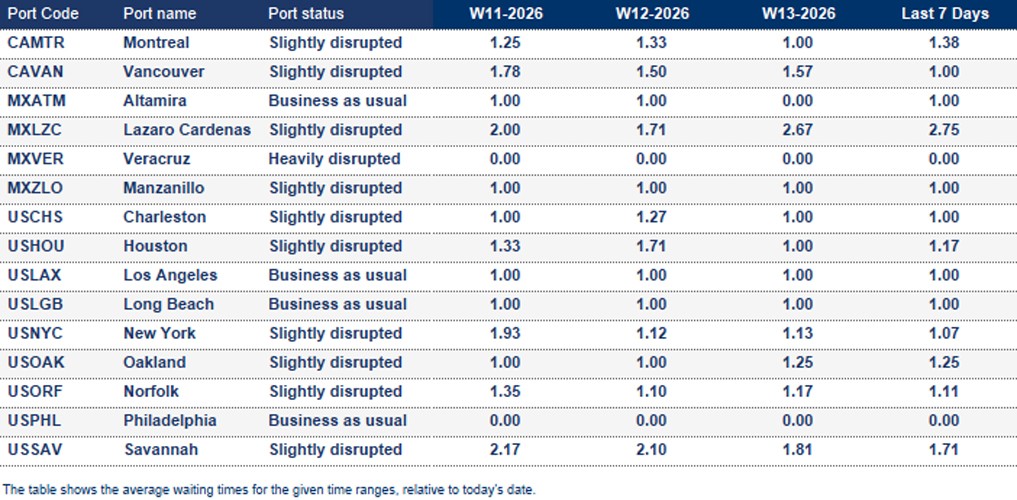
Lazaro Cardenas: The 7-day average vessel waiting time is around 2.75 days.
South and Central America
Brazil
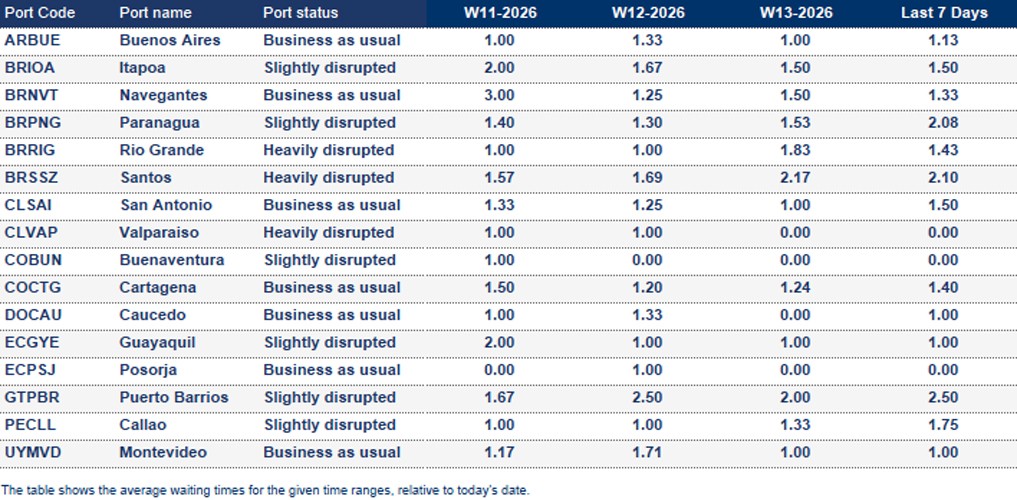
Itapoa: The 7-day average vessel waiting time is around 2.13 days. The yard is currently operating at 72% capacity. The berth window at Itapoa is fully occupied, leaving no gaps between scheduled services. Vessels that arrive within their assigned berth window experience minimal waiting time, while those arriving outside the window may face significantly longer delays.
Paranagua: The 7-day average vessel waiting time is around 2.08 days. The terminal is operating under pressure, with yard utilisation at 82% and waiting times of up to 48 hours. Rail replacement works by TCP on piers 216 and 218 have been ongoing since 10 March, impacting vessel operations and causing delays. The works are expected to continue for approximately 45 days.
Pecem: The 7-day average vessel waiting time is around 0 days. Equipment shortages are leading to a delay for the vessels arriving out of the window.
Rio Grande: The 7-day average vessel waiting time is around 1.43 days. The berthing window is almost full, resulting in a massive delay for vessels arriving out of the window.
Santos: The 7-day average vessel waiting time is around 2.1 days. Rail replacement and repair works are ongoing at TCP Terminal Piers 216 and 218, resulting in delays to vessel operations. The works are expected to be completed by the end of April.
Chile
Antofagasta: The port is currently impacted by heavy swells.
Arica: The port is currently impacted by heavy swells.
Coronel: The port is currently impacted by low visibility.
Iquique: The yard is at 98%. The port is impacted by severe swells.
Lirquen: The port is currently impacted by low visibility.
Puerto Angamos: Operations are currently limited due to high swells.
San Vicente: The port is currently impacted by low visibility.
How Kuehne+Nagel estimates port disruption statuses
Seaexplorer has four port statuses that are estimated based mainly on the 7-day average vessel waiting time. Other factors include yard congestion, labour strikes, natural disasters or intermodal disruptions. Slightly different rules are applied to major ports, or ports that are hubs in their region, as they are typically more efficient.
- Business as usual means the port is currently operating without any significant disruption.
- Slightly disrupted is used if the 7-day average vessel waiting time exceeds 2 days.
- Heavily disrupted is used if the 7-day average vessel waiting time exceeds 4 days.
- Port closed is used when the port suspends operations due to a major disruptive event.
How Kuehne+Nagel calculates the 7-day average vessel waiting time
Mainline container vessels may spend a certain number of days waiting at designated anchorage areas before their scheduled port call.
To calculate the 7-day average waiting time, we consider the waiting days of these vessels, excluding:
- Waiting times for feeder vessels,
- Idle ships without an announced next port,
- Slow steamers heading toward the anchorage, but not actively waiting within the designated area
- Vessels passing through the anchorage area without intending to call at the port.
This rolling average is based on the last 7 days of data and is updated daily in seaexplorer. To find the latest waiting time for a port, enter the port name or code in the search bar and select the relevant option.
Stay Ahead, Stay Informed: Register for seaexplorer for the latest disruptions and vessel waiting times at global container ports.