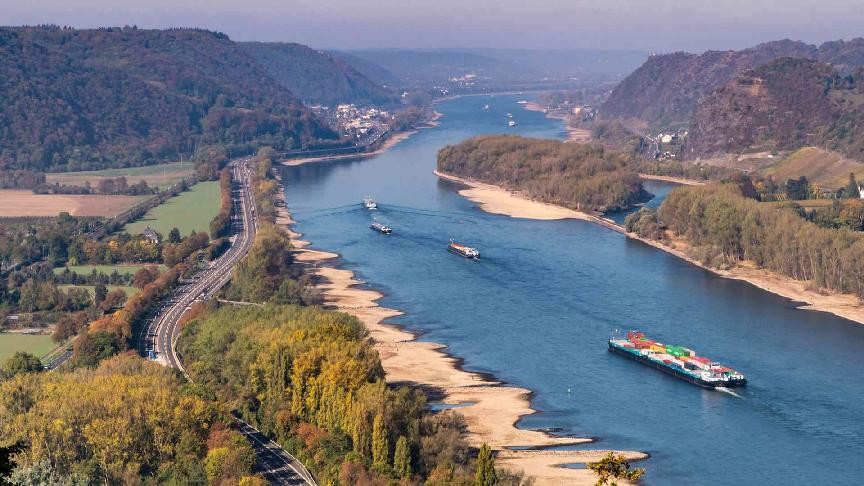

Water levels on the Rhine have risen sharply following rainfall over the weekend, easing the acute disruption that had brought parts of Germany's most important inland waterway to a near standstill in mid-August. The recovery is real but partial: cargo vessels can load more than they could a week ago, though shallow water at the key Middle Rhine bottleneck still prevents fully laden sailings.
Where are levels today
At Kaub, the reference gauge near Koblenz that determines how heavily barges can be loaded on the Middle Rhine, the reading is around 75 cm and rising slowly, according to Germany's Federal Waterways and Shipping Administration (WSV). That marks a dramatic rebound from the record low of roughly 5–6 cm recorded in mid-August, which fell well below the previous all-time low of 25 cm set in 2018.
Further downstream, the Cologne gauge stood at about 0.95 m on the morning of 25 August and is forecast to climb gradually through midweek. Northern sections around Cologne and Duisburg, which were also constrained earlier in the month, are improving.
Vessels generally need a gauge of about 1.50 m at Kaub to sail fully loaded. So despite the rebound, barges remain well below full capacity.
What it means for freight
The practical impact on supply chains persists, even as conditions improve:
- Partial loading continues. Vessels that had stopped sailing past Kaub in mid-August are resuming, but with reduced loads — reportedly around 700–800 tonnes depending on vessel type, a fraction of normal payload.
- Capacity is spread thinner. Cargo continues to be divided across several part-loaded vessels, tightening barge availability and keeping freight rates and low-water surcharges elevated.
- Modal shift remains in place. A portion of freight — particularly bulk commodities, chemicals and fuels — has been shifted to rail and road, where capacity is also under pressure.
- The ARA corridor is operating. Shipping between the ARA seaports (Amsterdam, Rotterdam, Antwerp) and North Rhine-Westphalia continues via the Rhine and the western German canal network.
Outlook
Germany's Federal Institute of Hydrology (BfG) points to a continued gradual recovery, with further rain forecast across the catchment this week that could bring additional relief. However, forecasters caution that a return to normal levels is unlikely before the autumn.
The likely path over the coming weeks is a partial recovery off historic lows rather than full normalisation — meaning loading restrictions and elevated costs should be factored into planning through September.