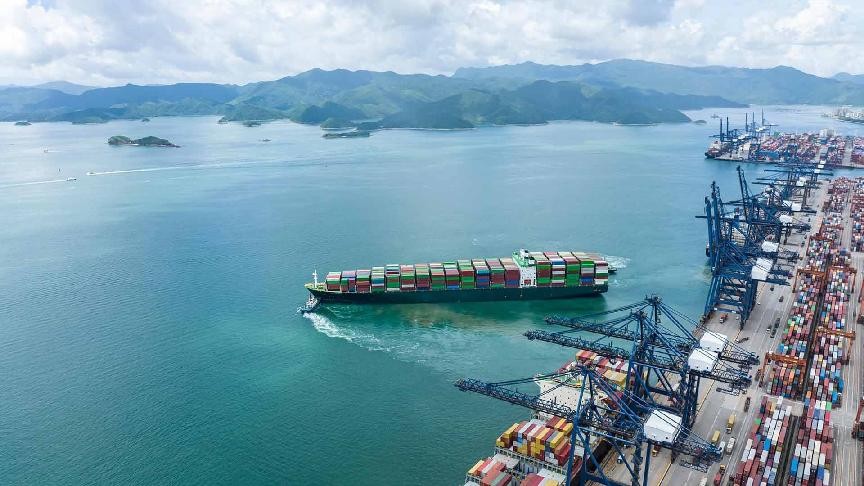
SEPTEMBER delivered the busiest month in the Port of Long Beach’s 116-year history with the US’ second-busiest container port almost hitting 1m teu, up 25% on September 2025.
Volumes were up 3.9% through the first nine months of 2026, chief executive Noel Hacegaba told Lloyd’s List, leaving the Californian port within reach of its first 10m teu year.
But behind those record volumes lies a less reassuring driver: uncertainty.
Speaking to Lloyd’s List at the World Ports Conference in London this month, Hacegaba said the recent extension of the trade truce between the US and China through to January 2027 will lead to more shippers front-loading cargoes ahead of potential changes to tariffs early next year.
Success to this point though has been driven by disruption elsewhere, he said. Extreme weather, including disruption to the Panama Canal, which saw slots reduced earlier this year, has seen more cargo diverted to the US West Coast.
Skyrocketing bunker prices thanks to the conflict in the Middle East has also seen carriers consolidating services and deploying larger vessels, which Hacegaba said was sending more volume to ports that can handle the biggest ships in deployment, like Long Beach.
Could 2026 prove an outlier, boosted by a perfect storm of disruption that may unwind just as quickly?
“We haven’t had a normal year in quite some time,” Hacegaba said with a wry smile.
“But that’s what ports must do. Ports are in the business of responding to disruption and offering customers time and reliability, time and certainty, which is what the market is not offering right now.”
Turning disruption into opportunity
He said 2026 offered a glimpse into the future. Long Beach plans to double its volumes by 2050 while moving to 100% zero emissions too.
“We’re going to densify, we’re going to electrify and we’re going to move more cargo out of the port on rail.”
Hacegaba cited Total Terminals International (TTI) as an example, with its Long Beach terminal able to handle 24,000 teu vessels while rapidly shifting the accompanying volumes inland by rail.
The port is planning to triple its on-dock its rail capacity to nearly 5m teu with its Pier B project, which is estimated to come with a $1.8bn investment to be completed in 2032.
Expensive, and lengthy, but worth it, in Hacegaba’s view. At the moment it takes on average four days to move a container off a ship, on to a train and out of the port. The Pier B project will reduce this to 24 hours, he said.
Long Beach is not going to double its volumes by doubling its real estate: “it would take too long, it would be too expensive”, Hacegaba said.
Instead, it is going to speed up the container’s journey through the port.
The future, he ventured, “is going to be bigger ships in terminals that are going to densify and move more containers out of the terminal on rail”.
That time saving will become increasingly important as cargo travels further inland.
Following the cargo
Hacegaba said China accounted for 70% of Long Beach’s total import and export volumes in 2019. Today, that share is closer to 55%, yet the port continues to break handling records.
The difference is increasingly being made up by cargo from Southeast Asia.
Sailing from Vietnam to the US west coast adds around two to three days compared with China, he said. Faster rail turnarounds at Long Beach can help shippers claw back some of that time, strengthening the port’s appeal as a US gateway.
That shifting trade pattern is one reason Hacegaba remains bullish on the outlook for trans-Pacific volumes, despite lingering concerns over US-China relations as negotiations reopen next year.
“When you have the world’s number one, number two economies talking about a trade deal, it has global implications. And for a port like ours that sits on the transpacific that relies on trade with China, it matters,” he said.
But that shift in manufacturing from China to Southeast Asia has “been in motion for years”, he said. Meanwhile, Long Beach’s volumes keep climbing.
“The 2050 vision that I laid out in January sends a strong signal to the marketplace that the Port of Long Beach is bullish on the future, and that we're committed to making the investment to double our capacity and get to 100% zero emissions,” he told Lloyd’s List.
The port has committed $3.3bn to get to 20m teu by 2050.
“We’re all in,” he said emphatically.