
The competitiveness of US container ports deserves a more serious discussion.
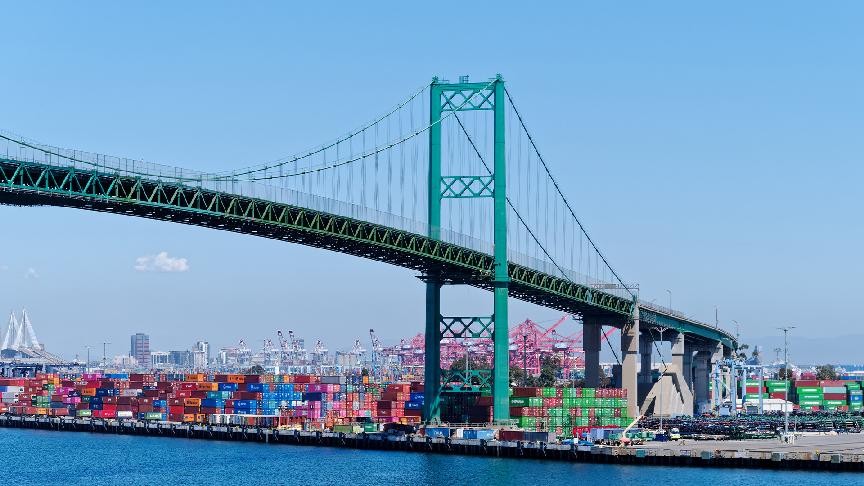
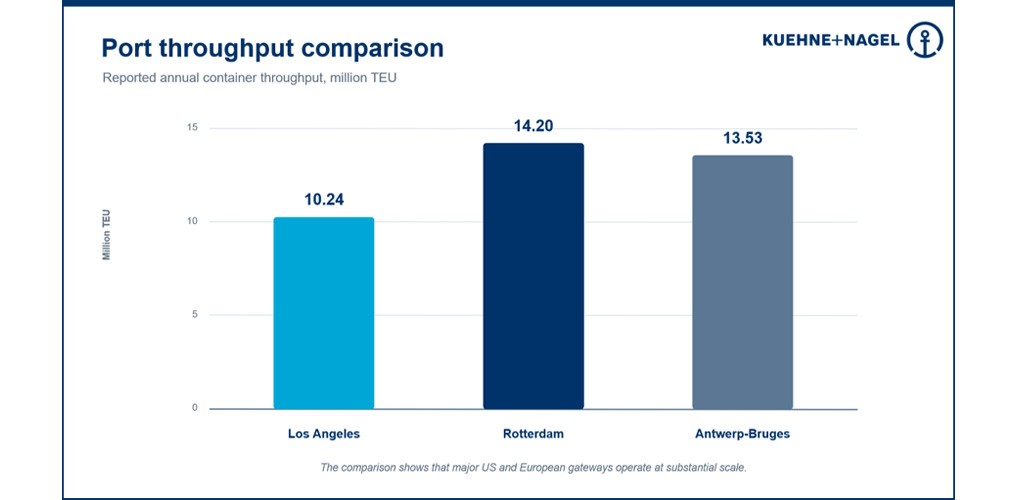
America does not lack infrastructure, cargo or scale. In 2025, Los Angeles alone handled 10.24 million TEU, compared with approximately 14.2 million in Rotterdam and 13.53 million in Antwerp-Bruges. The combined Los Angeles/Long Beach gateway handled approximately 31% of all US international waterborne container trade.
These are enormous logistics systems. The relevant question is therefore not whether American ports can handle large volumes. They clearly can.
The question is: at what total cost per TEU?
This is where port productivity becomes much more than crane moves per hour.
Vessel waiting time, berth productivity, terminal dwell, gate operating hours, truck turnaround, chassis availability, rail connections, labour utilisation and demurrage all consume resources. A port can perform well at the ship-to-shore interface while still imposing substantial costs elsewhere in the logistics chain.
The World Bank’s Container Port Performance Index illustrates why comparisons also need caution. It measures principally vessel time in port, not the total cost of moving cargo through the gateway. Efficient vessel turnaround reduces cost, improves schedule reliability and releases effective vessel capacity, but it represents only one part of the equation.
Labour must be part of the productivity discussion
Labour is inevitably sensitive, particularly in the United States where dockworkers have a long tradition of collective bargaining.
But this should not become a debate about unions versus non-union labour.
The economically relevant measurement is labour cost per container moved.
High wages, strong worker protections and competitive ports are entirely compatible if productivity is correspondingly high. Conversely, low productivity makes every labour hour more expensive when expressed per TEU.
The same principle applies to operating practices. If terminals, labour arrangements and landside logistics allow infrastructure to operate efficiently across longer hours, expensive assets are utilised more intensively. If trucks, containers or ships spend time waiting, that capacity is being consumed without moving cargo.
And those costs do not disappear.
They ultimately migrate into terminal charges, trucking costs, storage, demurrage, detention, freight rates and inventory costs.
Europe is hardly immune. Antwerp-Bruges, for example, estimates that approximately 25 days of industrial action in 2025 resulted in 2.4 million tonnes of lost throughput, around 1% of its annual volume. That is an important reminder that labour disruption has a measurable economic cost regardless of which side of the Atlantic it occurs.
Measure what really matters
Perhaps US port competitiveness needs a different KPI.
Not simply TEU handled. Not crane productivity alone. Not vessel turnaround alone.
But the total time and cost required to move one loaded TEU from ship to the inland transportation network — and the same measurement in reverse for US exports.
Then compare Los Angeles, New York/New Jersey and Savannah with Rotterdam and Antwerp on exactly the same basis.
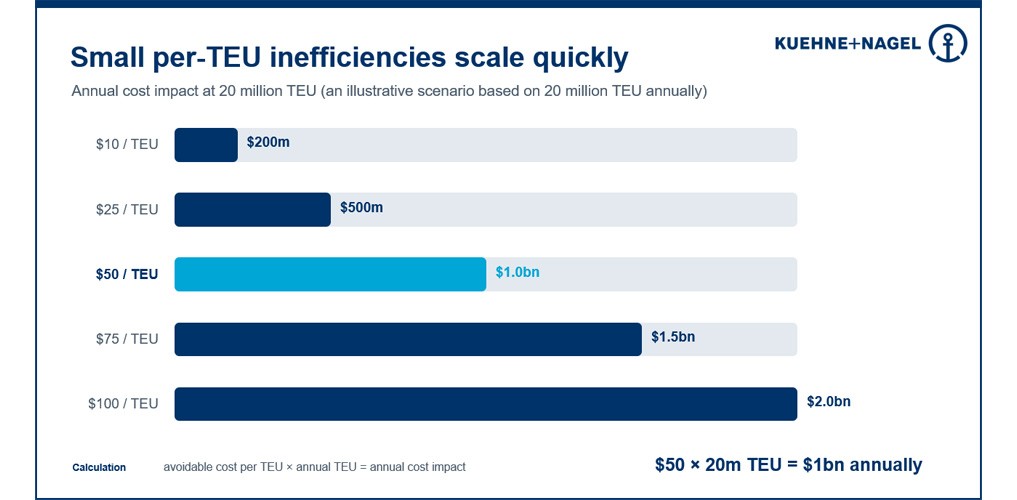
For an economy moving tens of millions of international TEU annually, even $50 of avoidable additional cost per TEU becomes billions of dollars over time.
Port productivity is therefore not simply an operational discussion between terminals, employers and unions.
It is part of the cost of American trade — and ultimately part of US industrial competitiveness.
This is an area where Kuehne+Nagel is also very active, with our investment in IMC: we concretely see there is huge value to be delivered by providing solutions on landside logistics in the USA for all supply chains inbound and outbound.