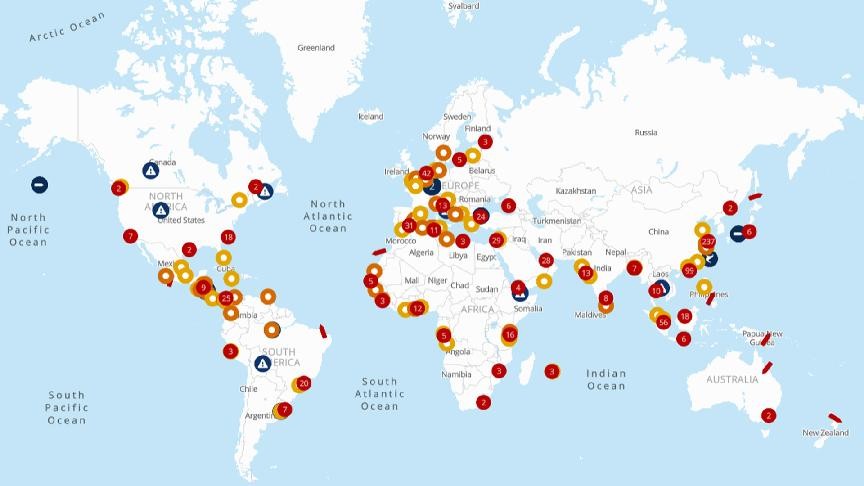

- As a leader in sea logistics, Kuehne+Nagel closely tracks and collects data on the movement of vessels, including actual arrivals and vessel delays.
- A summary of this analysis, based on neutral data, is published monthly in our Schedule Reliability Report, available on Sea News.
Executive Summary
Global reliability
Global schedule reliability remained under pressure in August and showed little sign of recovery following the sharp deterioration recorded in June and July.
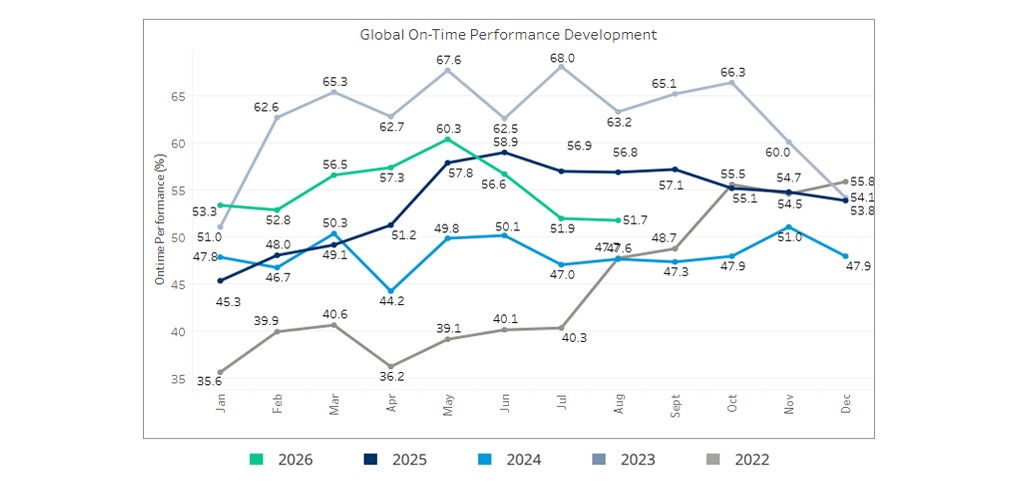
On-time performance stabilised at 51.7%, remaining well below the August 2025 level and significantly below the stronger performance recorded in the second quarter of 2026.
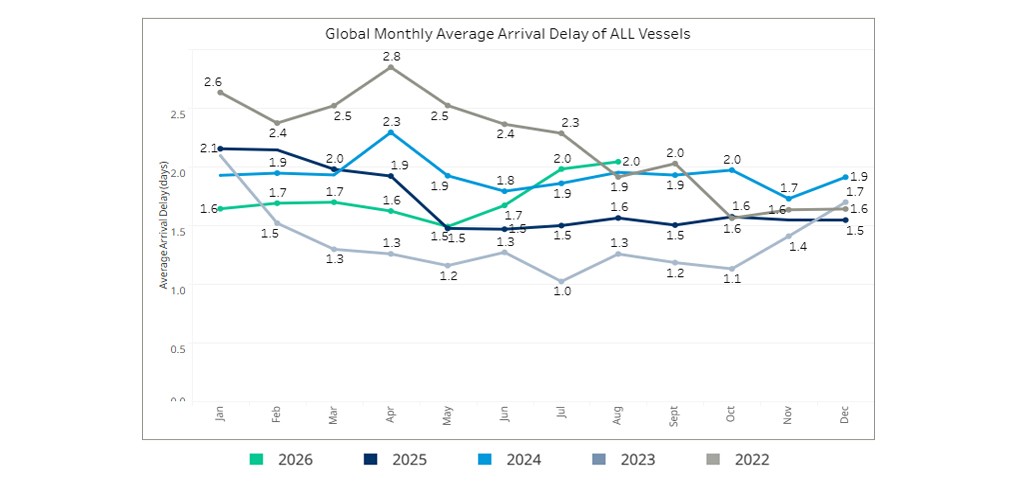
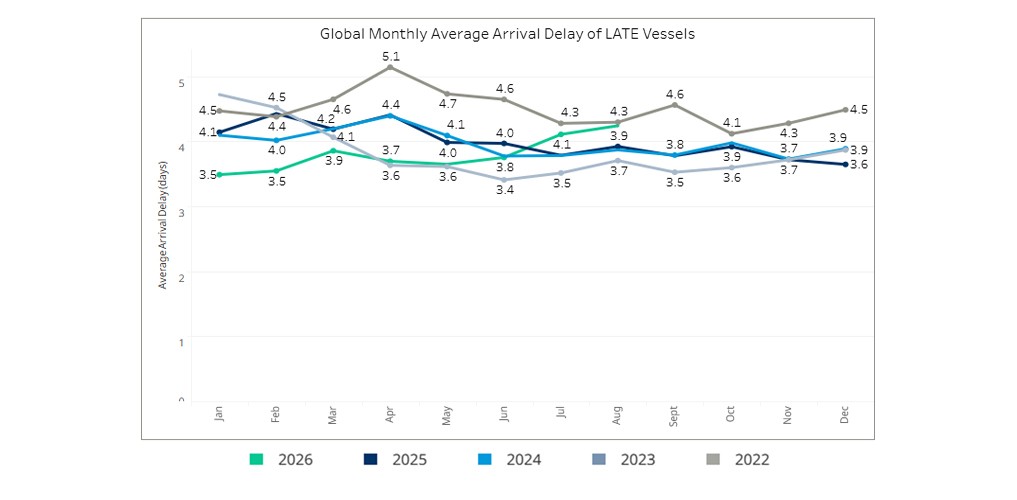
While the overall share of vessels arriving on time changed marginally, delays remained elevated in August. Average delay across ALL vessel arrivals remained at 2.0 days, while LATE-arriving vessels experienced slightly longer delays than in July.
Trade performance
Trade lane performance was more mixed than in July. Several corridors connecting North America, North Europe and South America recorded improvements, partly offsetting weaker performance elsewhere.
However, the broad pattern remained consistent with recent months, with the majority of Asia-linked trades deteriorating further. North America East Coast ↔ South America West Coast remained the strongest-performing trade lane overall, while Asia-linked services accounted for most of the weakest-performing corridors in August.
Featured trade
Asia ↔ North America East Coast reliability declined to 50.9% in August, down 3.2 percentage points from July and 5.2 percentage points below August 2025.
The overall weakening was driven by the North America East Coast → Asia backhaul, where reliability fell sharply to 35.8%, and arrival delays increased.
By contrast, the Asia → North America East Coast headhaul remained comparatively resilient, improving slightly to 63.9%. This divergence shows that the trade’s deterioration was concentrated on the backhaul rather than reflecting broad-based weakness in both directions.
Global on-time performance development
Global schedule reliability remained stable at 51.7% in August, following the steep decline seen in previous months. Performance was 5.1 percentage points below August 2025 but remained above August 2024. With no evident recovery, reliability remained at its weakest level for 2026.
Average arrival delay across ALL vessels remained stable at around 2.0 days in August.
In contrast, the average delay among LATE vessels increased slightly to approximately 4.3 days.
Reliability per trade lane
Trade-lane performance was mixed in August, with nine of the 20 corridors improving. Gains were concentrated on several North America, North Europe and South America routes, while six of the seven Asia-linked lanes declined.
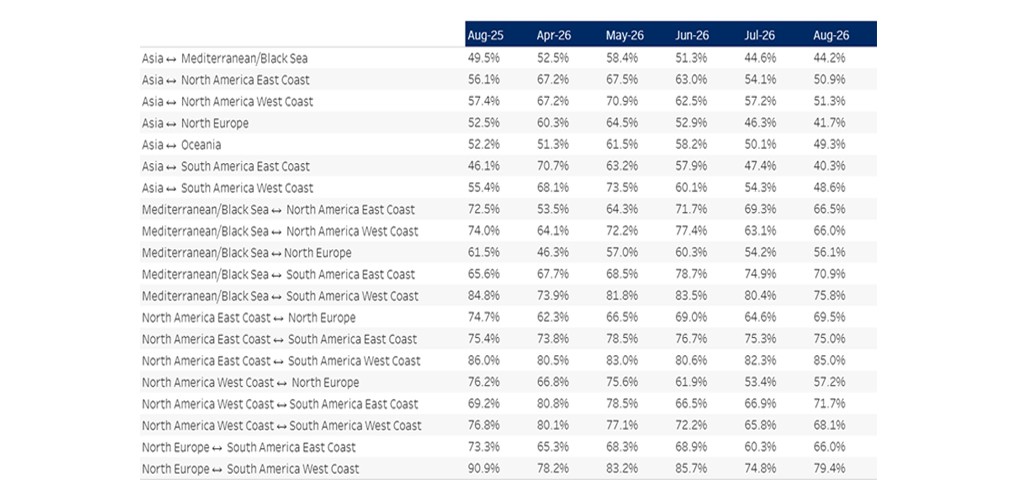
North America East Coast ↔ South America West Coast remained the strongest-performing corridor at 85.0%. Asia ↔ South America East Coast recorded the largest monthly decline, falling 7.1 percentage points to 40.3%
The weakness across Asia-linked trades coincided with weather-related disruption and severe congestion at several major Asian gateways.
Reliability on Asia↔North America East Coast
Asia ↔ North America East Coast recorded an on-time performance of 50.9% in August, down 3.2 percentage points from July and 5.2 percentage points below August 2025.
The trade presented contrasting developments across the two directions. While headhaul reliability stabilised following July's decline, backhaul performance deteriorated further, driving the overall weakening of the trade.
Headhaul
Asia → North America East Coast improved slightly in August, rising from 63.3% to 63.9%. Although reliability stayed below the stronger levels recorded earlier in 2026, indicating that performance stabilised following July's decline.
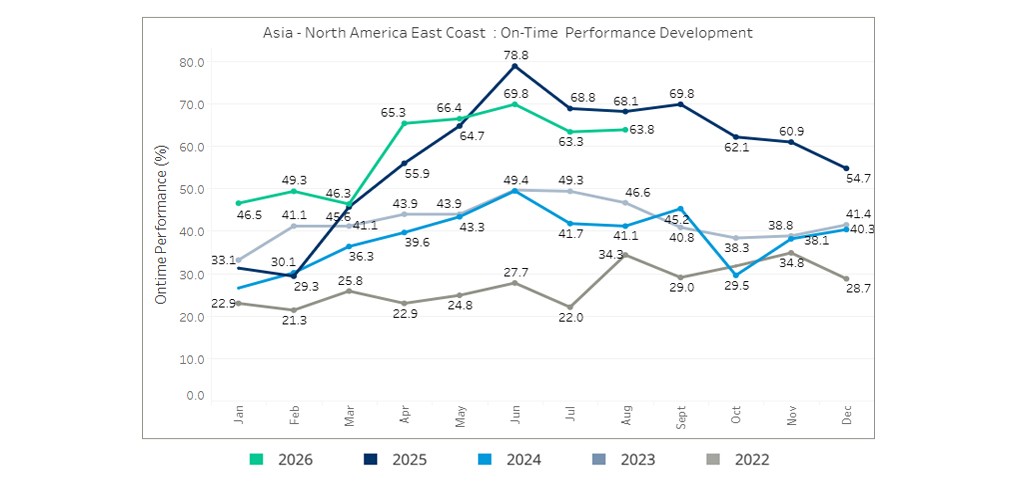
Arrival performance also improved during the month. Average delay across ALL vessels fell from 1.9 to 1.2 days, while LATE-vessel delay remained stable at 3.5 days, indicating a more consistent schedule performance.
Backhaul
North America East Coast → Asia continued to weaken in August, with on-time performance falling from 44.2% to 35.8%. This represented the lowest reliability recorded on the corridor during 2026.
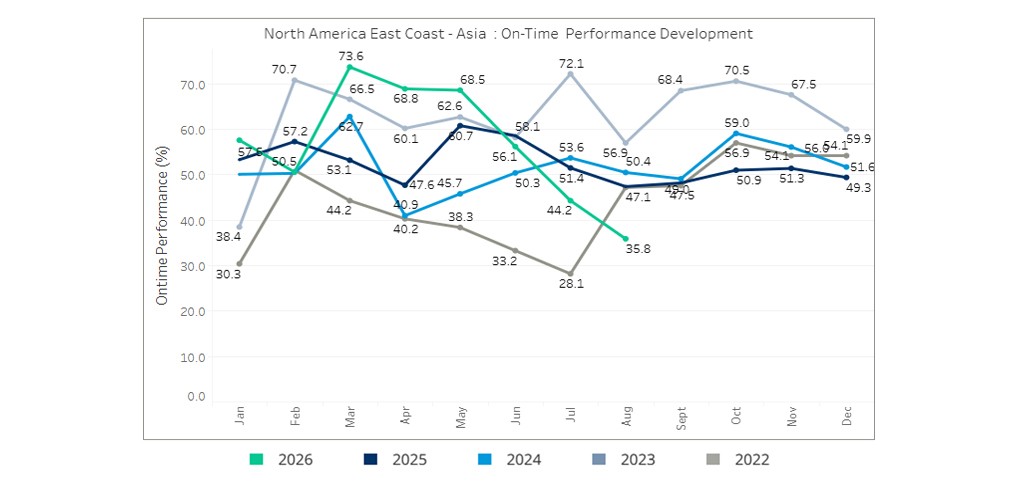
Arrival delays also deteriorated. Average delay across ALL vessels increased from 2.5 to 3.0 days, while LATE-vessel delay rose from 4.5 to 4.8 days. Lower reliability and longer delays indicate that both the share of late arrivals and the average delay increased in August.
Methodology
Calculating the on-time performance
To calculate the on-time performance of a direct service, Kuehne+Nagel uses carrier-published vessel schedules. Only schedules that meet our quality criteria are included in the analysis.
As carriers continuously update schedules, announced arrival times typically become more accurate as a vessel approaches its destination. To ensure a consistent comparison, a 14-day schedule freeze period is applied prior to arrival.
Actual vessel arrivals are therefore benchmarked against the last announced schedule published 14 days before the vessel reaches the destination port.
Actual arrival times are determined using AIS (Automatic Identification System) vessel tracking data. A vessel is considered on time if it arrives within a ±24-hour window of the last announced arrival time.
Scope of the analysis
This report focuses exclusively on direct container services operated by the twelve largest global carriers: MSC, Maersk, CMA CGM, COSCO, OOCL, Hapag-Lloyd, ONE, Evergreen, HMM, ZIM, Yang Ming and PIL.
The analysis measures vessel schedule reliability and does not represent overall container lead-time reliability. Additional factors, including transhipment delays, intermodal transfers, port congestion and terminal operations, may affect the total transit time experienced by customers.
Assigning services to trade lanes
Many liner services operate across multiple regions and may call at ports in more than one trade lane e.g. a carrier service between Asia and North Europe also calls ports in the Middle East and or the Mediterranean), As a result, an individual service may be included in multiple trade-lane analyses.
Trade-lane definitions
There is no industry-wide standard for defining trade lanes. Kuehne+Nagel therefore applies its own trade-lane mapping methodology, assigning individual ports to trades based on a consistent internal framework.The report focuses on the principal East-West and North-South container trades. Niche and intra-regional services, such as Intra-Asia and Intra-Europe trades, are currently outside the scope of the analysis.
A PDF version of this report can be found here.