

As a leader in sea logistics, Kuehne+Nagel closely tracks and collects data on the movement of vessels, including actual arrivals and vessel delays.
- A summary of this analysis, based on neutral data, is published monthly in our Schedule Reliability Report, available on Sea News.
Executive Summary
Global Reliability
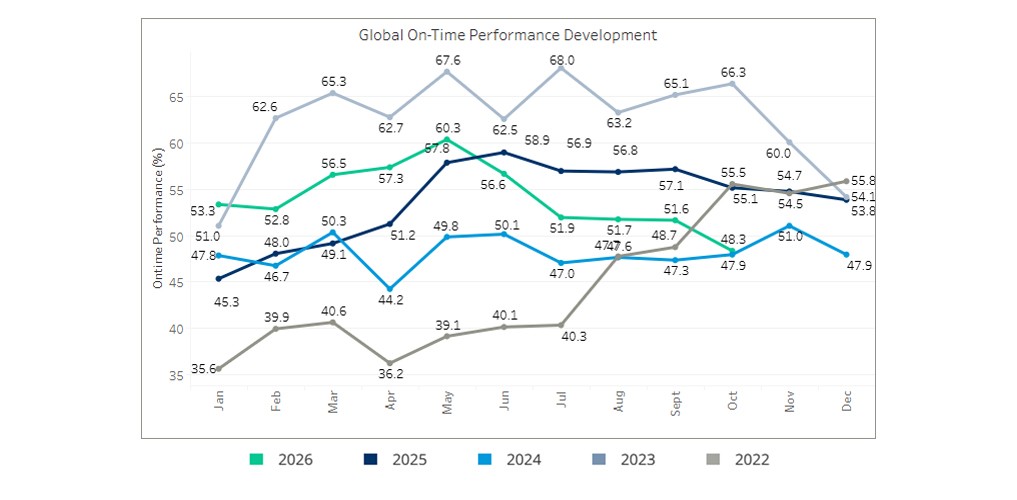
Global schedule reliability weakened further in October, falling from 51.6% in September to 48.3%. Performance moved below the 50% level and remained well below the stronger results recorded earlier in 2026. Average delay for LATE vessels improved slightly to 4.0 days, while the average across ALL vessels remained unchanged at 2.1 days.
Trade Performance
Trade-lane performance weakened broadly in October, with 14 of the 20 corridors declining. The sharpest falls were concentrated in North America West Coast-linked trades, including a 30.8-point decline on North America West Coast ↔ South America West Coast.
Mediterranean/Black Sea ↔ South America West Coast remained the strongest corridor at 88.5%. Asia ↔ Oceania recorded the largest deterioration among Asia trades, falling 10.6 points to 38.4%.
Featured Trade
North America East Coast ↔ North Europe remained above the global benchmark despite a marked monthly decline. Overall, on-time performance fell from 72.9% in September to 62.8%, but remained 3.2 percentage points above October 2025.
Both directions weakened, with the sharper deterioration on North America East Coast → North Europe. On-time performance declined to 54.1%, compared with 66.4% in the opposite direction. Average arrival delays also increased in both directions, reinforcing the broader weakening seen in October.
Global On-Time Performance
Global schedule reliability declined from 51.6% in September to 48.3% in October, a month-on-month decrease of 3.3 percentage points. This is the first time global on-time performance has fallen below 50% since March 2025, marking a notable deterioration from the broadly stable levels seen in recent months.
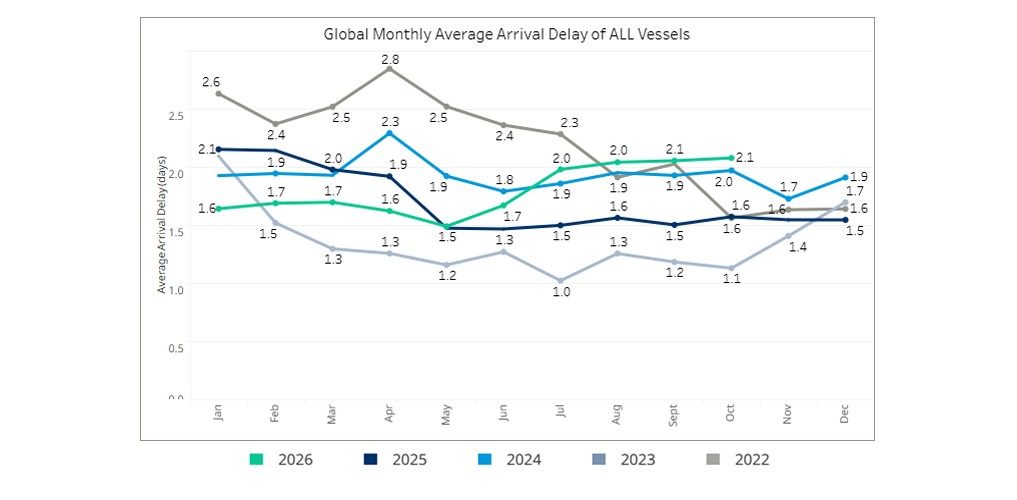
Average arrival delays remained elevated in October. For LATE vessels, the average arrival delay improved slightly from 4.2 days in September to 4.0 days, while the average delay for ALL vessels remained unchanged at 2.1 days. 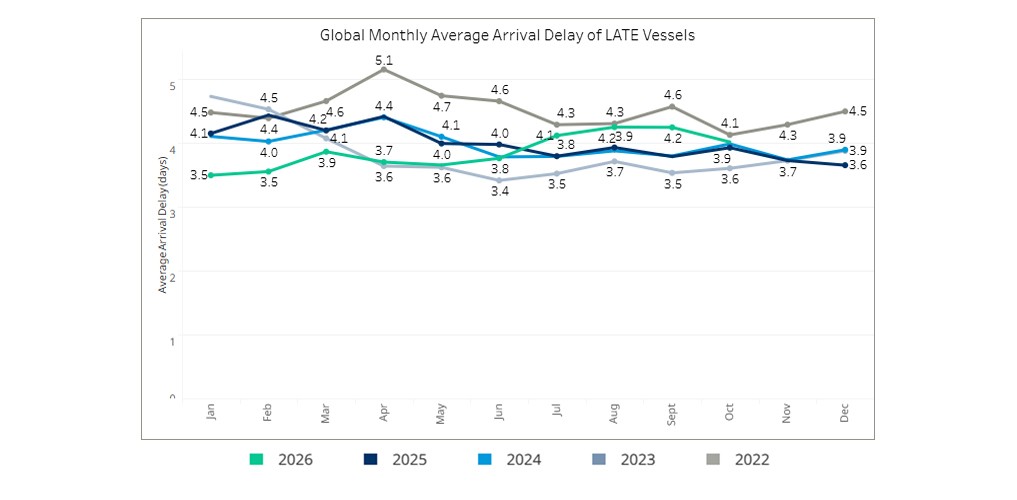
Reliability per Trade Lane
Trade-lane performance weakened broadly in October, with 14 of the 20 corridors declining month-on-month. Against the global on-time performance of 48.3%, several key trades remained below the global benchmark, particularly across major Asia-linked trades.
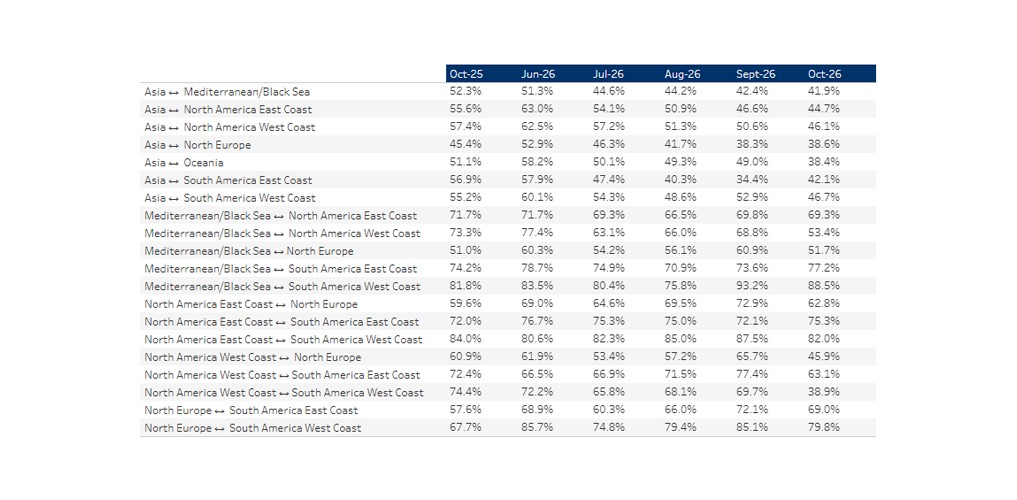
Asia ↔ Oceania fell to 38.4%, down 10.6 percentage points month-on-month, while Asia ↔ Mediterranean/Black Sea fell to 41.9%. Weakness was not limited to Asia-linked trades: North America West Coast ↔ North Europe fell sharply to 45.9%, down 19.8 percentage points month-on-month and 15.0 points year-on-year.
Reliability on North America East Coast ↔ North Europe
Schedule reliability on North America East Coast ↔ North Europe fell from 72.9% in September to 62.8% in October, a decline of 10.1 percentage points.
Despite the monthly deterioration, performance remained 3.2 points above October 2025 and 14.5 points above the global average of 48.3%.
The decline came amid weather-related disruption, terminal closures and vessel bunching at several North European gateways.
Headhaul
North Europe → North America East Coast was the more resilient direction in October, although on-time performance fell from 75.3% in September to 66.4%, a decline of 8.9 percentage points.
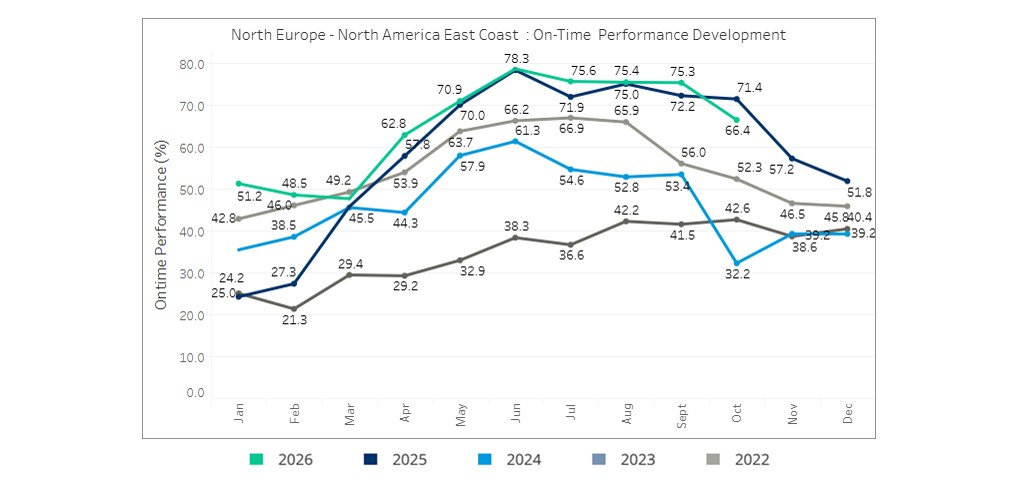
Average arrival delays also increased. LATE vessels rose from 2.7 to 3.2 days, while the average across ALL vessels increased from 0.7 to 1.1 days. Despite this deterioration, on-time performance remained well above the global average of 48.3%.
Backhaul
North America East Coast → North Europe recorded the sharper decline, with reliability falling from 71.9% in September to 54.1% in October, a 17.8 percentage-point drop.
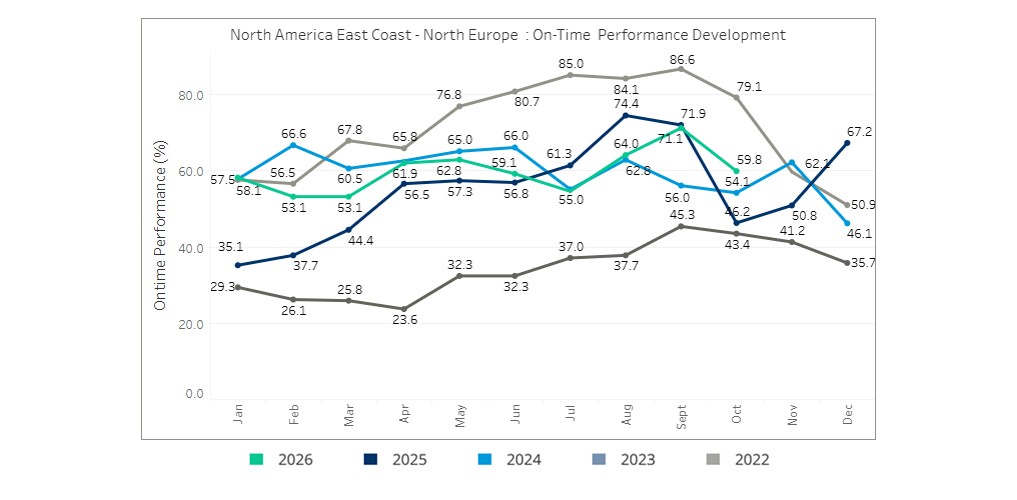
Arrival delays also increased, with LATE vessels rising from 3.1 to 3.4 days and ALL vessels from 1.1 to 1.5 days. The sharper decline in this direction was the main driver of the trade's overall deterioration in October.
Methodology
Calculating the on-time performance
To calculate the on-time performance of a service, Kuehne+Nagel uses vessel schedules from carrier(s) offering that service. Only carrier schedules that match our quality criteria are used for the schedule reliability calculation. As carriers update schedules constantly, they become more accurate the closer vessels get to a destination port. For this reason, we have implemented a "schedule freeze period" of 14 days prior to actual vessel arrival. In other words, we benchmark the actual arrival with what carriers last announced 14 days earlier. To identify the actual time of arrival, Kuehne+Nagel consumes AIS (Automatic Identification System) vessel data. All vessels which arrive within a +/- 24-hour window at the port of destination compared to the last announced arrival are considered to be on time. Port call omissions and blank sailings announced after the 14-day freeze are excluded from the calculation.
Assigning carrier services to multiple trade lanes
Many services operate on various trade lanes (e.g. a carrier service between Asia and North Europe also calls ports in the Middle East and or the Mediterranean), and therefore carrier services may be listed in multiple trade lanes.
Definition of trade lanes
There is no common standard for the definition of trade lanes. This means, depending on the source, you will find different trade lanes as well as different regions, countries and ports assigned to a trade lane. Kuehne+Nagel has defined its own way of mapping and has assigned ports to these trade lanes accordingly. On-time performances of vessels are captured in our reports on defined main trades, meaning trades moving large container volumes on vessels. Therefore, niche trades and services within one trade, called "Intra Trade" services (e.g. Intra-Asia, Intra-Europe), are currently out of scope. A PDF version of this report can be found here.
A PDF version of this report can be found here.