
- As a leader in sea logistics, Kuehne+Nagel closely tracks and collects data on the movement of vessels, including actual arrivals and vessel delays.
- A summary of this analysis, based on neutral data, is published monthly in our Schedule Reliability Report, available on Sea News.
Executive Summary
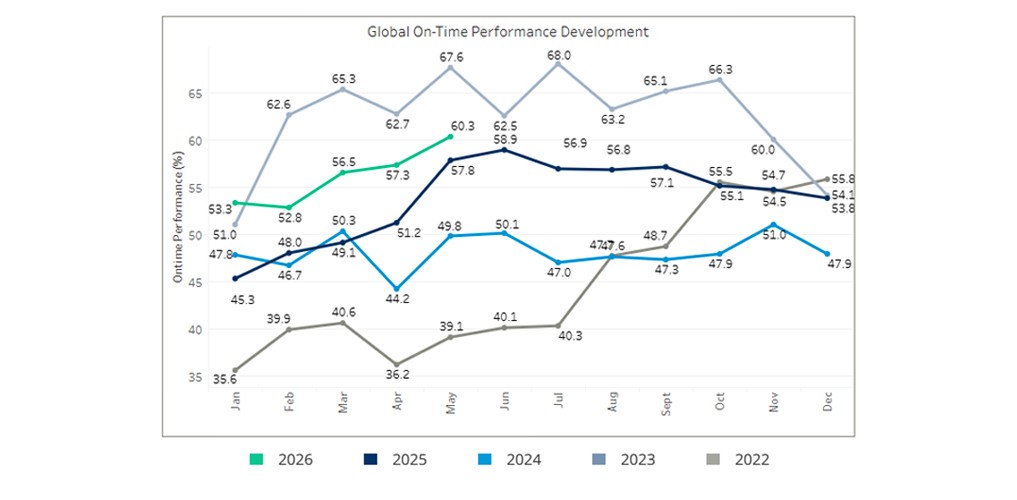
Global on-time performance improved further in May, rising to 60.3%. This marks a 3.0 percentage-point improvement month on month and a 2.5 percentage-point increase versus May 2025.
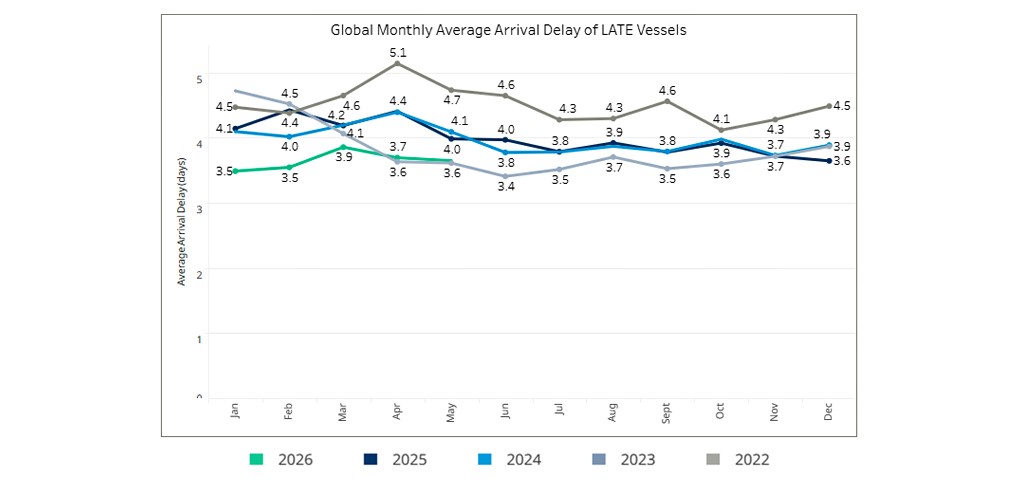
Performance remained above levels seen during the Red Sea disruption period, while overall delay metrics also moved in the right direction. Average arrival delay improved to 3.6 days for LATE vessels and to 1.5 days across ALL vessels.
Trade-lane reliability improved broadly, with 17 of the 20 major trades posting month-on-month gains. Mediterranean/Black Sea-related trades saw the strongest increases, while the highest May performance remained concentrated on South America West Coast lanes
Featured trade lane – Asia ↔ Mediterranean/Black Sea
Asia ↔ Mediterranean/Black Sea performance improved further in May, with on-time performance reaching a 2026 high and delay metrics also moving in the right direction.
The headhaul leg recovered in May, with on-time performance returning to the mid-50% range and both LATE-vessel and ALL-vessel delays improving from April. The direction appears to be stabilising after a weak first quarter, although reliability remains below the stronger start seen in January.
Mediterranean/Black Sea → Asia performance improved further in May, with on-time performance rising to 60.7%, the highest level so far in 2026. Average delay across ALL vessels also fell to a 2026 low of 1.3 days, while LATE-vessel delay remained well below last year’s level.
Global On-Time Performance
Global on-time performance improved further in May, reaching 60.3%. This is 3.0 percentage points higher than in April and 2.5 percentage points above May 2025.
Performance also remained above the levels seen during the Red Sea disruption period in 2024 and 2025, underlining continued market resilience despite the closure of the Strait of Hormuz.
Average arrival delays improved further in May. Delays for LATE vessels continued to ease, with average arrival delays improving to 3.6 days.
Across ALL vessels, average delays also showed further improvement, declining to 1.5 days in May.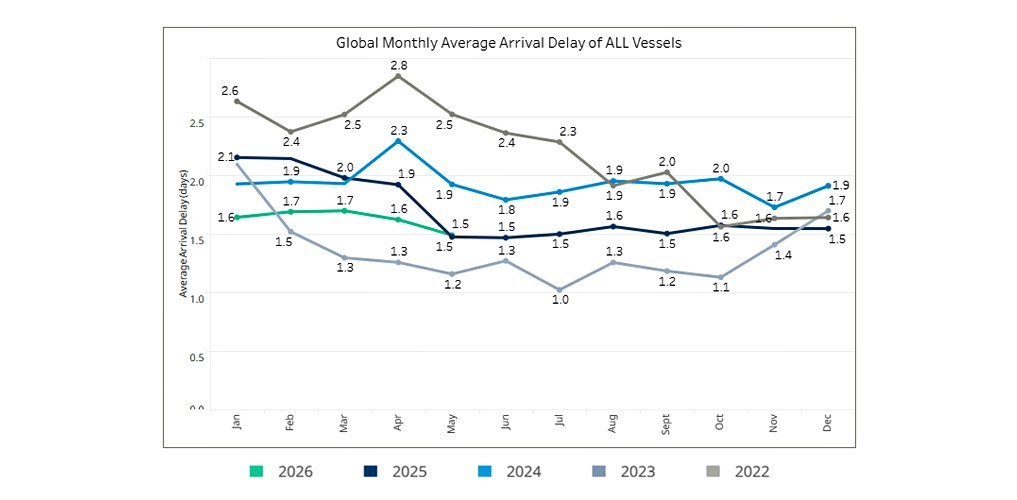
Reliability per Trade Lane
Reliability across the major trades improved again in May, with 17 of the 20 trades posting month-on-month gains. Mediterranean/Black Sea-related trades recorded the strongest increases, while Asia ↔ Oceania also rebounded.
The best May performance remained concentrated on South America West Coast trades. North Europe ↔ South America West Coast led at 83.2%, followed by North America East Coast ↔ South America West Coast at 83.0% and Mediterranean/Black Sea ↔ South America West Coast at 81.8%.
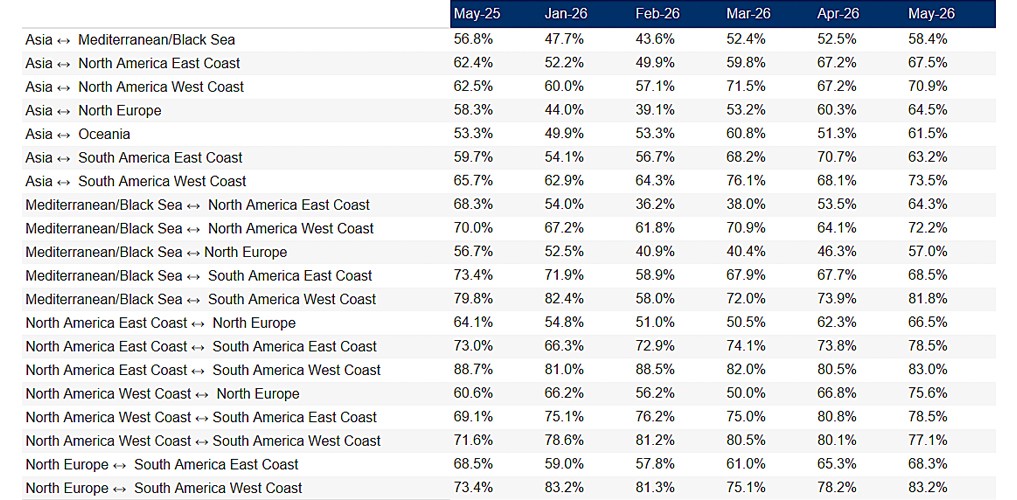
The annual trend was also positive, with 16 of the 20 trade lanes performing above May 2025 levels. North America West Coast ↔ North Europe recorded the strongest year-on-year gain, while only a small number of lanes remained below last year’s level.
Reliability on Asia ↔ Mediterranean/Black Sea
The Asia ↔ Mediterranean/Black Sea trade strengthened further in May, with on-time performance reaching a 2026 high of 58.4%.
Arrival delays also decreased for both LATE vessels and ALL vessels, confirming a broader improvement in overall trade-lane performance.
We take a closer look at each direction separately to show how this improvement developed across the two legs of the trade.
Headhaul
The headhaul leg strengthened in May, with on-time performance recovering to the mid-50% range after softening through the first quarter. The month-on-month improvement was clear, although the lane remained below the stronger January level.
Delay metrics improved in parallel. Average arrival delay fell to 3.5 days for LATE vessels and to around 1.7 days across ALL vessels. Both measures were lower than in April and slightly better than in May 2025.
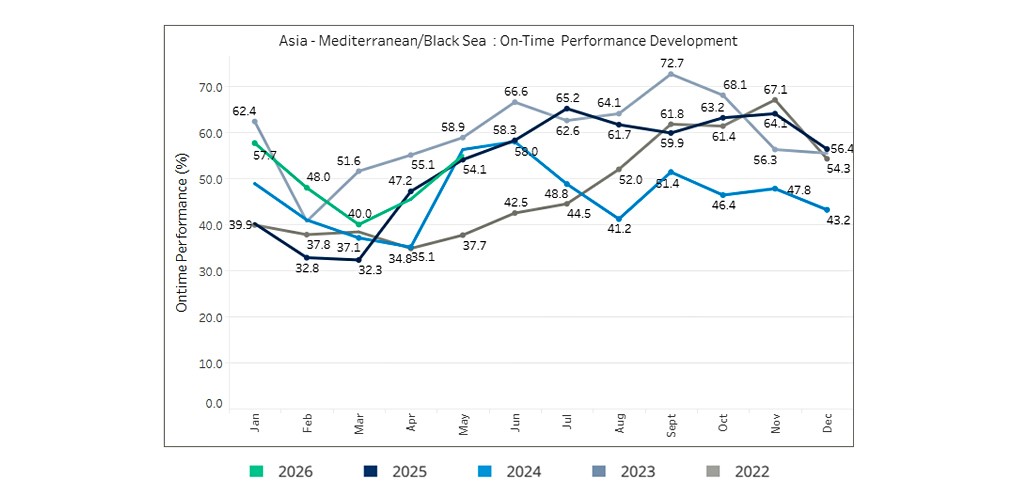
Overall, the May data indicates a more stable performance trend on this leg.
Backhaul
The Mediterranean/Black Sea → Asia leg improved further in May, with on-time performance rising to 60.7%. This is up 4.2 percentage points from April and 3.0 percentage points above May 2025, marking the strongest result so far in 2026.
Delay metrics also remained favourable. LATE-vessel delay was stable at 3.3 days and well below last year’s level, while average delay across all vessels declined to 1.3 days, the best result recorded in 2026.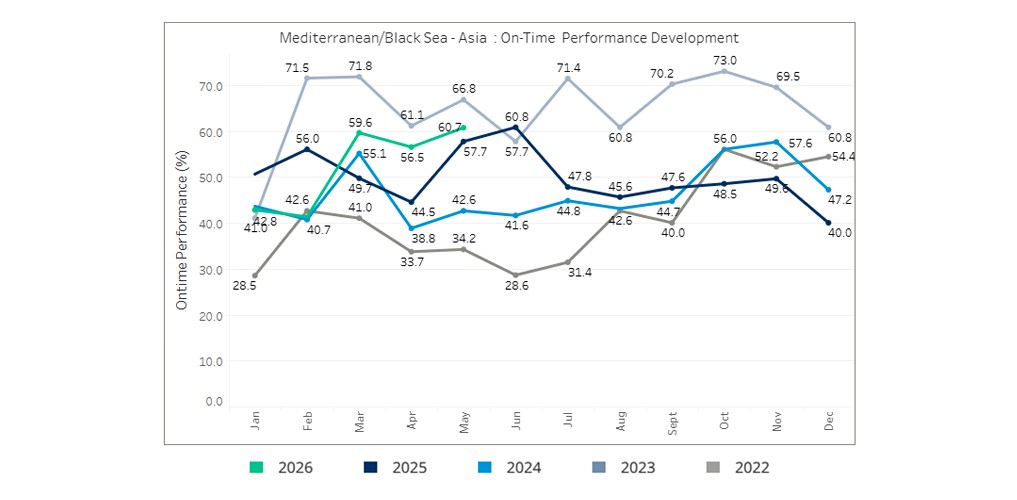
Overall, these trends point to a more stable and reliable trade lane in May.
Methodology
Calculating the on-time performance
To calculate the on-time performance of a service,Kuehne+Nagel uses vessel schedules from carrier(s) offering that service. Onlycarrier schedules that match our quality criteria are used for the schedulereliability calculation.
As carriers update schedules constantly, they become moreaccurate the closer vessels get to a destination port. For this reason, we haveimplemented a "schedule freeze period" of 14 days prior to actualvessel arrival. In other words, we benchmark the actual arrival with whatcarriers last announced 14 days earlier. To identify the actual time ofarrival, Kuehne+Nagel consumes AIS (Automatic Identification System) vesseldata. All vessels which arrive within a +/- 24-hour window at the port ofdestination compared to the last announced arrival are considered to be ontime. Port call omissions and blank sailings announced after the 14-day freezeare excluded from the calculation.
Assigning carrier services to multiple trade lanes
Many services operate on various trade lanes (e.g. a carrierservice between Asia and North Europe also calls ports in the Middle East andor the Mediterranean), and therefore carrier services may be listed in multipletrade lanes.
Definition of trade lanes
There is no common standard for the definition of tradelanes. This means, depending on the source, you will find different trade lanesas well as different regions, countries and ports assigned to a trade lane.Kuehne+Nagel has defined its own way of mapping and has assigned ports to thesetrade lanes accordingly. On-time performances of vessels are captured in ourreports on defined main trades, meaning trades moving large container volumeson vessels. Therefore, niche trades and services within one trade, called"Intra Trade" services (e.g. Intra-Asia, Intra-Europe), are currentlyout of scope.
A PDF version of this report can be found here.