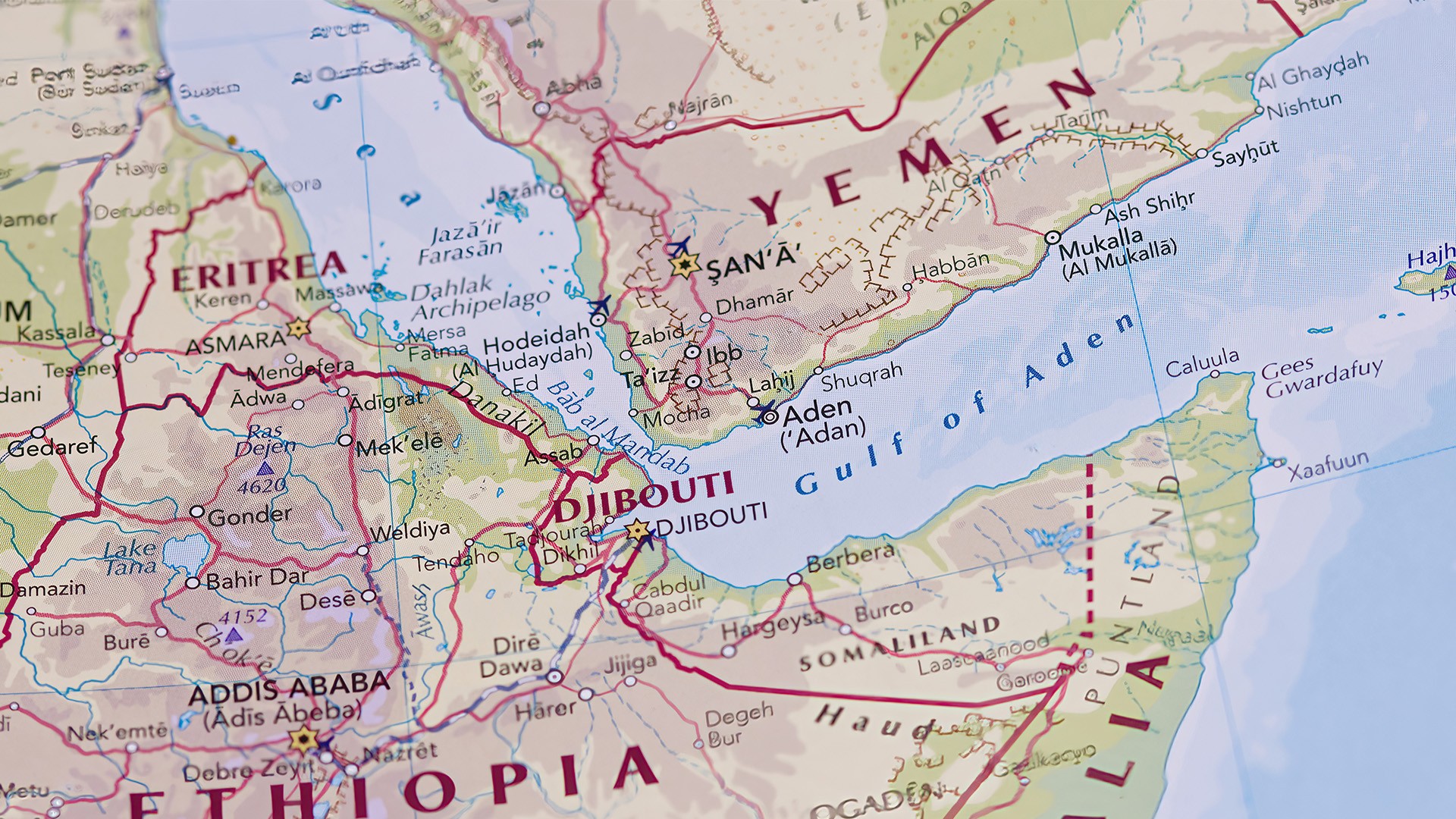

FREEDOM of navigation across the Middle East is under growing strain as geopolitical tensions choke critical maritime routes. Iran’s decision to levy payments on transiting vessels has created a model that Houthi militants may soon replicate at the Bab el Mandeb, further threatening global trade flows.
“We can say with utmost confidence that discussions have taken place about introducing toll mechanisms to shipping in the Red Sea,” said Obsidian International project director Joe Sheffer during a presentation on the Red Sea at Marine Insurance Asia 2026.
The UK-based security intelligence firm has been closely monitoring activity within the Houthi militant group. It works with governments as well as public and private sector companies to address national, community and environmental security challenges globally.
Sheffer added that these discussions within the Houthi militia have been supported by Iranian involvement and have occurred “almost certainly” at a very senior level, involving Houthi leader Abdul-Malik al-Houthi.
“While not implemented yet, they indicate an effort to formalise control over maritime traffic, rather than to be simply disruptive.”
Houthi militants have been attacking vessels crossing the Bab el Mandeb strait since November 2023, following the start of the war in Gaza. Attacks stopped late last year, following a ceasefire.
Key shipowners and operators, including container lines Maersk and CMA CGM, were beginning to return to the Red Sea with the decline in attacks. But the crisis in the Strait of Hormuz has renewed fears of Red Sea crossings as risk stays elevated.
While Sheffer sees Iranian involvement with the Houthis, he also states that the Houthis are behaving as their own entity with its own set of initiatives independent of Iran.
“They’re presenting their actions as tied to Palestine and to Yemen’s defence, and not as tasks assigned by Tehran. Outsiders may not accept this framing, but it gives the movement room to act selectively. And this is the most important point — pressure on maritime shipping can be described as conditional and political.”
Military intervention is also unlikely to resolve any attacks from the Houthis, with Sheffer pointing to August 2025’s seizure of Houthi weaponry as a mere glimpse of the advancements in the militant group’s arsenal.
“We can assume similar shipments going through and being almost certainly arrived at Hodeidah port with exactly the same equipment after this was seized.”
Sheffer also explained that the incident with HMS Diamond from the British Navy showed how military vessels could potentially be overwhelmed.
“If the Houthis did that to that kind of destroyer, there will be no way of convoying or any of the previous tactics that have worked in the Red Sea to safely allow for commercial shipping to pass through. So, it will be closed,” he said.
The intelligence expert anticipates plans to mine the Red Sea, noting his firm is already seeing signs of remotely triggered mines being placed in key shipping lanes.
A video of a floating mine was shown during his presentation. Sheffer suspects that the mine was likely planted in 2019.
But the newer mines pose a greater threat, with senior sources confirming they are far more sophisticated. Sheffer also observed evidence of renewed training with Al‑Shabaab, though the intent remains unclear.
“It could point to a broader, multifront strategy affecting the Red Sea. Alternatively, it may reflect a longer-term ambition, developing proxy capabilities in the way that mirrors the Islamic Revolutionary Guard Corps model.”
Tolls on the Bab el Mandeb strait have been previously discussed in the maritime industry, although nothing could be confirmed. These discussions date back prior to the introduction of the “Tehran toll booth”, with some players pointing out a website for payments.
And payment is where Sheffer sees the biggest hurdle with a toll system by the Houthis.
The brunt on Asia
An escalation of disruptions on the Red Sea could severely cut crude oil exports to Asia with the Middle East Gulf and Red Sea ports being closed off.
Red Sea ports have become even more crucial, with Saudi Arabia diverting crude oil from its east coast ports to the west coast using the Saudi’s East-West Pipeline.
Since attacks on the Strait of Hormuz began, exports from Red Sea ports have skyrocketed.
Vortexa data shows March crude oil liftings rising by 250% to 3.51m barrels per day compared to 1m bpd in February. April’s loadings climbed a further 32% from March to 4.62m bpd.
The rise in April loadings happened despite attacks on the pipeline.
78% of March loadings were destined for Asia, while 52% of April loadings were destined for Asia.
Freedom of navigation has also become a big talking point at Singapore Maritime Week, with attendees throughout this week wondering what could be next for Asia. Iran's toll booth system has made attendees question whether other organisations, like the Houthis, or even nations would do the same.
The Strait of Malacca was a hot talking point with foreign minister Vivian Balakrishnan on April 22 telling CNBC that the current Hormuz crisis is a “dry run” if a war broke out between China and the US.
The US Energy Information Association pegs the SOM as the chokepoint with the highest volumes of crude oil flows. It recorded 23.2m bpd flowing through in 1H25.
Indonesian finance minister Purbaya Sadewa, on April 22, suggested a possible toll on the Strait of Malacca — a thought he quickly walked back.