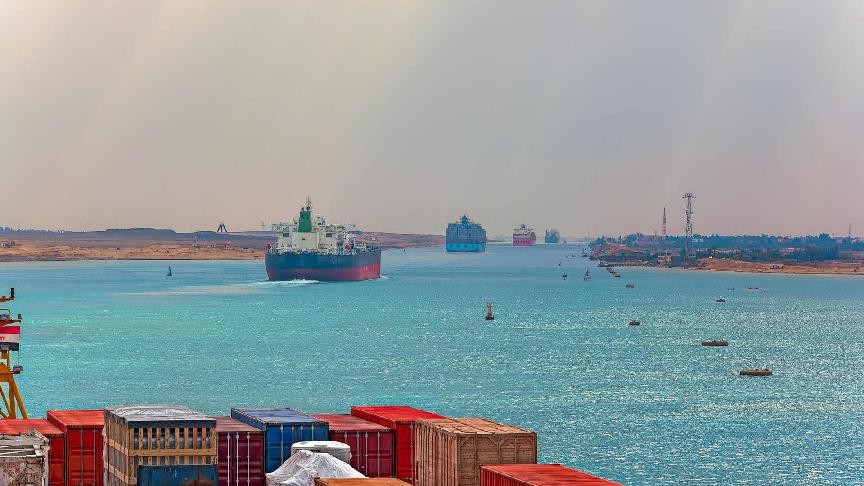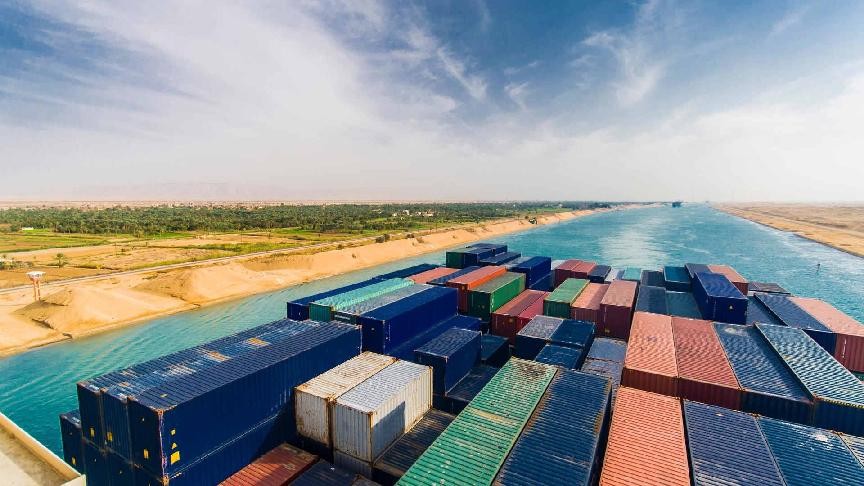

MAERSK has expanded its return to the Red Sea by restoring its Middle East-Indian Subcontinent-US East Coast service to the Suez Canal route, providing further evidence that major container carriers are cautiously testing conditions for a broader comeback after nearly three years of disruption.
The latest move comes just days after Maersk and Hapag-Lloyd confirmed that their Gemini Cooperation-operated AE15 Asia-Europe service would also return to the trans-Suez route, with the 18,000 teu Majestic Maersk (IMO: 9619919) poised to undertake the first voyage.
Maersk said the structural change to its standalone MECL service would cut westbound voyages by an average of seven days and eastbound sailings by around 14 days. The service will also add an eastbound call at Jeddah.
The first westbound trans-Suez sailing will be operated by the 6,200 teu US-flagged Maersk Denver (IMO: 9332999), while the first eastbound voyage will be undertaken by its sister vessel, fellow US-flagged Maersk Chicago (IMO: 9332975).
“This change marks a further step towards a gradual return to the trans-Suez corridor,” Maersk said.
While Maersk has framed the move as another incremental step rather than a full-scale return, it adds to mounting evidence that carriers are increasingly willing to probe the viability of Red Sea transits following months of improved security conditions.
Lloyd’s List Intelligence vessel-tracking data shows that six Maersk vessels ranging between 6,000 teu and 6,500 teu have passed through the Suez Canal since late May. The carrier has conducted a limited number of voyages through the Red Sea since then, including impromptu sailings on the MECL service, but also alongside alliance partner Hapag-Lloyd, a Maersk spokesperson confirmed to Lloyd’s List earlier this week.
The latest announcement marks a further reversal of Maersk’s position from March, when it again diverted services around the Cape of Good Hope after an earlier attempt to restore Red Sea operations.
In January, Maersk said the MECL service would resume Suez transits after successful trial voyages by the 6,500 teu Singapore-flagged Maersk Sebarok (IMO: 9315238) and again with the Maersk Denver. A month later, Maersk and Hapag-Lloyd extended the return by announcing that their ME11 Middle East-Mediterranean service would also transit the Red Sea.
However, by early March both carriers had reverted to Cape routing, citing “unforeseen constraints arising from the wider operating environment in the Red Sea region”.
The renewed return by Maersk comes amid broader signs that container operators are gradually re-entering the market, albeit selectively.
According to Lloyd’s List Intelligence data, the number of containerships above 10,000 teu transiting the Bab el Mandeb increased to 126 in the first half of 2026 from 40 during the same period a year earlier, representing a 215% increase.
The data also reveals that no ships above 16,000 teu crossed the chokepoint during the first half of 2025. But in the first six months of 2026, there were 16 transits by vessels between 16,000 teu and 19,000 teu, and seven voyages by ships exceeding 20,000 teu.
All of those ultra-large vessel transits of ships of +20,000 teu capacity were operated by CMA CGM, the only one of the top 10 container lines to maintain dedicated Suez Canal services throughout the crisis, albeit supported by French naval escorts.
The French carrier has also expanded deployments of its vessels on the route, increasing monthly transits from 14 vessels in April to 36 in June, Lloyd’s List Intelligence data shows.
Last week, the Suez Canal Authority also announced the successful transit of the 24,000 teu LNG dual-fuel CMA CGM SAINT GERMAIN (IMO: 9987201), making its maiden passage through the canal. The 2025-built vessel was sailing from Morocco to Malaysia on CMA CGM’s NEU5/FAL3 service within the Ocean Alliance network linking Asia with Europe.
Other carriers continuing to operate through the region include Italy’s Messina Line, which deploys 4,000 teu vessels between the Mediterranean, India and East Africa via the Suez Canal.
Saudi Arabia’s Folk Maritime, owned by the Public Investment Fund, also continues regular transits through the Bab el Mandeb Strait with 1,800 teu vessels serving Saudi ports and the Indian subcontinent. The carrier operates its “North Red Sea Service” in partnership with CMA CGM and an India-Gulf service under a vessel-sharing agreement with Oman’s Asyad.
Singapore-based Pacific International Lines has likewise maintained Red Sea operations, deploying 7,000 teu vessels on its “RS2” Asia-Red Sea service alongside regional feeder operations using 2,000 teu boxships.
Taiwan’s Wan Hai Lines too has maintained its FM1 Far East-Mediterranean service via the Suez Canal using 7,000 teu boxships connecting China, Malaysia, Egypt and Türkiye. The carrier also continues to deploy vessels of up to 3,000 teu on its AR2 Asia-Red Sea service through the Bab el Mandeb Strait.
Confidence returns, but cautiously
Overall container capacity transiting the Bab el Mandeb reached 5.1m teu during the first half of 2026, up 32% from 3.8m teu in the corresponding period of 2025. Second-quarter volumes increased 20.4% year on year to 2.8m teu.
Yet despite the recovery, traffic remains well below pre-crisis levels. June recorded 229 containership transits through the chokepoint, compared with 545 sailings in October 2023 before the Houthi attacks triggered widespread rerouting.
More tellingly, only seven vessels above 16,000 teu passed through the Bab el Mandeb last month, compared with more than 100 ships of above at least 18,000 teu operating on the route before the crisis.
For now, most carriers remain cautious about committing their largest vessels.
But Maersk’s decision to restore a second service to the Suez route is the latest indication that carriers are reassessing the risks of Red Sea transits. And with tensions in the Middle East Gulf flaring up again this week, a more established Red Sea network could also help maintain cargo connectivity to markets west of the Strait of Hormuz via the region’s southern landbridge. Notably, the revised eastbound MECL service includes a call at Jeddah, gaining access to Saudi Arabia’s logistics corridor.
However, any broader Red Sea return would shorten voyage distances, cut roundtrip times — particularly on the Asia-Europe trade which continues to reroute on mass around the Cape, and effectively release capacity back into the market by reducing the number of ships needed to maintain existing networks.
That would remove one of the key factors supporting freight rates since the crisis began, increasing supply (analysts pin this at up to 10% of global fleet capacity) and potentially putting downward pressure on prices, particularly if demand growth weakens.
Traffic levels remain well below pre-crisis norms, but rising transit numbers and the gradual return of larger ships suggest confidence is slowly rebuilding. Whether Maersk’s latest moves translates into a wider industry shift remains uncertain, but carriers are clearly beginning to test the waters once more.