
YET another chokepoint could join the list — alongside the Strait of Hormuz, Red Sea and Black Sea — if drought conditions return to the Panama Canal due to a predicted “Super El Niño” in late 2026.
The National Oceanic and Atmospheric Administration said on Thursday that existing El Niño conditions are “strengthening”, the chance of a “very strong” El Niño in fall and winter 2026-2027 has risen to over 90%, and there is now a 69% chance that conditions in October-November will be the most severe on record.
The Panama Canal Authority (ACP) has already announced five successive draught restrictions for the neopanamax locks, culminating in the latest reduction to 47.5 ft (14.5m) effective September 3, down from the normal level of 50 ft that prevailed before July 3.
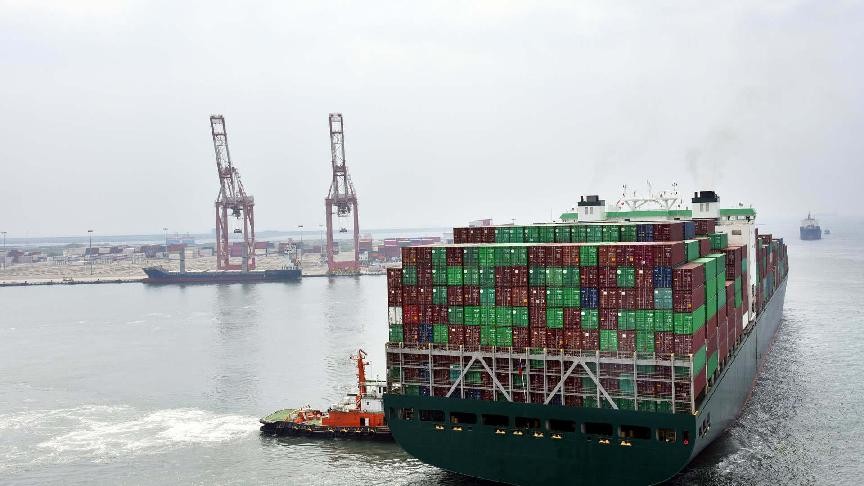
“Lower neopanamax water levels are having an impact, specifically on containerships having to carry fewer boxes, and major lines have already announced additional fees for clients utilising Panama-transiting liners, likely because of this,” Ross Griffith, head of Americas freight pricing at Argus, told Lloyd’s List.
CMA CGM will begin levying a $500 per teu surcharge for Asia-US Panama Canal transits on September 10, Hapag-Lloyd is charging $130 per teu from August 15, and MSC will charge $100 per teu from August 19 and $149 per teu from September 12. Maersk began charging $175 per teu on August 3.
Draught restrictions require liner operators to carry fewer containers. Utilisation constraints increase as draught declines, thus the surcharges.
“A carrier operating a vessel through Panama could face a combination of reduced cargo intake, higher costs per carried teu and potentially greater operational risk,” said Drewry in a report on Thursday.
So far, the effect is relatively modest. In a press briefing in 2023 during the previous drought, ACP administrator Ricaurte Vasquez Morales said that each foot of reduced draught requires 350 fewer teu to be loaded on containerships.
Reductions announced so far amount to 2.5 ft, an 875 teu reduction per transit. But if history is any indication, that may be the just the beginning.
The neopanamax draught went as low as 43.5 ft during the 2023-2024 drought, with that 6.5 ft reduction equating to a requirement for 2,275 fewer teu per transit.
The ACP currently projects that Gatun Lake water levels in mid-October will fall to the lowest level since June 24, 2024, at the tail end of the last drought crisis.
Auction prices spike again
Draught restrictions are coinciding with high demand for neopanamax transits by containerships amid the US import peak season. Executives on quarterly calls of Maersk and Hapag-Lloyd on Thursday highlighted surprisingly resilient import demand from the US.
According to ACP data*, there were 191 containership transits via the neopanamax locks in July, up 10% month on month (m/m). It was the highest monthly tally for neopanamax containerships since Lloyd’s List began tracking the data in October 2022.
Last month also saw a resurgence of neopanamax locks transits by liquefied natural gas carriers. There were 20 LNG carrier transits in July, double the number in June and the highest total since October 2023.
There were 310 total neopanamax locks transits in July, up 5% m/m.
Strong demand for Panama Canal transits has caused auction prices for booking slots to spike, according to data compiled by Argus.
The average auction price for a neopanamax locks slot rose to $2.5m in the week of August 3-9 — the highest average recorded since Argus began tracking this data in January 2024. The average auction price for a panamax locks slot jumped to $1.1m that week, also the highest average recorded.
According to Griffith, “High auction prices are coming from backlogs of vessels waiting to win at auction, which are likely raising the average number of bids on each individual auction and pushing them significantly higher.”
There were 115 vessels in the Panama Canal queue on Thursday, up from 40 at the beginning of the year, according to ACP data.
Lingering upside from Hormuz crisis
Auction prices have spiked twice before: during the 2023-2024 drought and in March-April 2026 as a consequence of the Hormuz crisis.
The effective closure of the Strait of Hormuz caused an initial scramble in Asia for replacement crude and products from the US Gulf, leading to a surge in Panama Canal tanker transits.
Tanker transits via the neopanamax locks quickly reverted to normal but panamax transits have remained unusually high, at 250 in July. That is down 22% versus May, but still the fourth-highest monthly total since at least October 2022 (excluding the March-May Hormuz crisis period, it is the highest).
There were 745 total transits of the panamax locks in July, up 10% m/m, although June’s numbers were depressed by locks maintenance.
The role of Panama’s box hubs
In response to escalating draught restrictions, containerships can either load fewer boxes in Asia, reducing utilisation, or tranship containers across the isthmus by land, a strategy that was heavily employed during the 2023-2024 drought.
The canal operates in parallel with the Panama Canal Railway (bought by Maersk last year from Canadian Pacific Kansas City), trucking connections, and five transhipment terminals, two on the Pacific side and three on the Atlantic.
The ACP is currently hoping to add two more hubs: Telfers on the Atlantic side and Corozal on the Pacific. The prequalification process closed on July 9.
The railway connects Balboa on the Pacific with MIT, CCT and Cristobal on the Atlantic. PSA International on the Pacific is on the opposite side of the canal from the railway, and uses trucking to connect to Atlantic terminals.
If there is a super El Niño, and another drought ensues, these five terminals — and the connections between them — will rise in importance.
Coincidentally, this would occur during a period when the Panama container hub business is in significant flux. There have been extreme swings in market share recently.
Balboa and Cristobal were previously operated by Hong Kong’s CK Hutchison. Panama’s Supreme Court voided the concession on January 29.
On February 24, Maersk subsidiary APM Terminals took over as operator of Balboa under an 18-month stewardship contract, and MSC subsidiary TIL took over as operator of Cristobal under the same terms.
The legal case against CK Hutchison coincided with pressure from US President Donald Trump to remove Chinese influence from Panama’s ports. CK Hutchison filed an arbitration case against the government of Panama and Maersk on April 7.
In apparent retaliation for the contract voiding, Chinese carrier Cosco and sister company OOCL ceased calls in Balboa on March 10 and shifted their business to MIT, operated by SSA Marine, and CCT, operated by Evergreen.
Port throughput statistics from the Panama Maritime Authority highlight the profound impact this had on market shares during 1H26.
Cristobal throughput plunged by 219,458 teu or 35% in 1H26 versus 1H25, and Balboa’s throughput fell by 153,786 teu or 12%.
This was clearly due to the contract change, not overall demand, as total throughput at Panama’s five transhipment hubs rose by 129,460 teu or 3%.
The big winners were MIT and CCT. Throughput at MIT surged by 302,442 teu or 23% in 1H26 versus 1H25. CCT’s throughput rose by 161,972 teu or 20%.
PSA International’s volume also rose, up 38,290 teu or 5%.
However, monthly data shows that both APM Terminals and TIL have bounced back from their earlier struggles. By June, throughput at both Balboa and Cristobal had returned to historical levels.
Balboa, in particular, would gain in importance if the forecast for a super El Niño proves correct.
If so, restrictions would require large-scale transhipment of containers from Balboa to Atlantic terminals. Maersk would be in prime position as both interim operator of Balboa and owner of the Panama Canal Railway.
In January 2024, during the last drought, Maersk implemented a “land bridge” Asia-US service that did not transit the canal but instead dropped off containers in Balboa, brought them by rail to MIT, then reloaded them on another vessel for final delivery. History may repeat itself.
*The ACP does not release monthly transit statistics by segment or statistics on total monthly transits. It releases fiscal-year-to-date transits by segment and fiscal-year-to-date total transits since October, the beginning of its fiscal year. Lloyd’s List calculates monthly transits by comparing each month’s cumulative fiscal-year-to-date statistics.