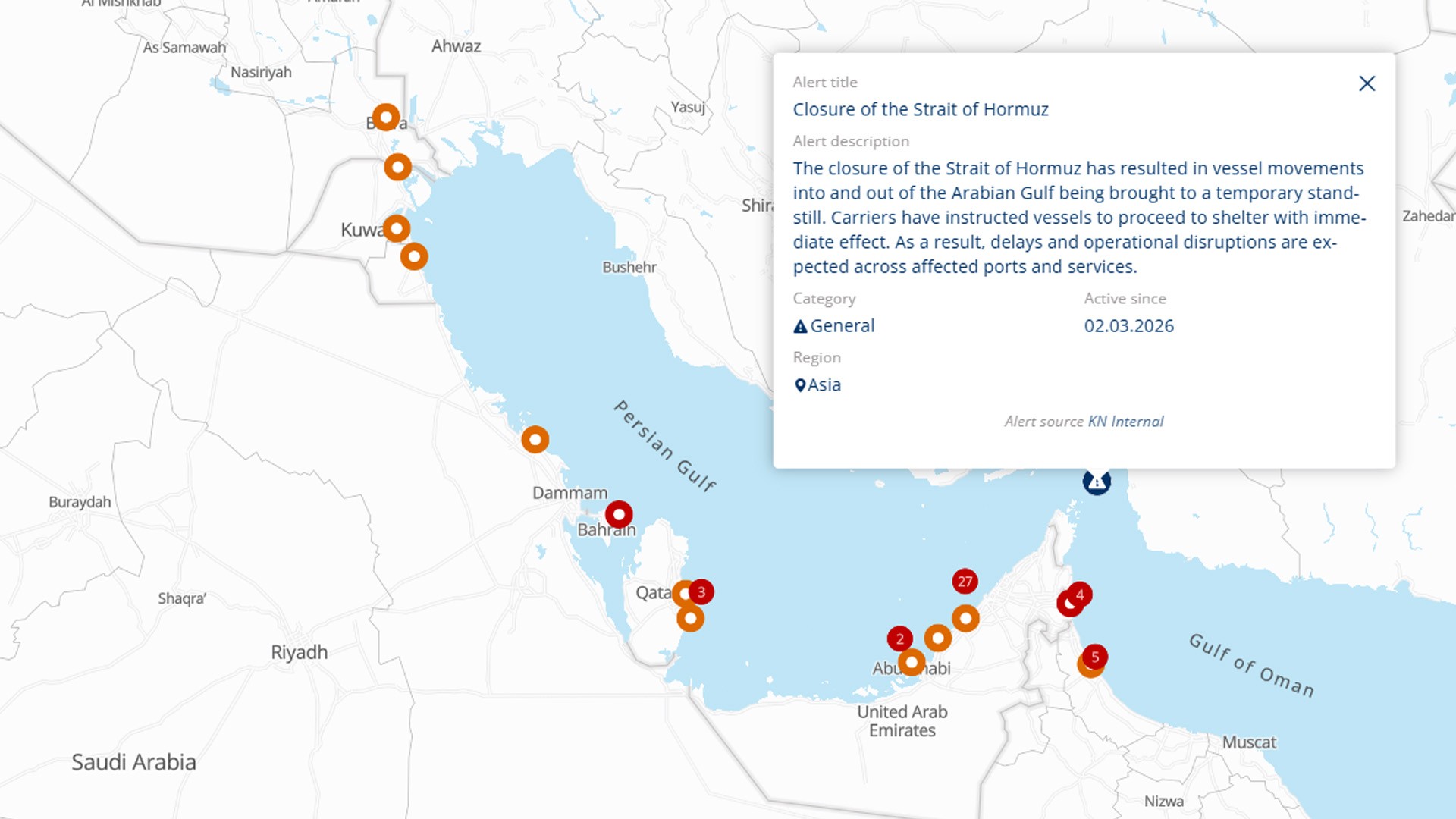

The ongoing closure of the Strait of Hormuz has created a highly unusual situation for global container shipping. While disruptions linked to port congestion or vessel waiting times are typically captured quickly by standard monitoring tools, the current situation in the Persian Gulf requires a different analytical lens.
Why the seaexplorer Disruption Indicator does not yet show the full impact
During the Covid-19 pandemic, the seaexplorer Disruption Indicator provided an accurate reflection of global port congestion, as vessels were bunching up in front of ports worldwide. In the current scenario, however, additional information must be consulted to obtain a comprehensive understanding, since the disruption indicator alone may not capture flow interruptions like those occurring in the Persian Gulf.
Kuehne+Nagel’s seaexplorer Disruption Indicator focuses on container vessels waiting at anchorage areas at the world’s top 45 ports. This methodology is well-suited to detecting congestion-driven disruptions, where vessels queue outside ports while awaiting berth availability or clearance.
The Strait of Hormuz closure, however, represents a flow interruption rather than a port congestion event. At present, no container vessels can transit into or out of the Persian Gulf. As a consequence, no new container vessels are arriving at Persian Gulf ports, and anchorage queues there are not building up as usual. The anchorage area off Jebel Ali, for example, currently shows only one container vessel waiting, a figure that would normally suggest minimal disruption. In the current context, however, this impression is misleading.
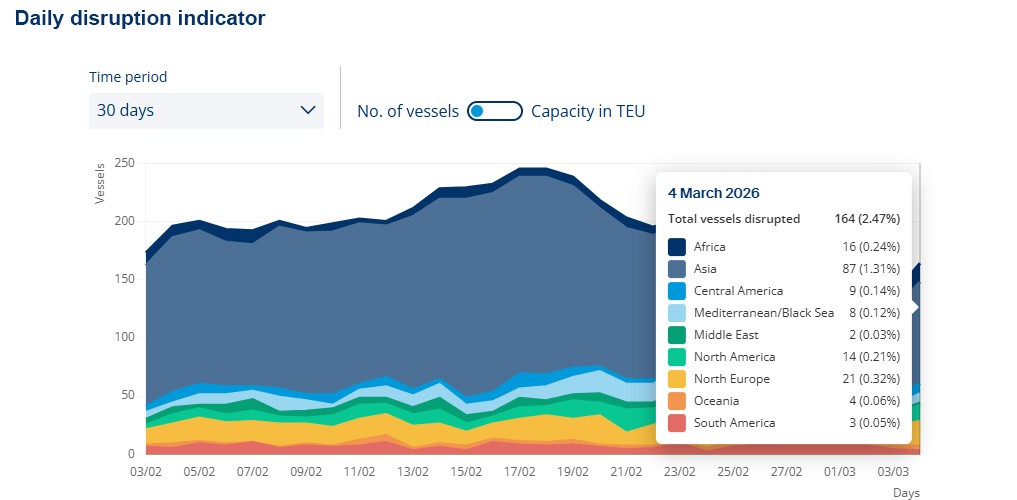
Global port congestions not yet visible - Vessels waiting at top 45 ports
The reality: 130 container vessels effectively immobilised
When the analysis moves beyond anchorage data and instead focuses on overall vessel positions, a very different picture emerges. Approximately 130 container vessels are currently locked inside the Persian Gulf, accounting for around 2% of the global container fleet. These vessels are unable to exit the region to continue their rotations, cannot be replaced by inbound vessels, and cannot reposition to alternative trades. Because vessels cannot move either into or out of the Persian Gulf, this number is expected to remain largely static until transits through the Strait of Hormuz resume.
In effect, the Persian Gulf has become a temporary container shipping cul-de-sac, removing a meaningful portion of global container capacity from active circulation.
Operational uncertainty: Wait, divert, or discharge elsewhere?
For vessels originally scheduled to call Persian Gulf ports but that have not yet entered the region, carriers now face difficult operational decisions. Some vessels may remain waiting outside the region until there is greater clarity on when the Strait of Hormuz might reopen. Others may be diverted to alternative ports, where cargo intended for Persian Gulf destinations could be discharged at intermediate hubs. In some cases, carriers may be forced to reconfigure services entirely, skipping Gulf calls and reshuffling rotations.
Each of these options carries operational, contractual, and cost implications, particularly for cargo with strict destination requirements.
Where the disruption will become visible next
Although the disruption is currently not visible in Persian Gulf anchorage statistics, it is likely to surface elsewhere in the global network. As vessels are forced to wait or reposition, anchorage areas outside the Persian Gulf, particularly major transhipment hubs such as Singapore, may begin to fill up. Once this happens, the secondary congestion will start to appear in the seaexplorer Disruption Indicator. The indicator will therefore reflect the knock-on effects of the Strait of Hormuz closure rather than the initial cause itself, meaning the disruption is likely to show up with a delay and at a distance from the original chokepoint.
What this means for capacity and schedules
The temporary immobilisation of roughly 2% of the global container fleet has several implications for the wider market. Effective vessel supply is reduced on affected east–west and regional trades, while schedule reliability risks increase even on lanes that do not directly serve the Middle East. Equipment availability may also come under pressure, as containers remain stranded inside the Persian Gulf for an extended period. If the disruption persists, these factors could ultimately translate into upward pressure on freight rates.
In addition, we will most likely also see increases in transit times, especially on the Asia-Europe trade lane. These longer transit times are expected to become visible soon in seaexplorer’s Dashboard, particularly in the weekly median transit time developments.
Outlook: A static situation until transit resumes
Unlike congestion-driven disruptions, where queues gradually build and then unwind, the situation in the Strait of Hormuz is essentially binary. As long as the Strait remains closed, the number of container vessels in the Persian Gulf will not change materially. Meaningful resolution will only occur once safe transits resume. At that point, a sudden release of capacity could itself trigger secondary congestion effects at downstream ports.
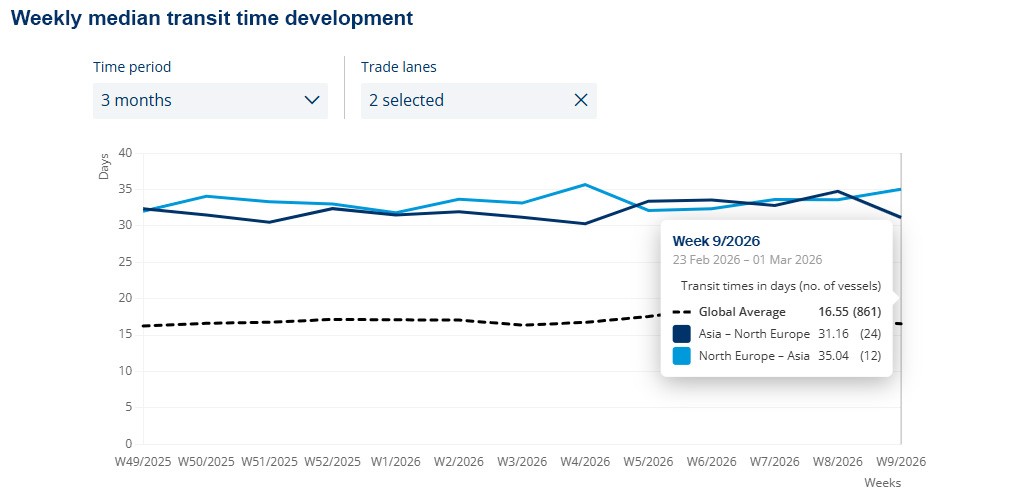
The median tranist time between Asia and North Europe may increase in the upcoming weeks
Key takeaway
The absence of visible congestion at Persian Gulf ports should not be mistaken for a lack of disruption. The current closure of the Strait of Hormuz has effectively removed a significant block of container capacity from global circulation. While this is not yet reflected in anchorage-based indicators, the impact is real and is likely to become increasingly visible at alternative waiting locations and transhipment hubs in the coming weeks.