
- As a leader in sea logistics, Kuehne+Nagel closely tracks and collects data on the movement of vessels, including actual arrivals and vessel delays.
- A summary of this analysis, based on neutral data, is published monthly in our Schedule Reliability Report, available on Sea News.
Executive summary
Global Reliability
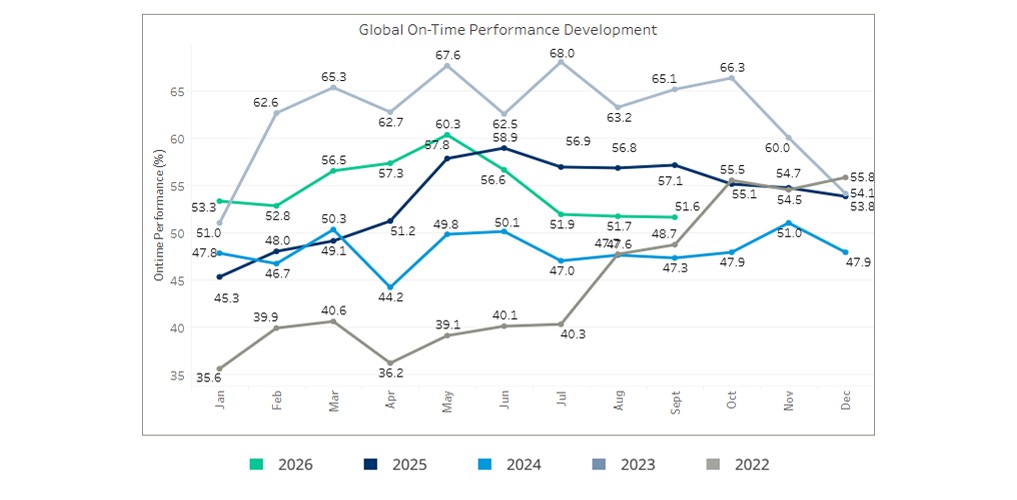
Global schedule reliability remained broadly stable in September at 51.6%, compared with 51.7% in August, following the sharp deterioration recorded in June and July.
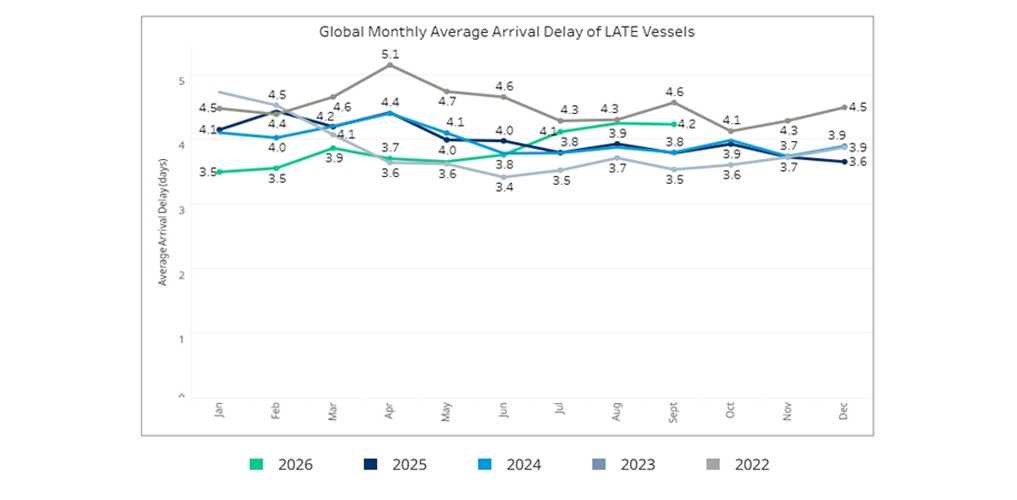
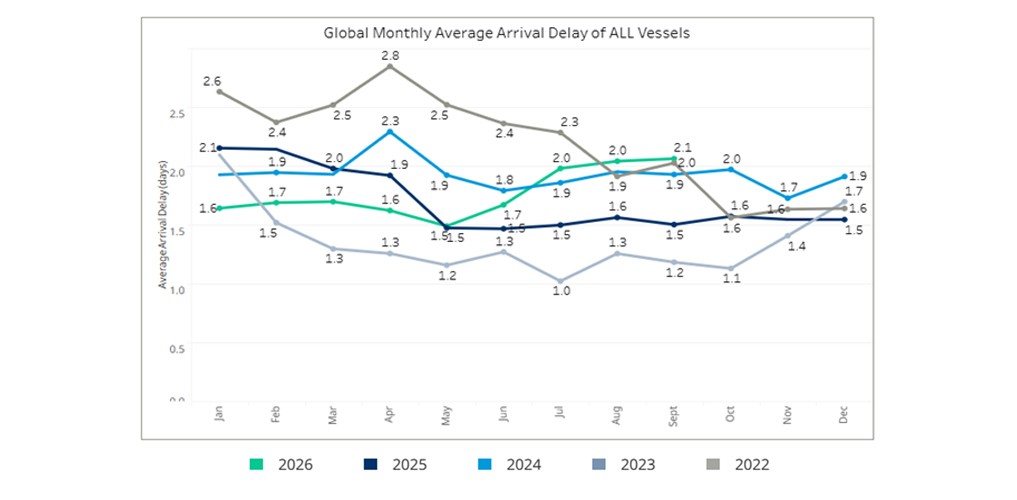
Average arrival delays increased slightly during September, reaching 4.2 days for LATE vessels and 2.1 days across ALL vessels.
While the overall share of vessels arriving on time changed only marginally, vessels continued to experience elevated delays, providing little evidence of a broader recovery in arrival performance.
Trade Performance
Trade-lane performance improved broadly in September, with 13 of the 20 corridors recording MoM gains, compared with nine in August.
The strongest September result was recorded on Mediterranean/Black Sea ↔ South America West Coast at 93.2%.
The weaker results remained concentrated across several Asia-linked trades. Asia ↔ South America East Coast fell a further 5.8 points to 34.5%, while Asia ↔ North Europe declined 3.4 points MoM to 38.3%.
Featured Trade
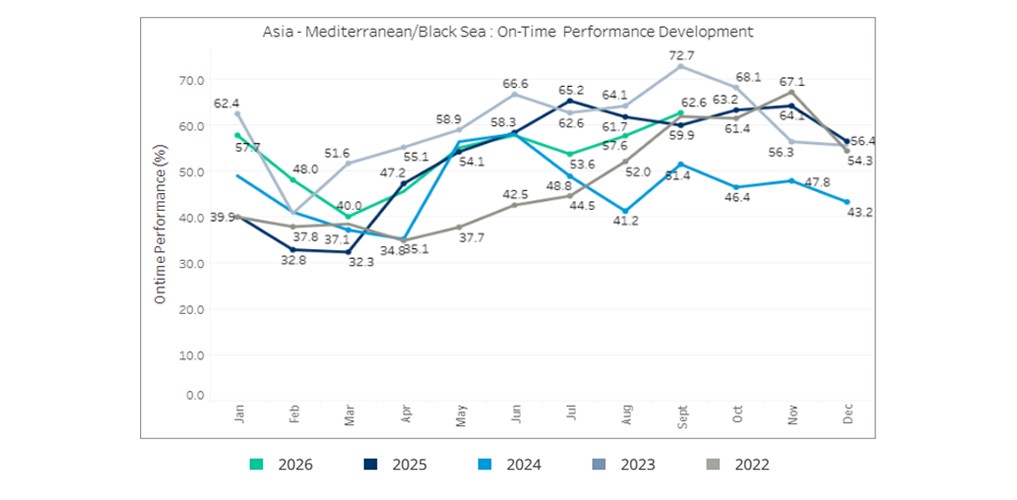
Asia ↔ Mediterranean/Black Sea continued to weaken in September, with on-time performance declining from 44.2% in August to 42.4%.
This result masked a clear difference between directions. Asia → Mediterranean/Black Sea reached 62.6%, while the backhaul recorded only 29.1%, leaving a 33.5 percentage-point gap between the two directions.
The weaker backhaul reliability was accompanied by higher arrival delays, averaging 4.8 days for LATE vessels and 3.2 days across ALL vessels.
Global on-time performance
Following the sharper decline in June and July, global schedule reliability has changed only marginally over the past two months. September remained below the stronger performance recorded earlier in 2026, with no clear upward movement yet visible.
Average arrival delays edged higher despite broadly stable on-time performance. LATE-vessel delay increased to 4.2 days, while the average across ALL vessels rose to 2.1 days, indicating limited improvement in overall arrival performance.
Reliability per tradelane
Tradelane performance improved more broadly in September, with 13 of 20 corridors recording MoM gains, compared with nine in August.
Mediterranean/Black Sea ↔ South America West Coast led at 93.2%, following a 17.4 percentage-point increase, while Asia ↔ South America East Coast declined to 34.5%, the lowest September result.
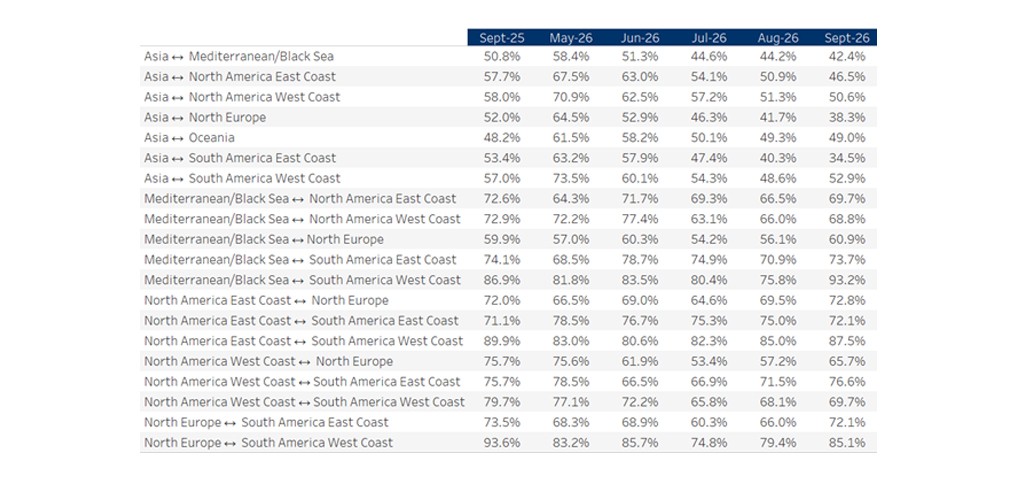
Despite the broader improvement, weakness remained concentrated across Asia-linked trades. Six of the seven Asia-linked corridors declined MoM, with only Asia ↔ South America West Coast improving.
The YoY picture was also weaker across most Asia-linked trades, particularly Asia ↔ South America East Coast, Asia ↔ North Europe and Asia ↔ North America East Coast.
Reliability on Asia↔Mediterranean/Black Sea
Asia ↔ Mediterranean/Black Sea reliability declined for a fourth consecutive month, falling 1.8 percentage points to 42.4% in September. Performance was also 8.4 percentage points below September 2025.
Reliability has now fallen from 58.4% in May to 42.4% in September, a decline of 16.0 percentage points over four months.
However, the overall result conceals contrasting directional performance, with a stronger Asia headhaul performance offset by continued weakness on the Mediterranean/Black Sea → Asia backhaul.
Headhaul
Asia → Mediterranean/Black Sea reliability improved to 62.6% in September, making the headhaul materially more reliable than the reverse direction.
The stronger on-time result was accompanied by lower average delays: 3.2 days for LATE vessels and 1.3 days for ALL vessels.
Backhaul
Reliability of the vessels returning to Asia declined to 29.1% in September, leaving the backhaul substantially below the 62.6% recorded on the headhaul.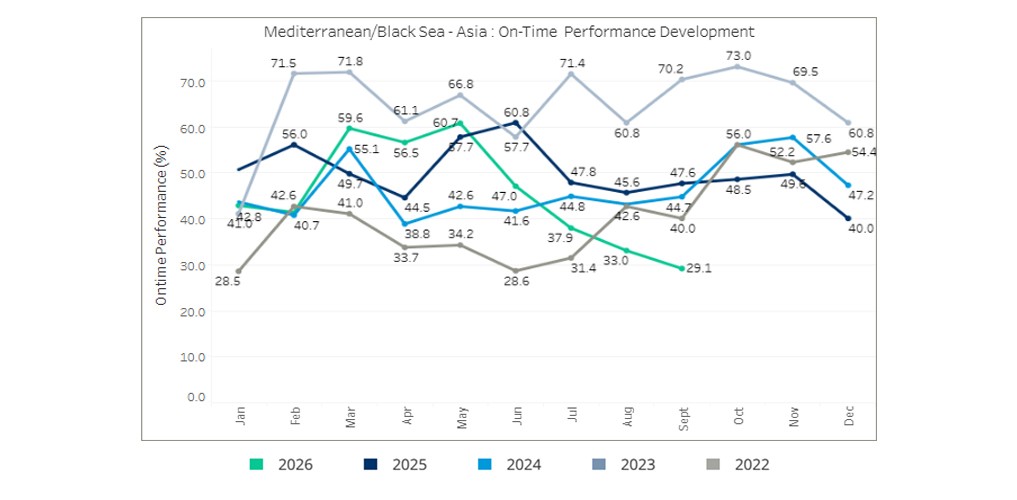
LATE vessels arrived an average of 4.8 days behind schedule, unchanged from August, while average delay across ALL vessels also remained unchanged at 3.2 days. Indicating a larger share of vessels arrived LATE in September compared with August.
Methodology
Calculating the on-time performance
To calculate the on-time performance of a direct service, Kuehne+Nagel uses carrier-published vessel schedules. Only schedules that meet our quality criteria are included in the analysis. As carriers continuously update schedules, announced arrival times typically become more accurate as a vessel approaches its destination.
To ensure a consistent comparison, a 14-day schedule freeze period is applied prior to arrival. Actual vessel arrivals are therefore benchmarked against the last announced schedule published 14 days before the vessel reaches the destination port. Actual arrival times are determined using AIS (Automatic Identification System) vessel tracking data. A vessel is considered on time if it arrives within a ±24-hour window of the last announced arrival time.
Scope of the analysis
This report focuses exclusively on direct container services operated by the twelve largest global carriers: MSC, Maersk, CMA CGM, COSCO, OOCL, Hapag-Lloyd, ONE, Evergreen, HMM, ZIM, Yang Ming and PIL.
The analysis measures vessel schedule reliability and does not represent overall container lead-time reliability. Additional factors, including transhipment delays, intermodal transfers, port congestion and terminal operations, may affect the total transit time experienced by customers.
Assigning services to trade lanes
Many liner services operate across multiple regions and may call at ports in more than one trade lane e.g. a carrier service between Asia and North Europe also calls ports in the Middle East and/or the Mediterranean), As a result, an individual service may be included in multiple trade-lane analyses.
Low-frequency port outliers, defined as having fewer than 10% of the service’s median number of calls, are excluded from the reliability calculation.
Trade-lane definitions
There is no industry-wide standard for defining trade lanes. Kuehne+Nagel therefore applies its own trade-lane mapping methodology, assigning individual ports to trades based on a consistent internal framework.The report focuses on the principal East-West and North-South container trades. Niche and intra-regional services, such as Intra-Asia and Intra-Europe trades, are currently outside the scope of the analysis.
A PDF version of this report can be found here.