
- As a leader in sea logistics, Kuehne+Nagel closely tracks and collects data on vessel movements, including actual arrivals and delays.
- A summary of this analysis, based on neutral data, is published monthly in our Schedule Reliability Report, available on Sea News.
Executive Summary
Global schedule reliability continued to improve in April, reaching 57.3%, an increase of 0.7 percentage points month on month and 6.1 percentage points compared with April 2025.
Vessel arrival performance also strengthened, with shorter delays for LATE-arriving vessels (3.6 days) and stable performance across ALL vessels (1.6 days), indicating gradual improvement.
At trade‑lane level, performance was mixed, with improvements concentrated on long‑haul East–West routes.
The North America West Coast ↔ North Europe lane recorded the strongest month‑on‑month rebound, while Asia ↔ North America East Coast and Asia ↔ North Europe also delivered solid gains.
Asia–South America trades continued to stand out year‑on‑year, with both East Coast and West Coast lanes recording improvements of more than 18 percentage points, confirming sustained recovery on these routes.
Featured trade lane – Asia ↔ South America East Coast
Headhaul performance strengthened significantly, reaching the highest levels observed on this trade in recent years, while backhaul reliability stabilised following a strong recovery earlier in the year.
Although arrival delays for LATE vessels remain elevated, overall performance has materially improved.
Global On-Time Performance
After March’s notable improvement, global schedule reliability strengthened further in April, reaching 57.3%, an increase of 0.7 percentage points month-on-month.
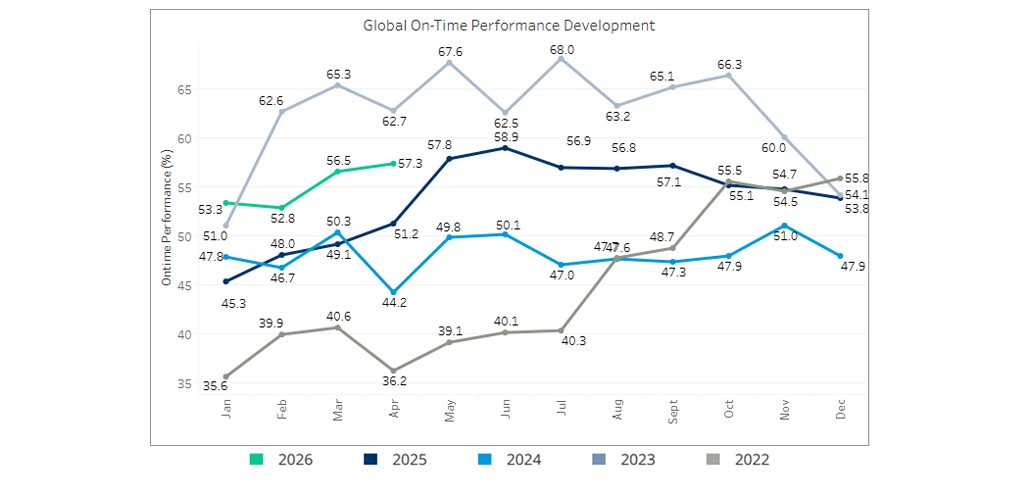
Compared with April 2025, this is an improvement of 6.1 percentage points.
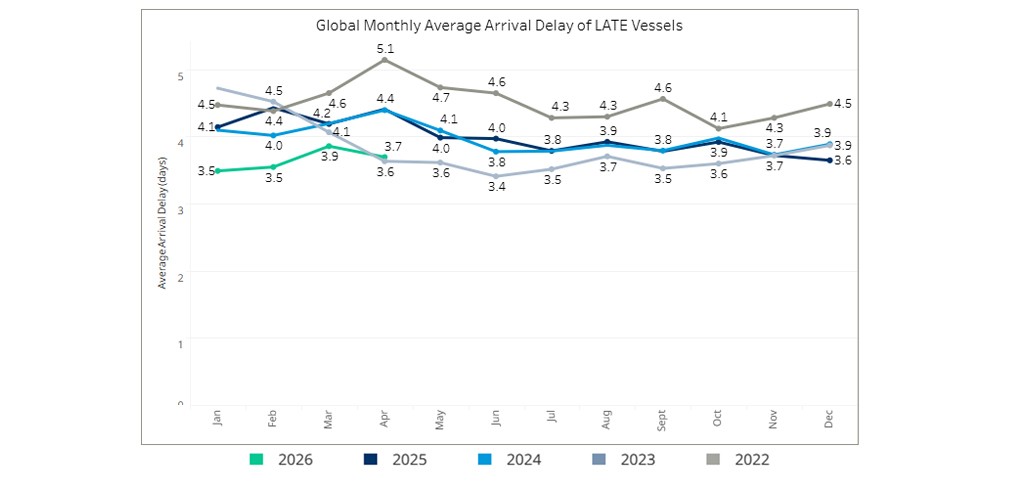
LATE vessels arrived an average of 3.7 days behind schedule, improving by 0.3 days versus March.
On a year-on-year basis, delays for LATE vessels are 0.7 days shorter in 2026.
Across ALL vessels, the average arrival delay was 1.6 days, a 0.1-day month-on-month reduction.
Reliability per Trade Lane
Reliability across the major tradelanes showed mixed performance in April, with improvements concentrated on East–West routes.
The strongest month‑on‑month improvement was recorded on North America West Coast ↔ North Europe, which rebounded sharply, rising by 16.3 percentage points following a weaker performance in March.
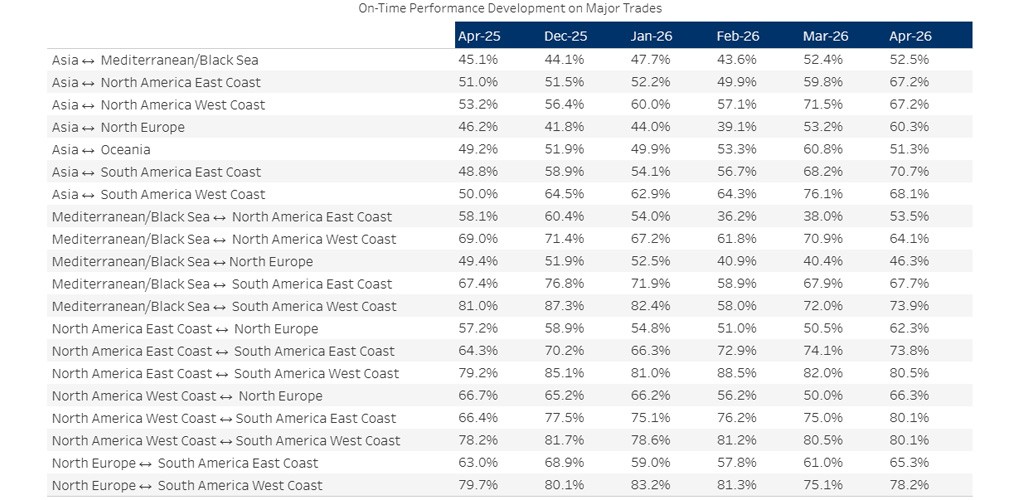
Asia ↔North America East Coast and Asia ↔North Europe also delivered solid gains, increasing by 7.4 and 7.1 percentage points, respectively.
Asia ↔ North America East Coast and Asia ↔ North Europe also delivered solid gains, increasing by 7.4 and 7.1 percentage points, respectively.
Reliability on Asia ↔ South America East Coast
This month’s spotlight trade is Asia ↔ South America East Coast, which has shown consistent improvement since the start of the year.
In April, reliability reached 70.7%, increasing by a further 2.5 percentage points month on month. More notably, this trade recorded the strongest year‑on‑year improvement across all lanes, rising by 21.9 percentage points in April.
From an arrival perspective, LATE vessels arrived with an average delay of 3.3 days, while overall schedule performance shows that ALL vessels arrived 1.1 days later than planned.
Southbound
The figure below highlights a sharp upward shift in headhaul performance during April, with reliability increasing by 7.3 percentage points over the month. This rebound played a central role in lifting overall trade‑lane performance.
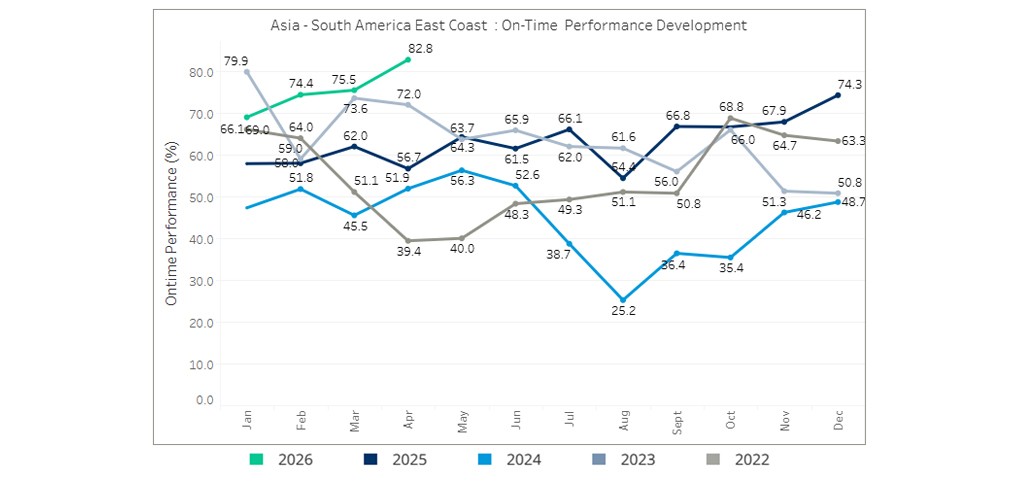
On a year‑on‑year basis, the turnaround is even more pronounced. Reliability improved by 30.2 percentage points compared with April 2025, positioning April 2026 as the strongest result recorded for this trade in recent years.
Average delays among LATE-arriving vessels eased to 3.3 days, while overall arrivals remained stable, with ALL vessels averaging a 0.7‑day delay against schedule.
Northbound
Backhaul performance stabilised following a strong recovery in Q1. Reliability peaked at 62.0% in March before easing marginally to 61.2% in April.
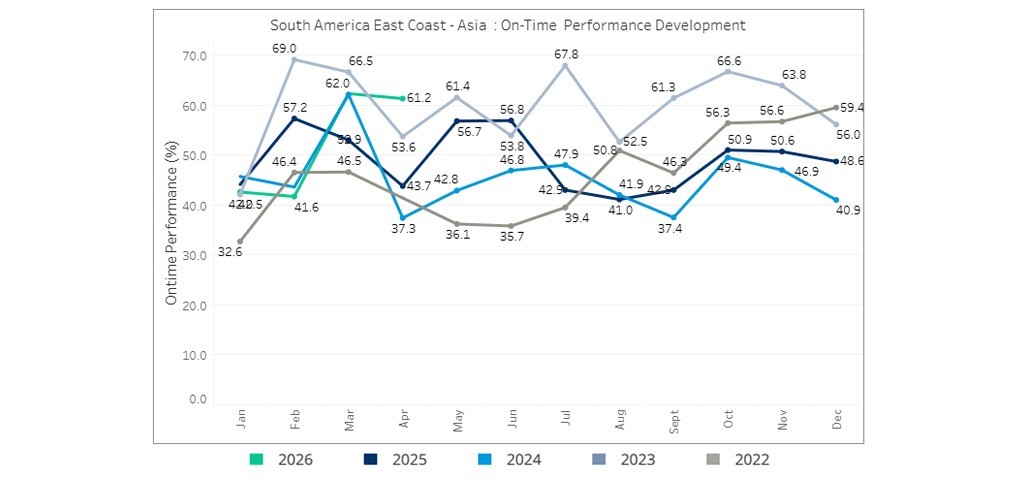
The sharp recovery from the low point in January continues to drive a strong year‑on‑year comparison, with reliability improving by 17.5 percentage points in April.
The average delay for LATE vessels increased by 0.1 days to 3.3 days, while delays across ALL vessels also rose by 0.1 days to 1.3 days.
Methodology
Calculating the on-time performance
To calculate the on-time performance of a service, Kuehne+Nagel uses vessel schedules from carrier(s) offering that service. Only carrier schedules that match our quality criteria are used for the schedule reliability calculation.
As carriers update schedules constantly, they become more accurate the closer vessels get to a destination port. For this reason, we have implemented a "schedule freeze period" of 14 days prior to actual vessel arrival. In other words, we benchmark the actual arrival with what carriers last announced 14 days earlier. To identify the actual time of arrival, Kuehne+Nagel consumes AIS (Automatic Identification System) vessel data. All vessels which arrive within a +/- 24-hour window at the port of destination compared to the last announced arrival are considered to be on time. Port call omissions and blank sailings announced after the 14-day freeze are excluded from the calculation.
Assigning carrier services to multiple trade lanes
Many services operate on various trade lanes (e.g. a carrier service between Asia and North Europe also calls ports in the Middle East and or the Mediterranean), and therefore carrier services may be listed in multiple trade lanes.
Definition of trade lanes
There is no common standard for the definition of trade lanes. This means, depending on the source, you will find different trade lanes as well as different regions, countries and ports assigned to a trade lane. Kuehne+Nagel has defined its own way of mapping and has assigned ports to these trade lanes accordingly. On-time performances of vessels are captured in our reports on defined main trades, meaning trades moving large container volumes on vessels. Therefore, niche trades and services within one trade, called "Intra Trade" services (e.g. Intra-Asia, Intra-Europe), are currently out of scope.
A PDF version of this report can be found here.