

- As a leader in sea logistics, Kuehne+Nagel closely tracks and collects data on vessel movements, including actual arrivals and vessel delays.
- A summary of this analysis, based on neutral data, is published monthly in our Schedule Reliability Report, available on Sea News.
Executive Summary
Global schedule reliability improved in March, increasing by 3.8 percentage points to 56.6%, in line with seasonal trends observed in previous years.
Performance was also 7.5 percentage points higher year on year, indicating a broader recovery compared with March 2025.
The average arrival delay for LATE vessels increased (3.9 days), while delays across all vessels remained stable (1.7 days).
Trade‑lane performance showed wide variation, ranging from 38.0% to 82.0%. Most trades recorded improvements in March, with the strongest gain observed on Asia ↔ North America West Coast, while North America East Coast ↔ South America West Coast remained the most reliable.
Year‑on‑year comparisons highlighted double‑digit improvements across several major trades, reinforcing the overall positive trend despite ongoing volatility.
Featured trade lane – Asia ↔ Middle East
The Asia ↔ Middle East trade experienced significant disruption in March following the closure of the Strait of Hormuz, which constrained port access and disrupted vessel schedules.
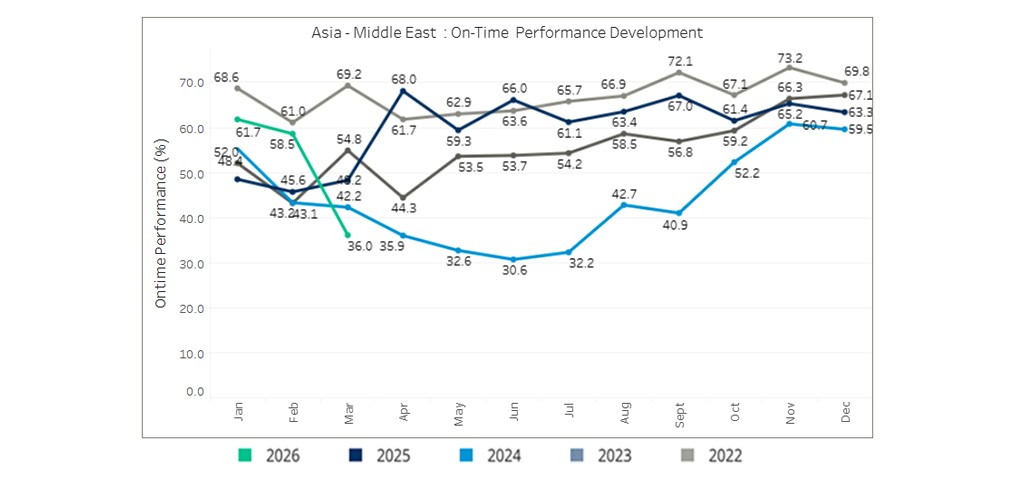
Reliability on the headhaul trade declined sharply, falling to 36.0%, accompanied by extended transit times and rising arrival delays.
Seaexplorer data shows that average transit times nearly doubled over the course of March, while arrival delays increased both within the month and on a rolling 30‑day basis.
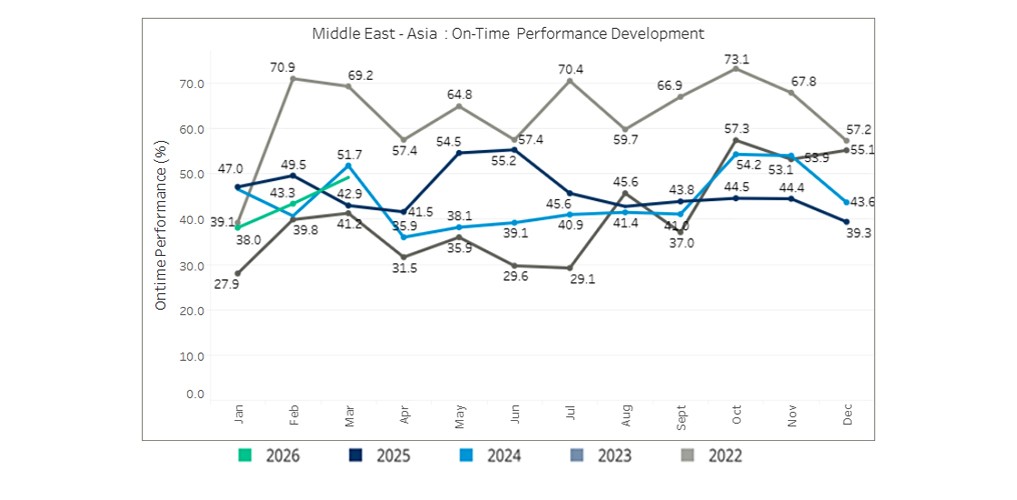
Backhaul performance strengthened in March, with reliability rising to 49.1%, supported by both month‑on‑month and year‑on‑year gains.
Nevertheless, operational constraints at key ports persisted, particularly at Jeddah and Salalah, where departure delays increased, signalling continued pressure on network execution.
Although carriers deployed Landbridge and alternative routing solutions to maintain cargo flows, the data indicates that these measures introduced additional complexity and delay.
Global On-Time Performance
Schedule reliability increased by 3.8 percentage points in March, reaching 56.6%.
This improvement follows a recurring seasonal pattern observed in previous years, during which performance typically improves.
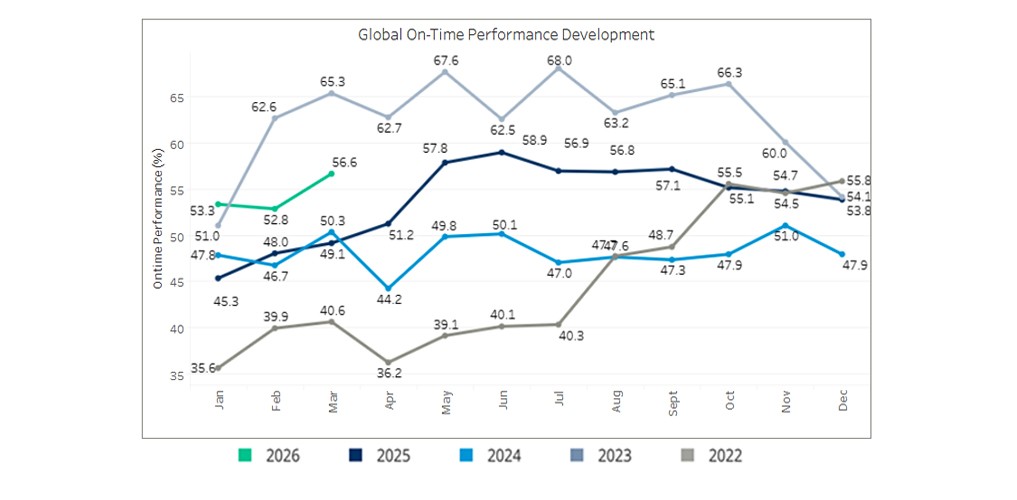
On a year‑on‑year basis, schedule reliability was 7.5 percentage points higher, highlighting a meaningful improvement compared with the same month last year.
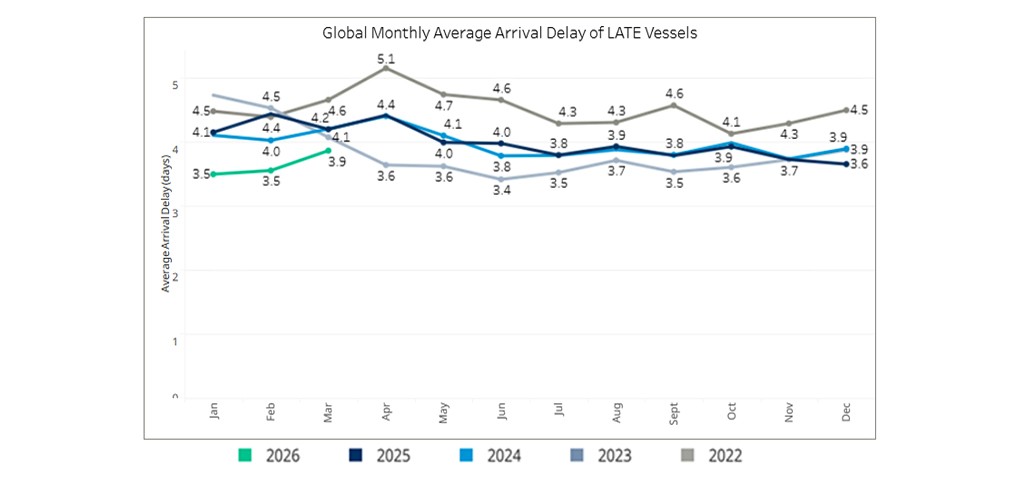
Despite the improvement in on‑time performance, the average arrival delay for LATE vessels increased by 0.4 days to 3.9 days.
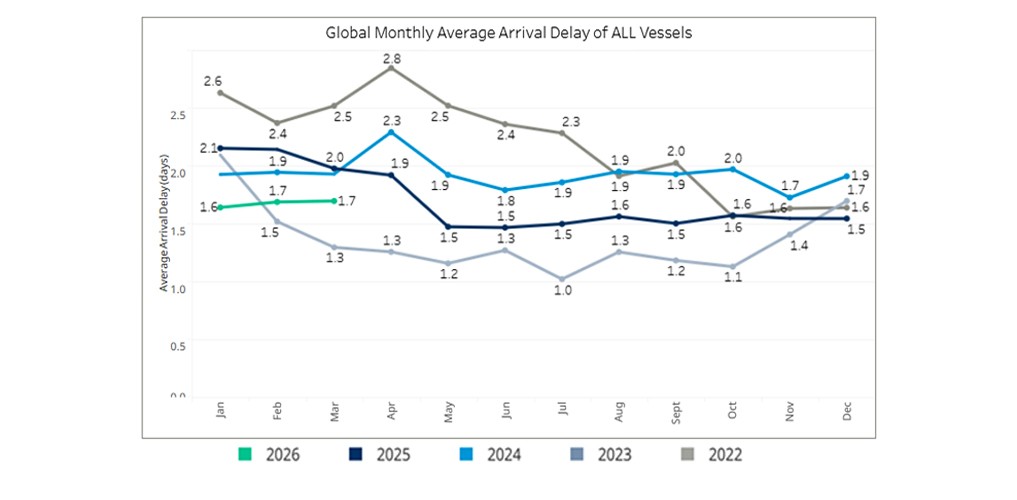
In contrast, the average arrival delay across all vessels remained stable at 1.7 days.
Reliability per Trade Lane
In March, trade performance ranged from 38.0% to 82.0. Thirteen trades recorded month-on-month gains between 1.2 and 14.4 percentage points, while the remaining trades experienced modest declines of -6.5 to -0.5 percentage points.
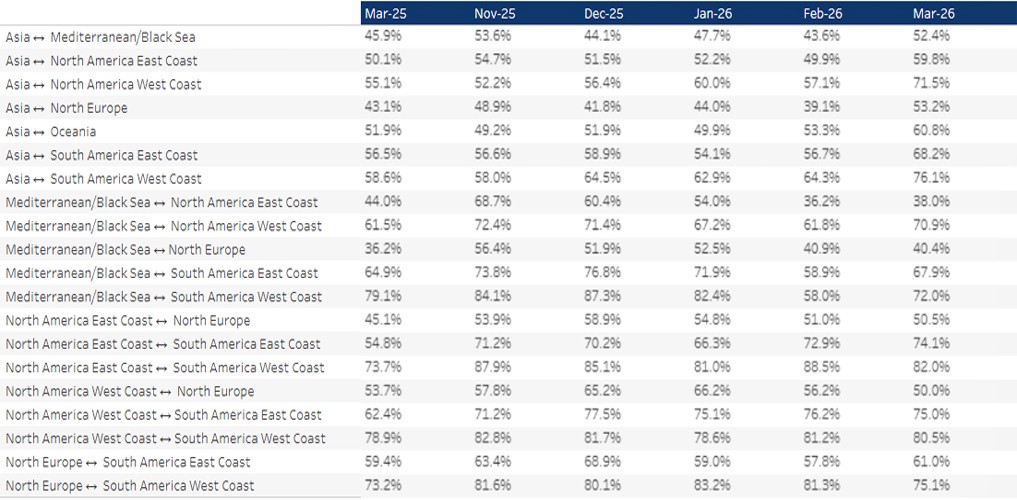
Although the North America East Coast ↔ South America West Coast trade was the most reliable at 82.0%, the Asia ↔ North America West Coast trade delivered the strongest improvement, increasing to 71.5%.
On a year-on-year basis, most trades showed significant gains, with the largest improvement observed on the North America East Coast ↔ South America East Coast route.
Reliability on Asia ↔ Middle East
Since late February, escalating conflict in the Middle East has led to the closure of the Strait of Hormuz, significantly disrupting vessel operations and restricting calls at several key ports across the region. As a result, schedule reliability and transit times on affected trades have come under increased pressure.
In response, carriers have implemented Landbridge and multimodal solutions via alternative gateways, including Jeddah, Sohar, Salalah, Aqaba, Khor Fakkan, and Fujairah, to maintain cargo flows to impacted markets.
The following section examines the Asia ↔ Middle East trade, assessing the impact of these disruptions on schedule reliability and related performance metrics.
Asia → Middle East
As shown in the figure below, schedule reliability deteriorated sharply in March, falling to 36.0% from 58.5% in February. This decline was accompanied by a notable increase in delays, with the average arrival delay for LATE vessels rising to 3.9 days, while delays across ALL vessels increased to 2.5 days.
seaexplorer data further indicates a significant extension in transit times over the course of the month for this direction.
Average transit time increased from 13.28 days in early March to 23.65 days by week 13 (23–29 March).
Overall delays also worsened, with average arrival delays in Jeddah increasing from 1.99 days to 2.32 days during March and reaching 2.49 days on a rolling 30‑day basis.
Middle East → Asia
On the backhaul, reliability was 49.1% in March, a 5.8 percentage-point increase from February and a 6.2 percentage-point gain year-on-year.
The average arrival delay for LATE vessels increased by 0.2 days, while for ALL vessels, delays were stable at 1.9 days.
Operational challenges were particularly evident at key origin ports. Average departure delays from Jeddah were 2.48 days in March, up from 1.98 days in February, with 77% of vessels departing later than scheduled in the last 30 days.
At Salalah, the average departure delay increased to 4.07 days, compared with 2.57 days in February, while arrival delays climbed to 3.73 days over the last 30 days.
Methodology
Calculating the on-time performance
To calculate the on-time performance of a service, Kuehne+Nagel uses vessel schedules from carrier(s) offering that service. Only carrier schedules that match our quality criteria are used for the schedule reliability calculation.
As carriers update schedules constantly, they become more accurate the closer vessels get to a destination port. For this reason, we have implemented a "schedule freeze period" of 14 days prior to actual vessel arrival. In other words, we benchmark the actual arrival with what carriers last announced 14 days earlier. To identify the actual time of arrival, Kuehne+Nagel consumes AIS (Automatic Identification System) vessel data. All vessels which arrive within a +/- 24-hour window at the port of destination compared to the last announced arrival are considered to be on time. Port call omissions and blank sailings announced after the 14-day freeze are excluded from the calculation.
Assigning carrier services to multiple trade lanes
Many services operate on various trade lanes (e.g. a carrier service between Asia and North Europe also calls ports in the Middle East and or the Mediterranean), and therefore carrier services may be listed in multiple trade lanes.
Definition of trade lanes
There is no common standard for the definition of trade lanes. This means, depending on the source, you will find different trade lanes as well as different regions, countries and ports assigned to a trade lane. Kuehne+Nagel has defined its own way of mapping and has assigned ports to these trade lanes accordingly. On-time performances of vessels are captured in our reports on defined main trades, meaning trades moving large container volumes on vessels. Therefore, niche trades and services within one trade, called "Intra Trade" services (e.g. Intra-Asia, Intra-Europe), are currently out of scope.
A PDF version of this report can be found here.