
CHINA’S containerised export system is being reshaped by a powerful combination of geopolitical pressure, manufacturing diversification and the rapid rise of Southeast Asia as an alternative export platform that remains tightly linked to Chinese supply chains.
The result is not a retreat of Chinese trade, but a redistribution of where and how Chinese‑origin goods move through the global container system.
Much of this realignment stems from the China+1 manufacturing strategy, a risk-mitigation approach where companies maintain their core manufacturing base in China while diversifying production to other countries, and the continued expansion of the Belt and Road Initiative, both of which have accelerated as US-China tensions hardened and tariffs became a structural feature of global commerce.
Rather than displacing China, the strategy has created a more layered production model in which Southeast Asian economies absorb labour‑intensive assembly while China continues to supply the bulk of intermediate goods, machinery and components. At the same time, the BRI is extending China’s reach into new markets beyond its traditional partners.
Over the past two years, these dynamics have intensified, with vessel calls and volumes increasingly reflecting the new geography of China‑linked trade.
Southeast Asia becomes China’s extended export platform
Chinese export flows into Southeast Asia have surged, and the data shows how tightly this growth remains anchored to China’s own supply chains. Container Trades Statistics figures indicate that between 2023 and 2025, Chinese containerised exports rose by more than 40% to India, 36% to Vietnam and 37% to Thailand. These markets are not replacing China so much as extending it, acting as secondary export gateways for goods whose value chain still runs through Chinese factories.
This surge reflects the payoff from years of investment in shifting assembly and processing operations into neighbouring economies to manage geopolitical risk, contain costs and ease tariff pressures. The China+1 model is now clearly visible in trade flows.
Lloyd’s List Intelligence tracking of next‑port‑of‑call movements out of Chinese hubs reinforces this picture. The geography of liner trades is being redrawn as carriers reconfigure networks around new political and manufacturing realities. Nominal vessel capacity into Vietnam and Thailand has climbed 44.8% and 26.1% respectively from 2023 to 2025, making both economies increasingly central nodes in a China‑anchored regional production system. India’s capacity dipped last year, but only after a dramatic fivefold jump in 2024.
These marked shifts show just how volatile carrier deployment has become as lines continue to chase the demand created by shifting political and manufacturing realities.
These structural shifts in production and demand are intersecting with operational disruption on the main east-west corridors.
LLI’s next‑port‑of‑call data shows how the Red Sea crisis has widened divergence on these trades while accelerating a broader shift toward rationalising deepsea networks around fewer, more concentrated port calls. Carriers are leaning more heavily on major transhipment hubs, reshaping the flow of China‑linked cargo through Southeast Asia.
Singapore has emerged as the central anchor of this system. As Lloyd’s List reported last month, the world’s largest transhipment hub has seen a sharp rise in traffic, with carriers directing 20.2% more China‑origin teu tonnage into the port over the past two years.
The same pattern is visible across the region’s other key hub‑and‑spoke arteries. Calls into Malaysia, home to Tanjung Pelepas and Port Klang, have climbed 30%, while Indonesia has seen dedicated capacity nearly triple over the same period.
For China, these rapidly expanding markets have helped offset the drag from a strained trading relationship with the US.
Tariffs have reshaped trade flows, but they have not produced the contraction once predicted. Supply chains have adapted around political obstacles rather than collapsing under them.
CTS data shows China-US container volumes have slipped only 3.4% in the past two years, a decline more than compensated by rising flows from Southeast Asia — most notably Vietnam, where US‑bound box numbers have jumped more than a third.
Trade statistics also point to Chinese goods continuing to reach the US through alternative channels. Mexico, long a nearshoring base for Chinese manufacturers seeking to preserve US market access, has benefited from tariff‑driven rerouting. Despite political pressure to close this “back door,” CTS data shows China-Mexico volumes rising 8.7% between 2023 and 2025. Not all of this cargo is destined for the US, but a significant share almost certainly is.
By contrast, it is US exporters rather than their Chinese counterparts who have absorbed the heaviest blow from the trade war. US-China trade was down 41% last year against comparable figures in 2023.
China deepens its strategic footprint in South America
China is also advancing into South America, where it has shifted from marginal to strategically central, driven by targeted investment, infrastructure building and a widening network of trade agreements.
Once a relatively minor actor, China now stands alongside the US and the European Union as one of the region’s dominant economic partners. Last year, the European Commission relayed its concerns over the rise of its rival in the region that, by 2035, China could even surpass the US as South America’s most important trading partner.
Beijing has expanded its reach through a growing set of free‑trade agreements, including those with Chile, Costa Rica, Ecuador, Nicaragua, Peru and most recently Colombia, and through the decision of more than 20 South American nations to join the BRI. These deals will not only help China secure access to critical minerals, but have also advanced the broader strategy to diversify supply chains and reduce dependence on traditional partners.
China’s investment in Peru’s port of Chancay forms a central pillar of its wider strategic push into South America, linking infrastructure, ownership and long‑term trade ambitions into a single, coherent project. In Peru, China has committed $1.3bn to the new deepwater port, which opened its docks to commercial box traffic in November 2024. Chancay is designed to function as a major transpacific gateway that avoids traditional US and Mexican entry points.
Its rapid development reflects China’s majority stake through state‑owned Cosco Shipping, and its classification as a flagship BRI asset has ensured political backing, financing and integration with China‑centric trade routes.
Chancay is intended not just as a standalone facility, but as the anchor of a broader logistics corridor linking South America directly to East Asia. Its emergence is already reshaping shipping patterns along the Pacific coast and accelerating China’s influence over regional supply chains. LLI vessel tracking shows capacity has expanded rapidly on China–Peru and China–Chile routes over the past two years.
The most dramatic surge in Chinese traffic to South America, however, is on routes to Brazil. Chinese capacity to Brazil has expanded from the equivalent of a single panamax vessel in 2023 to several hundred thousand teu in 2025 on direct services alone, according to LLI data.
This shift has been reinforced by Brazil’s renewed engagement with China under President Luiz Inácio Lula da Silva, with bilateral cooperation deepening across infrastructure, energy and logistics.
A centrepiece of this cooperation is the Central Bioceanic Railway Corridor, a proposed transcontinental rail link running from Brazil through Bolivia and into southern Peru, ultimately connecting to the aforementioned Chancay. If completed, it would create a continuous land‑and‑sea corridor from the Atlantic to the Pacific, but equally grant China’s exporters unrivalled access to the continent through Chancay.
China’s port system cements its global dominance
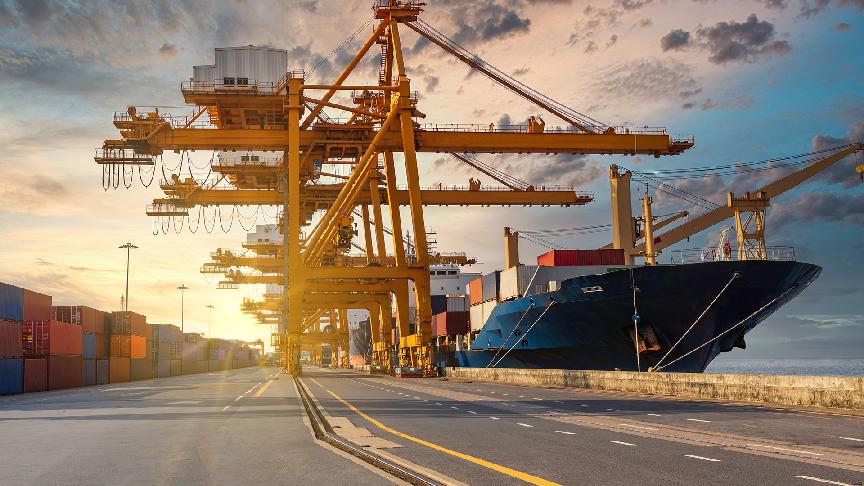
China’s export momentum is most clearly reflected in the extraordinary growth now moving through its major port system. In 2025, Chinese ports handled 354.5m teu, a 7% year‑on‑year increase, with Shanghai alone processing 55.1m teu. The mega‑hubs of Ningbo-Zhoushan, Shenzhen and Qingdao all posted strong gains, mirroring a nationwide surge. The scale is such that the growth recorded at China’s five largest ports last year was roughly equivalent to the entire annual throughput of Europe’s biggest port, Rotterdam.
This dominance is reinforced each year in the Lloyd’s List One Hundred Ports, where China consistently occupies the upper tiers of the global rankings. When the 2025 figures are compiled, the country’s share is likely to expand further still.
China’s ports remain the backbone of global container trade even as the export map becomes more dispersed. What is emerging is a more distributed, geopolitically responsive export ecosystem in which the country continues to anchor production while the spokes of its supply chain extend deeper into Southeast Asia, South Asia and the Americas.
Manufacturing is spreading, trade lanes are being redrawn by political pressure, and carriers are redesigning networks to serve a more fragmented and strategically sensitive export base.
China’s dominance in containerised trade endures, but it now operates through a wider, more complex regional production system shaped as much by geopolitics as by economics.