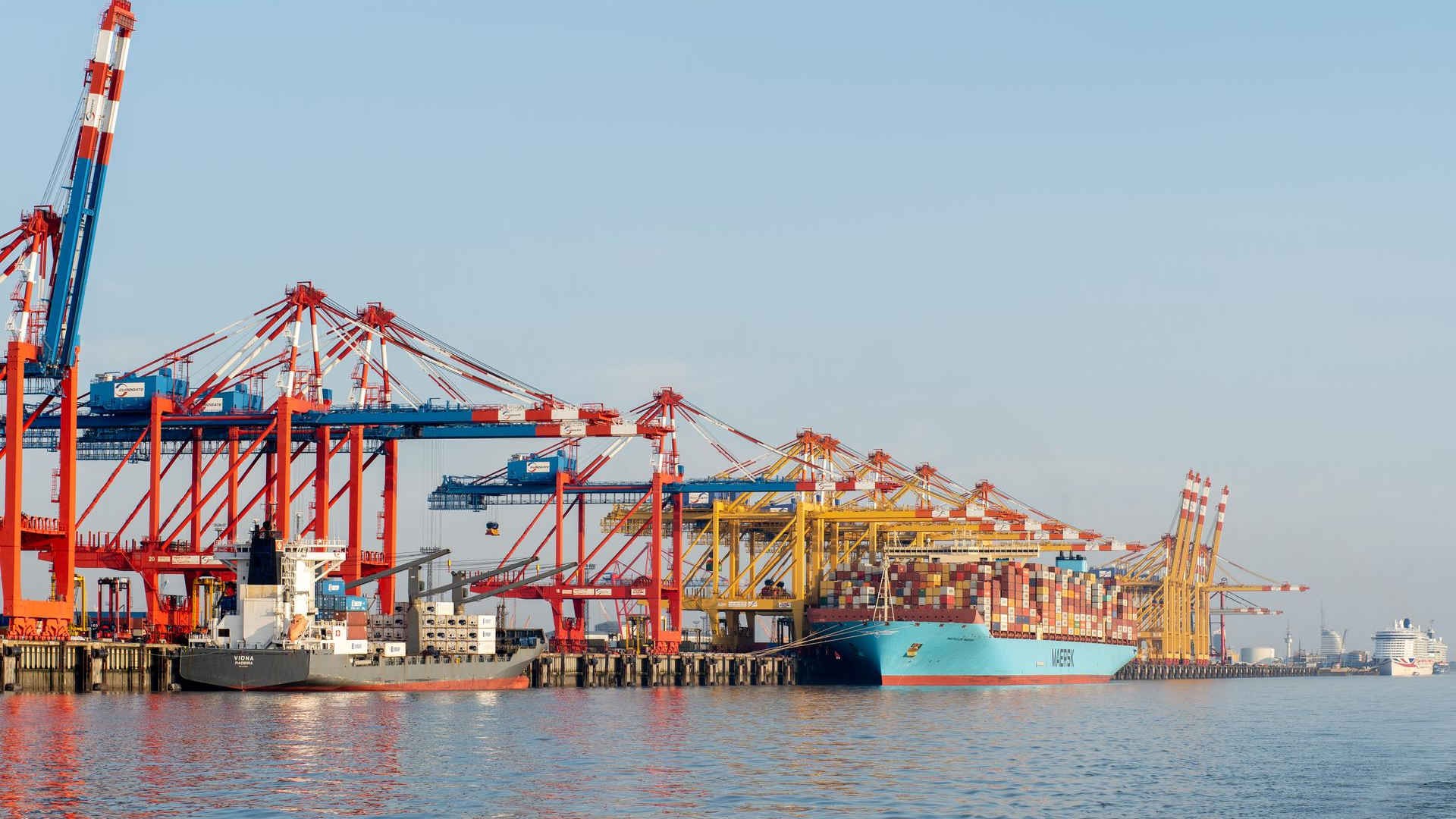

APM TERMINALS and Eurogate have announced plans for a €1bn ($1.2bn) modernisation of the North Sea Terminal Bremerhaven (NTB), aiming to turn the facility into one of Europe’s most advanced and energy‑efficient container terminals and reinforce Bremerhaven’s position in the North Range.
The partners, Maersk’s terminal operating arm APM Terminals and Bremen‑based port operator Eurogate, are in advanced negotiations on a long‑term agreement that would lift NTB’s capacity from 3m teu to 4m teu and convert the facility to zero‑emissions operations. The investment remains subject to internal and external approvals.
The upgrade would involve a full renewal of handling equipment, electrification of terminal operations and the use of renewable power, positioning NTB to become Germany’s first zero‑emissions container terminal.
“Bremerhaven has unique potential to grow as a strategic hub in the region and to support cargo flows into Germany as well as our ocean network,” said Maersk chief executive Vincent Clerc.
“Our investments are intended to realise the full potential of the terminal, making NTB one of the most competitive terminals in Europe’s North Range. We aim to future‑proof the terminal over the long term, while strengthening the reliability and resilience of supply chains for the German economy.”
The investment will be seen as a further coup for the German port, which has been a major beneficiary of the service reshuffle under Maersk’s Gemini partnership with Hamburg‑based Hapag-Lloyd. Under the new network, significant cargo has been redirected away from Hamburg towards Wilhelmshaven and neighbouring Bremerhaven, reflecting Maersk’s vested interest in NTB. This included the prominent calls on Gemini’s AE2 and AE5 Asia-Europe loops, in which Bremerhaven serves as one of its primary regional hubs.
With the addition of Gemini volumes, which began flowing through the port in February last year, Bremenports — the twin ports of Bremen and Bremerhaven, is expected to post further container throughput growth in 2025. After more than a decade of stagnation, traffic has begun to recover, although volumes remain well below the 6m teu‑plus peaks recorded in the early 2010s, when Bremerhaven ranked among the world’s 20 largest container ports.
Like many German gateways, Bremerhaven was hit hard by the pandemic between 2020 and 2022, followed by a sharp decline in trade with Russia after the invasion of Ukraine in 2023. This came off the back of losing significant services to rivals in the Northern Range in the preceding years. In 2024, the port handled 4.4m teu, placing it 46th in Lloyd’s List’s annual ranking of the world’s largest container facilities.
Michael Blach, chairman of Eurogate Group, which also has an interest in Bremen’s two other container terminals, namely Eurogate Container Terminal and MSC Gate — a joint venture with Mediterranean Shipping Company’s Terminal Investment Ltd, said the project builds on more than 25 years of cooperation between the partners.
“The joint project to equip the terminal with state‑of‑the‑art technology and decarbonise the operations, thereby making NTB fit for the coming decades, shows how convinced we are of the future success of Bremerhaven as a location in the global maritime trade network,” he said.
“The modernisation of the NTB sets standards and also secures many high‑value jobs in the region in the long term.”
Bremen’s mayor, Andreas Bovenschulte, welcomed too the commitment from Maersk, calling it “impressive proof of the efficiency of our ports and of Eurogate”.
He said the investment, combined with federal and state spending on port infrastructure, would strengthen Bremerhaven’s position in the North Range. But he also used the opportunity to urge Berlin to accelerate the long‑delayed deepening of the Outer Weser.
“With Maersk’s announced investments in the port’s superstructure and the state and federal government’s investments in the port infrastructure, Bremerhaven will be well positioned for the future,” he said. “Now it is up to the federal government to press ahead with the deepening of the Outer Weser and implement it quickly.”
The deepening of the Outer Weser remains a key prerequisite for unlocking the full potential of the upgraded terminal. A corresponding planning process is currently underway within the public administration.