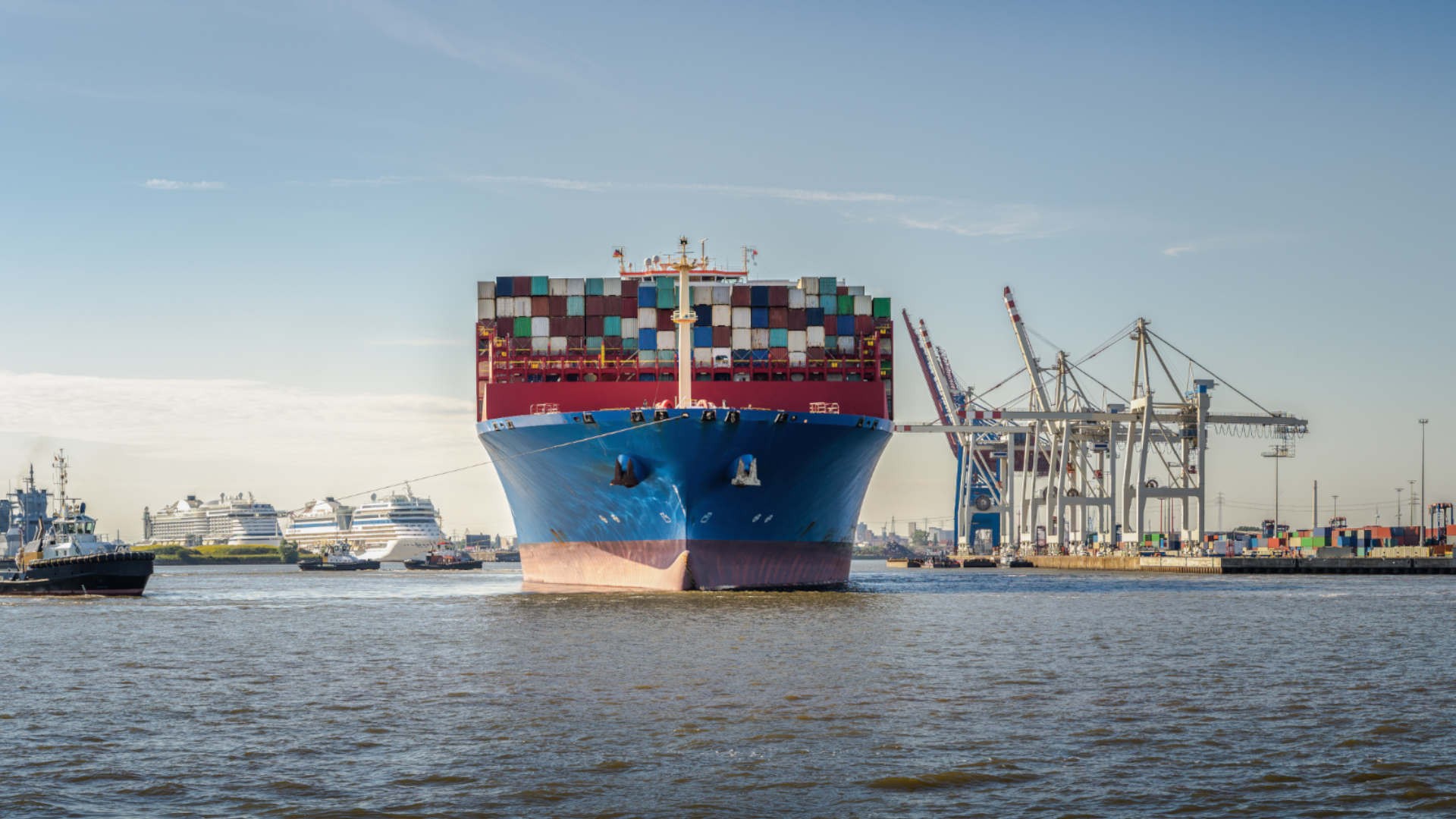

ASIA’S leading container carriers, long seen as slower than their European rivals to embrace dual-fuel technology, are rapidly closing the gap as decarbonisation gathers pace across liner shipping.
Since the fourth quarter of last year, the majority of new orders for alternative-fuel containerships have been placed by operators based in Asia, marking a decisive shift in investment strategy.
The surge reflects growing regulatory pressure, tightening emissions targets and increasing confidence in the commercial viability of alternative fuels.
Meanwhile, Asia-based majors have now begun taking delivery of their first methanol dual-fuel boxships, providing carriers with more flexibility as green fuel supply chains continue to develop.
European container carriers were early movers in ordering dual-fuel tonnage giving them a head start in the race to reduce carbon intensity, with CMA CGM and Mediterranean Shipping Co remaining far ahead of any rivals.
Asian carriers, by contrast, initially focused on fitting exhaust gas scrubbers to allow the continued use of high-sulphur fuel oil, but that balance appears to be shifting.
Asia-based boxship operators are moving quickly to scale up their dual-fuel fleets, reflecting a strategic recalibration triggered by regulatory uncertainty at the International Maritime Organization.
The delay of the IMO’s Net-Zero Framework has prompted carriers to reassess their decarbonisation paths. Rather than committing to a single fuel solution, many operators are now hedging their bets across multiple fuel types.
The change in approach is underscored by recent orders from Cosco, the world’s fourth-largest container carrier.
Earlier this month, the Chinese state-owned shipowner placed orders for 12 newbuilding containerships of 18,000 teu at China’s Jiangnan Shipyard. The vessels will be equipped with LNG dual-fuel propulsion, marking Cosco’s first use of LNG for containerships.
The order represents a notable strategic pivot for the company, which has previously positioned methanol as its preferred alternative fuel path. In recent years, the group ordered 26 methanol-powered newbuildings and has been developing methanol production facilities in partnership with domestic players in China.
At the same time, Cosco continues to advance its methanol strategy through vessel conversions. The company’s programme to retrofit four conventional-fuel boxships for methanol propulsion is nearing conclusion, with the third vessel expected to be redelivered soon.
The 13,800 teu COSCO Shipping Peony (IMO: 9785744) is undergoing dual-fuel sea trials, while sister ship COSCO Shipping Jasmine (IMO: 9785768) is being converted.
In September last year, Cosco took redelivery of its first retrofitted boxship — the 20,119 teu COSCO Shipping Libra (IMO: 9783538), followed by the return of sister vessel COSCO Shipping Gemini (IMO: 9783526) in November.
All the methanol conversions have been undertaken by a Cosco-owned shiprepair yard in China. The complicated work takes around four months and includes modifications to engine fuel-injection systems, the installation of new fuel tanks and the fitting of dedicated methanol fuel-preparation rooms.
The retrofit programme stems from a project arranged in December 2023 with engine designer Everllence, and Cosco holds options to convert a further nine vessels.
In December, Taiwanese containership operator Wan Hai Lines took a further step towards dual-fuel operations after confirming an order for six 6,000-teu gas-fuelled containerships at CSSC Huangpu Wenchong Shipbuilding. They are the Taipei-headquartered carrier’s first LNG fuel newbuildings.
The LNG move comes on top of big investments in 2024 for methanol dual-fuel boxships comprising 12 ultra-large, 16,000-teu vessels, with the order divided evenly between HD Hyundai Samho and Samsung Heavy Industries in South Korea.
Furthermore, Wan Hai Lines has 20 mid-sized boxships, also methanol-capable, which were ordered in 2024 with four being built by HD Hyundai Samho and 16 at Taiwan’s CSBC.
Wan Hai Lines’ larger compatriot Evergreen is pressing ahead with its alternative-fuel strategy, locking in shipbuilding contracts last November for a fresh wave of dual-fuel neo-panamax containerships.
The world’s seventh-largest liner ordered 14 LNG dual-fuel, 14,000 teu, vessels evenly split between Guangzhou Shipyard International and Samsung Heavy Industries.
Evergreen has also carved out a niche as one of just two major carriers to embrace methanol dual-fuel propulsion for feeder boxships, after ordering six 2,400 teu ships at CSSC Huangpu Wenchong in 2024.
That commitment may now be scaling up further. This week, the Taipei-listed group revealed follow-on orders for 16 3,100 teu vessels at the same yard, plus seven 5,900 teu boxships from Jiangsu New Yangzi Shipbuilding. However, fuel choices for its latest orders have yet to be disclosed.
In October last year, Evergreen put in to service the 16,500 teu Ever Eco (IMO: 1025203) in the Asia/Europe trade as its first ever methanol-capable containership.
South Korea’s largest shipowner, HMM, sealed firm contracts in October for a dozen 13,000-teu neopanamax containerships with the order split between domestic yards HD Hyundai Heavy Industries and Hanwha Ocean.
All 12 vessels will be built to LNG dual-fuel specifications, underscoring a strategic pivot away from methanol-powered tonnage. The move follows HMM’s earlier methanol dual-fuel orders for 12 ships, of which four entered service in 2025.
The LNG momentum is set to continue, with Singapore-based Pacific International Lines understood to have recently signed letters of intent for eight LNG dual-fuel neo-Panamax newbuildings of 13,000-teu class.
The order is expected to be evenly shared between HD Hyundai Heavy Industries and China’s Hudong-Zhonghua Shipbuilding Group. The vessels will build on PIL’s existing LNG programme, following 10 similar vessels ordered from Hudong-Zhonghua in 2024.
Previously cautious adopters of dual-fuel technology, Asian carriers are now accelerating investment and diversifying fuel pathways as regulatory uncertainty and decarbonisation pressures intensify.
Rather than backing a single solution, operators are clearly spreading risk across LNG and methanol to retain flexibility as fuel availability, pricing, and rules evolve.
But while European liner operators still hold an early-mover advantage, the scale of recent commitments from Asian players confirm the gap is narrowing.