
The 25th of June marks the annual Day of the Seafarer. This year, the day was celebrated at a time when the market is witnessing a record-high shortage of seafarers after years of multiple challenges.
A report by shipping research and consulting provider Drewry revealed that the market lost nearly 5% of its global seafarers in the past few years. While the percentage could seem manageable, the geopolitical conflict between Russia and Ukraine could further limit “the supply of a large number of officers,” says Drewry.
“Recruiting and retaining quality officers with experience on sophisticated vessel types is likely to be the first pressure point in a tightening supply pool,” said Drewry’s head of manning research Rhett Harris. “Employers need to ensure that a career at sea is an attractive career option for ambitious and well-educated people.”
More seafarers report abuse
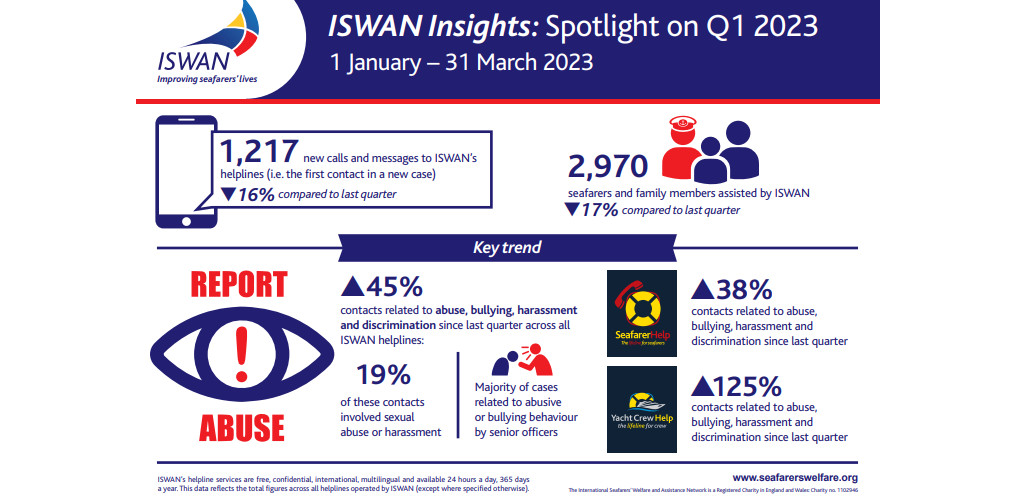
Seafarers are an essential part not only of the shipping industry but of the supply chain as a whole. However, they have been, unfortunately, facing abuse, bullying, harassment and discrimination. According to a report by The International Seafarers’ Welfare and Assistance Network (ISWAN), cases involving such issues “increased by 45% from Q4 2022 to Q1 2023.”
“The majority of these cases related to abusive or bullying behaviour by senior officers, and 19% involved sexual abuse or sexual harassment,” highlighted the ISWAN report based on data from its helpline services. The following infographic created by ISWAN illustrates the findings of the organisation.
Females onboard experience "exclusion and fear"
Another study conducted by Cardiff University, UK, found that female seafarers live a different experience at sea than men. The study highlighted that women onboard encounter feelings of “exclusion and fear” among their male peers.
Many of them had "male colleagues who explicitly told them that they did not belong on board and should accept a shore-based position or stay at home and raise a family,” reported the researchers. Females onboard also expressed feeling unsafe in ways related to “sexual harassment and assault by colleagues.”
One of the most recent sexual abuse incidents was reported on board a container carrier operated by Hapag-Lloyd. Danish news outlet Shipping Watch revealed that the carrier “laid off an employee in relation to a case of alleged rape of a female seafarer aboard the Ulsan Express.”
Similar incidents were also reported on Maersk’s vessels, most famously the case of Hope Hicks, who was raped by a superior in 2019. According to Shipping Watch, the investigation resulted in the dismissal of five employees working at the Maersk vessel.
More ESG measures required
On the bright side, the topic of seafarers’ well-being and happiness has been gaining more attention in the industry, especially since companies have set robust environmental, social, and governance (ESG) goals for the betterment of their businesses.
Just like in other industries, ESG reporting in maritime covers environmental issues as well as business ethics and employee health and safety. Companies have been adopting a reporting system that could help monitor violations in this regard.
While the focus remains on environment-related developments, an increasing number of activists are voicing the need for more attention to the social or people aspect of ESG. This is particularly important if the industry wishes to attract the younger generation.