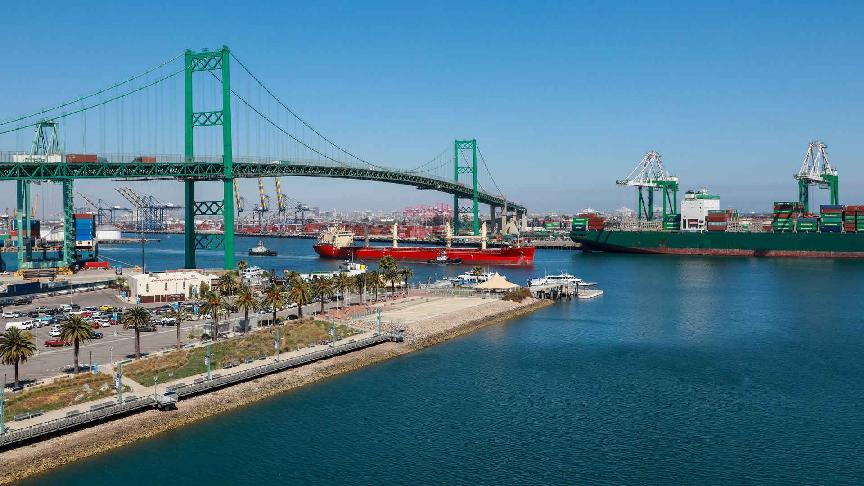

18 July (Lloyd's List) - THE PORT of Los Angeles – like neighbouring Long Beach – saw throughput jump in June versus May. Transpacific liner operators are now adding capacity, including extra-loaders, promising further strength ahead.
Los Angeles handled 827,757 teu last month, up 9.9% month on month and flat (down 0.6%) year on year. Imports came in at 428,753 teu, up 9.8% month on month and down 1.5% year on year.
Gene Seroka, executive director of the Port of Los Angeles, said during a press conference Wednesday that 63 containerships, including extra loaders, are currently en route to the two San Pedro Bay ports, up from a normal peak-season level of 52-55.
Seroka expects July throughout in the mid- to upper-800,000-teu range, above June’s level, and he’s optimistic about the second half overall.
He reported no congestion at the terminals, with all indicators – from rail dwell time to truck turns to vessel cargo exchanges – “at or better than pre-Covid levels”. The Port of Los Angeles is at 75-80% of its capacity, leaving ample room for further cargo.
Combined San Pedro Bay imports
The combined imports of Los Angeles and Long Beach averaged 758,960 teu per month in 1H24, up 9.9% from pre-Covid levels in 1H18 and 1H19 of 690,531 teu per month.
However, this is not unusual given the expected compound annual growth rate over time due to normal economic expansion, and inbound volumes are still 11.3% below the peak pandemic average of 856,126 teu per month in August 2020-July 2022.
The tariff effect
With presidential politics taking centre stage, there is an increasing focus on how tariffs – existing tariffs and proposed future tariffs – affect transpacific cargo flows. Seroka was joined in the press conference by Matt Priest, chief executive of the Footwear Distributors and Retailers of America (FDRA).
FDRA is a major shipper group with heavy exposure to tariffs. Its members account for 95% of US footwear sales, they import 99% of their products, and they ship over 2.5 billion pairs of shoes every year.
Over 90% of members’ goods are produced in China, Vietnam and Indonesia, with over two-thirds of volumes entering through the ports of Los Angeles and Long Beach.
Priest said that his members are already “highly tariffed” and pay duties of 16-17%, equating to $4bn per year. They face a potential mammoth increase under the proposal of presidential candidate Donald Trump, who has floated a 60% tariff on imports from China and a 10% tariff on goods from other nations.
“We are not sure whether this is on top of current duty rates or in lieu of them – we don’t have clarity on that yet,” said Priest.
Footwear importer tariff strategy will be three-fold: accelerate imports, shift more production out of China, and, to the extent tariffs are levied, pass them along to consumers.
FDRA members are now looking at “how they can bring in goods earlier”, he reported. “If the former president wins in November and his proposals go forward, that is obviously driving a lot of interest from our members in how they can start to bring in products prior to those duties.”
The ongoing shift out of China would continue, but much of that migration has already occurred.
“Well before September 1, 2019, when additional tariffs on Chinese footwear went into effect, members had been shifting out of China because of the cost of living there and fewer people interested in working in footwear factories. Most of the market shed by China in footwear over the past decade was captured by Vietnam.”
With regards to passing along costs, Priest said, “Tariffs are paid by American consumers through increased prices on goods that are imported. We are going to pass on as much of the cost as possible to consumers, depending on consumer appetite and their resiliency for those cost increases.”
Commenting on the tariff proposals, Seroka said, “There is a long way from here to there, whatever there may be. But if it does come to fruition, it could change the landscape of the future of the port.”
Meanwhile, Priest also pointed to a current market effect of tariffs – not related to Trump but to the Biden administration.
“Rates are higher than they’ve been in well over two years,” he said. “We think that one of the variables is the president’s announcement of the tariff on electric vehicles that begins Aug. 1. We think there has been a run on capacity to get products in before those tariffs take effect, which is driving up rates.”