
Update: 05.03.2026
Latest developments across the region
Security conditions remain unstable across the Persian Gulf and adjacent waterways. Carriers are tightening acceptance policies, and port operations continue with localised limitations. Vessel risk incidents and schedule uncertainty are increasing, with knock-on congestion expected at regional and extra-regional hubs.
This update consolidates the latest carrier advisories, port conditions, and vessel intelligence as of 5 March 2026.
Carrier updated response
Maersk: Following a fresh risk assessment and operational review, Maersk has announced:
- Booking suspension (inbound & outbound) for UAE, Oman (all ports except Salalah), Iraq, Kuwait, Qatar, Bahrain, and Saudi Arabia (Dammam & Jubail only).
- Exceptions apply to critical foodstuffs, medicines, and other essential goods.
- Dangerous cargo to/from Israel: Not accepted until further notice. All other acceptance to/from Israel remains open.
- Reefer and dangerous/special cargo: Suspended to/from UAE, Oman, Iraq, Kuwait, Qatar, Bahrain, and Saudi Arabia until further notice.
HMM is developing contingency plans and evaluating alternative operational solutions in response to the evolving situation.
Situation at impacted ports
- United Arab Emirates (UAE): All ports are operating, including Al-Fujairah, where operations have restarted.
- Bahrain: Port remains closed.
- Salalah, Oman: Operations have restarted; however, due to the unstable terminal situation, intermittent operational interruptions may occur.
- Saudi Arabia: All ports operating normally; vessel activities in Eastern Province (Dammam/Jubail) are limited to domestic port calls.
- Remaining regional ports: Operational.
Vessel situation and risks
An updated list of potentially affected vessels in the Persian Gulf can be found here.
The Malta-flagged 1,740 TEU Safeen Prestige was hit above the waterline while transiting eastbound through the Strait of Hormuz at 11:09 on 4 March, near Salib, Oman. In a separate event, a Bahamas-flagged tanker was also attacked on 4 March, southeast of the Kuwaiti coast.
The incident adds to growing operational pressure across the region, where widespread vessel diversions away from the Gulf are already causing significant schedule disruption.
According to Xeneta, over 600 container ships are scheduled to call at Jebel Ali over the next 90 days, but many are now expected to discharge cargo at the nearest available safe ports, increasing congestion risks across key Middle Eastern and Asian transhipment hubs.
Kuehne+Nagel continues to monitor the situation closely with timely updates on SeaNews and the Kuehne+Nagel page Middle East situation - Kuehne+Nagel operations | Kuehne+Nagel.
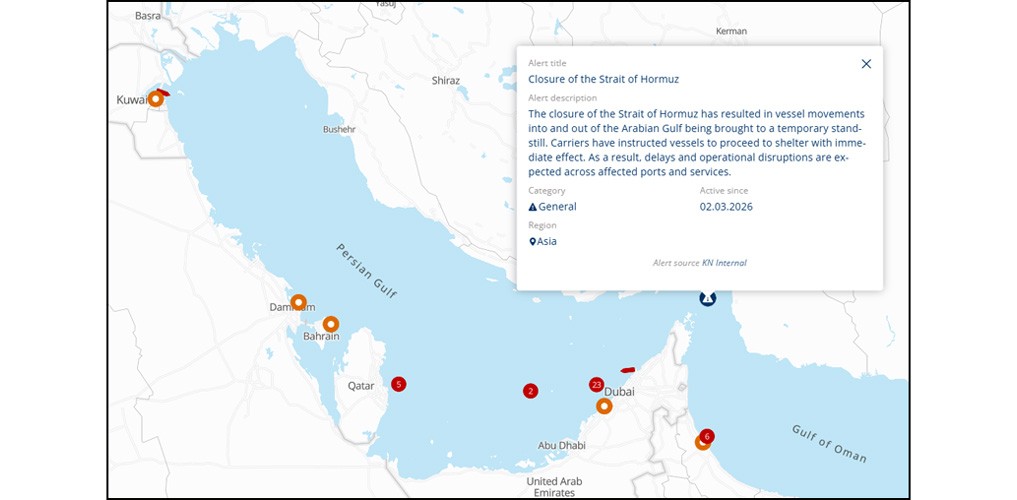
For the latest port and vessel statuses or situation updates, please refer to the seaexplorer alert map.
Update: 04.03.2026
Latest developments across the region
The security situation in the Middle East and the Persian Gulf remains volatile. Carriers continue to adjust their strategy in light of the development in the region. The port of Salalah experienced temporary closure after drone attacks nearby, but operations resumed as of today.
This update consolidates the latest carrier advisories, port conditions, and vessel intelligence as of 4 March 2026.
Carrier updated response
MSC declared End of Voyage (EoV) for all shipments currently under MSC custody destined for Arabian Gulf ports, regardless of whether cargo is ashore or at sea.
- The measure also covers empty containers already released for stuffing intended for export to affected destinations.
- All en‑route vessels will be diverted to the next safe port, where cargo will be discharged and made available for local pick‑up and recovery.
Hapag-Lloyd has imposed a booking stop with immediate effect for all cargo types, both to and from the United Arab Emirates, Iraq, Kuwait, Qatar, Bahrain, Oman (Sohar), Saudi Arabia (Dammam, Jubail), and Yemen. The measure is in place until further notice, aimed at ensuring cargo safety and equipment stability.
CMA CGM reiterates that crew, vessel, and cargo safety remain the highest priority. In response emergency measures now apply to all shipments to/from: Iraq (Umm Qasr), Bahrain, Kuwait, Yemen, Qatar, Oman, UAE, Saudi Arabia.
- Measures include — but are not limited to — vessel deviations to contingency ports and possible schedule changes.
Situation at impacted ports
Oman
- Salalah Port has restarted operations following drone activity on 3 March, where multiple drones were intercepted and one device fell within the port area.
- A separate drone incident at the Port of Duqm caused damage to a fuel tank, though it was contained and without casualties.
- As of 4 March, operations at impacted Omani ports have resumed, but with continued disruptions.
UAE: All ports are operating normally, except Al-Fujairah, which remains temporarily closed for a damage assessment following reported impacts. The port of Khor al Fakkan is reporting several GPS jamming issues.
The Port of Bahrain is still closed, while the remaining ports in the region report normal operations.
Situation of vessels in the Persian Gulf (seaexplorer Intelligence)
Seaexplorer data indicate substantial operational stagnation in the Persian Gulf. Around 130 container vessels are currently held in the region, with approximately 50 feeder vessels, averaging 1,100 TEU capacity.
Nearly 490,000 TEU of total capacity is currently immobilised, equivalent to ~2% of global market share. As for the distribution of vessels among leading shipping lines, the following general overview can be provided:
o CMA CGM: 15
o MSC: 13
o Hapag-Lloyd: 7
o Maersk: 5
o COSCO: 5
o Evergreen: 3
For the latest port and vessel statuses or situation updates, please refer to theseaexplorer alert map.
Update: 03.03.2026
Latest developments across the region
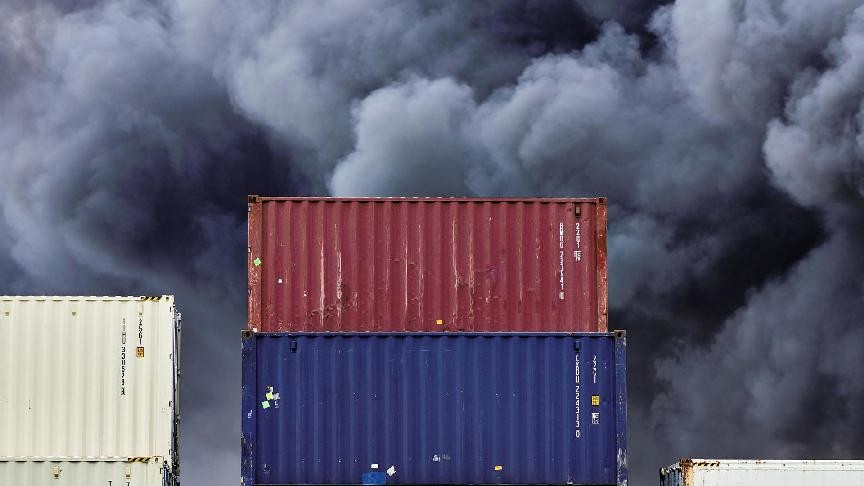
Multiple carriers have issued new restrictions, and service disruptions are expanding beyond the Arabian Gulf. At the same time, most regional ports continue operating normally except for Bahrain. Fire was reported at the port of Jebel Ali, UAE, after a missile attack. However, DP World managed to control the situation, and the port resumed operations after a short interruption.
This update compiles the latest carrier advisories, market intelligence, and port status as of 3 March 2026.
Carrier updated response
ZIM confirms full operational continuity despite the escalated security situation in Israel.
- ZIM vessels continue calling Israel as per schedule.
- All bookings to/from Israel are being accepted.
- Hazardous cargo is subject to dynamic restrictions based on the Israeli authorities’ guidance.
Maersk has issued one of the broadest operational responses so far:
- Immediate suspension of reefer, dangerous, and special cargo to/from: the UAE, Oman, Iraq, Kuwait, Qatar, Jordan, Bahrain, Saudi Arabia
- Suspension of new bookings between the Indian Subcontinent and the Upper Gulf (UAE, Bahrain, Qatar, Iraq, Kuwait, Saudi Arabia – Dammam/Jubail).
- Other global corridors remain open.
Hapag-Lloyd has introduced multiple booking stops linked to operational and security risks:
- Booking freeze from Africa to the Upper Gulf, covering: UAE, Iraq, Kuwait, Qatar, Eastern Saudi Arabia.
- Reefer booking stop (both directions) for Iraq, Bahrain, Kuwait, Qatar, UAE, Eastern Saudi Arabia, Oman.
- The carrier warns of likely schedule disruptions due to volatile vessel movements and port constraints.
CMA CGM has announced a regionwide suspension for dangerous goods:
- All DG/Hazardous bookings stopped (from/to): Iraq, Bahrain, Kuwait, Yemen, Qatar, Oman, UAE, Saudi Arabia, Jordan, Egypt (Ain Sokhna), Djibouti, Sudan, Eritrea.
Situation at impacted ports
As mentioned, following widespread reports of a missile strike and a fire at Jebel Ali over the weekend, the operations have resumed, according to DP World statements. Smoke was seen rising from the container terminal, leading to temporary concerns about a shutdown.
Most ports in the Middle East and the Gulf report continued operations, though with varying levels of disruption. Bahrain remains among the more affected locations in earlier reports, with the port still closed.
Haifa and Ashdod ports are operating normally with expected disruption.
Situation of vessels in the Persian Gulf
Linerlytica reports significant operational consequences following the Hormuz closure, citing nearly 650,000 TEU of weekly traffic affected. This is equivalent to 3.3% of global throughput.
Linerlytica further mentions that service reconfiguration could impact up to 10% of the global fleet through port congestion, vessel shortages and container equipment imbalance
The latest list of vessels known so far to be inside the Gulf area and potentially impacted by the situation is available through this link.
Original article: 02.03.2026
The political conflict between Iran and the United States has rapidly intensified since it started on Saturday, 28 February.
Military actions and the closure of the Strait of Hormuz have triggered significant disruptions across key Middle East maritime corridors.
As a result, leading container lines have stopped sailing through the Strait and diverted vessels away from the Suez Canal as a security measure.
This report presents an overview of the current situation as of the report's publication date.
Carriers' response to the situation so far
- MSC has suspended all bookings for worldwide cargo to the Middle East until further notice. The line has directed all vessels operating in or bound for the Gulf to proceed to designated safe shelter areas and is monitoring developments with authorities.
- CMA CGM has instructed all vessels inside or bound for the Gulf to proceed to shelter, suspended Suez Canal transits with rerouting via the Cape of Good Hope, and stopped all reefer bookings to/from Iraq, Bahrain, Kuwait, Yemen, Qatar, Oman, the UAE, Saudi Arabia, Jordan, Egypt (Ain Sokhna), Djibouti, Sudan and Eritrea.
- Hapag-Lloyd is suspending all transits through the Strait of Hormuz following an official closure by relevant authorities, noting potential delays, rerouting and schedule changes for Arabian Gulf port calls.
- ONE is temporarily suspending acceptance of new bookings to and from the Persian Gulf, with voyage-by-voyage assessments for cargo in transit or planned shipments.
- COSCO has halted container vessel transits through the strait on safety grounds.
- War risk surcharges are being applied by multiple lines on Middle East cargo
Latest situation at impacted ports
On 28 February, ports in Dubai, Oman and Bahrain halted activities following a series of aerial attacks, including an incident at Dubai’s Jebel Ali Port where debris from an aerial interception caused a fire at one of the berths.
By 1 March, operating conditions varied across the region: some ports continued functioning without any formal rise in security alert levels, while others faced temporary shutdowns or partial suspensions.
As of today, 2 March, the port of Bahrain remains closed while other ports in the region are operating with expected disruption.
Situation of vessels in the Persian Gulf
According to a Lloyd's List report, at least 15 container ships have reversed course when approaching or leaving Hormuz, with many either halted or diverted.
Overall traffic through Hormuz fell by 38% on Saturday, with 72 cargo vessels above 10,000 dwt.
Reports show that commercial ships near Hormuz have been struck by Iranian forces since the conflict began. In addition, Houthi forces in Yemen have reportedly decided to resume attacks on commercial shipping in the Red Sea.
Consequently, vessels have been asked to seek shelter, though no dedicated zone is identified.
Seaexplorer data shows over 100 container ships are currently in the Persian Gulf, either berthed at a port or waiting in a shelter area. A list of the vessels known so far to be inside the Gulf area and potentially impacted by the situation is available through this link.
Some of the larger vessels include
- CMA CGM Everglade – 15,254 TEU – outside Doha
- MSC Grace – 16,000 TEU – outside Jebel Ali
- MSC Francesca – 11,660 TEU – outside Doha
Potential impact on nearby ports
Commenting on the development on his LinkedIn page, shipping analyst Lars Jensen noted that major container vessels carrying cargo bound for Gulf destinations may begin offloading this cargo in Salalah, Khor Fakkan, Sohar, Duqm and Colombo.
Jensen expects onward movement handled by smaller vessels prepared to transit the affected areas.
He stated that such a shift would generate congestion at these ports and could later extend to wider Asian hubs if carriers stop loading cargo for the Gulf due to uncertainty over final delivery.
According to Jensen, this scenario risks turning Singapore, Tanjung Pelepas and Port Klang into transhipment bottlenecks for cargo that would ordinarily move directly to the Gulf.
Kuehne+Nagel is monitoring the situation closely and will report updates accordingly. More information is available in our latest advisory and on our seaexplorer alert map.