
Seaexplorer Schedule Reliability Report for April/May showed an overall recovery of global on-time performance to 50.2% last month.
In particular, Asian trades rebounded in May, following steep declines in April.
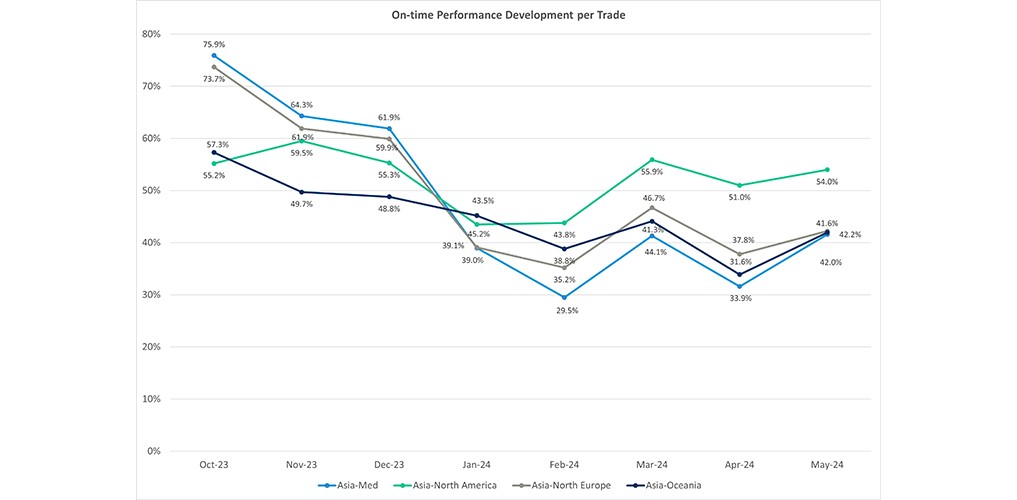
Of these trades, Asia↔Oceania recorded the highest percentage point decline in April and, despite a healthy upswing in May, recorded one of the lowest overall performances of 42.3%.
Asia→Oceania
A closer look at the head haul performance shows that reliability dropped significantly in October, corresponding with the start of the industrial action at DP World terminals in Australia.
The strikes ended in February; however, congestion continued as ports attempted to recover from the strikes, pro-Palestine protests, increased volumes and weather-related disruptions. This resulted in the reliability hitting a new low of 33.9%.
As the Red Sea crisis continues and shippers increase their order volumes, port congestion and operational challenges have risen at key Asian ports.
This directly impacted the average arrival delays of vessels at these ports.
According to analytics, the average arrival delay in Shanghai and Singapore for the year's first five months was around two days.
For the same period, Australian ports Sydney, Melbourne, and Brisbane measured an average arrival delay of around three days.
Oceania→Asia
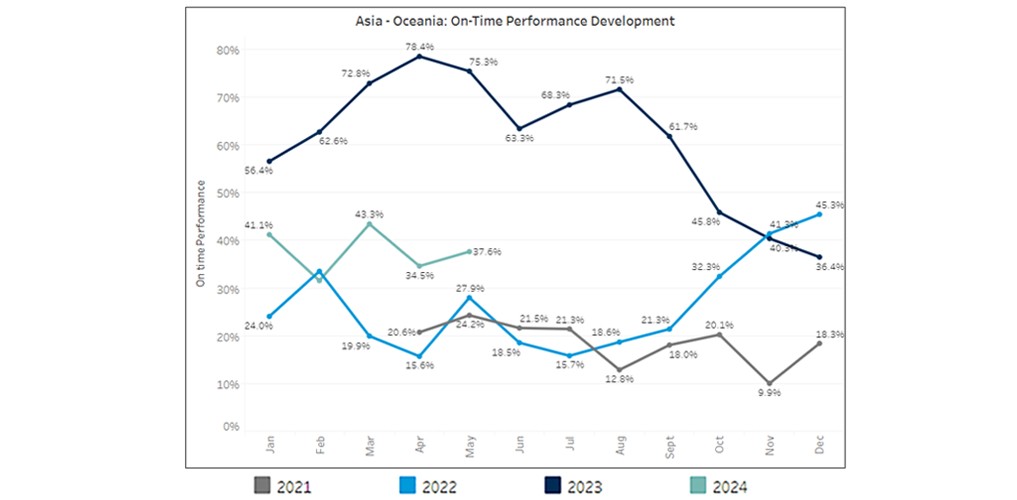
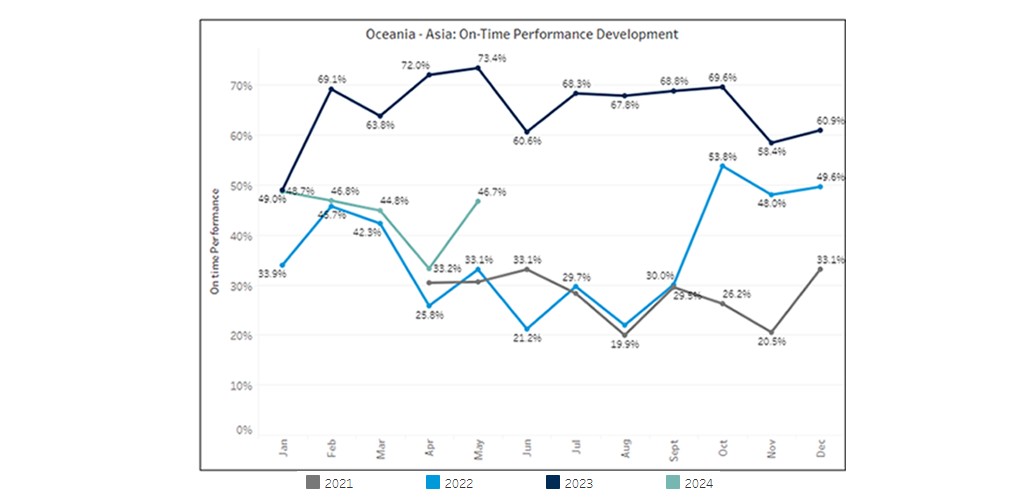
On the backhaul, performance showed greater gains in May, reaching 46.7%.
However, on a year-on-year level, May 2024 performance was 26.7 percentage points lower than in May 2023.
In addition, the average arrival delay for LATE and ALL vessels in May was 3.7 days and 2 days, respectively.
Transhipment cargo faces further delays
While the on-time performance analytics show direct routings only, cargo to/from the Oceania region is further impacted by extended delays at transhipment ports such as Singapore and Colombo.
For instance, transhipment waiting times in Singapore have increased to 2 weeks, adding up to 14 days to the expected transit time.
Carriers expect to continue diverting vessels into the next quarter at least, which could slow the climb to 2023 performance levels in future months.
Despite the considerable distance separating the island nations and the Red Sea, the resulting shipping disruptions have had far-reaching consequences for Oceania trades, which depend on a reliable and efficient service network.